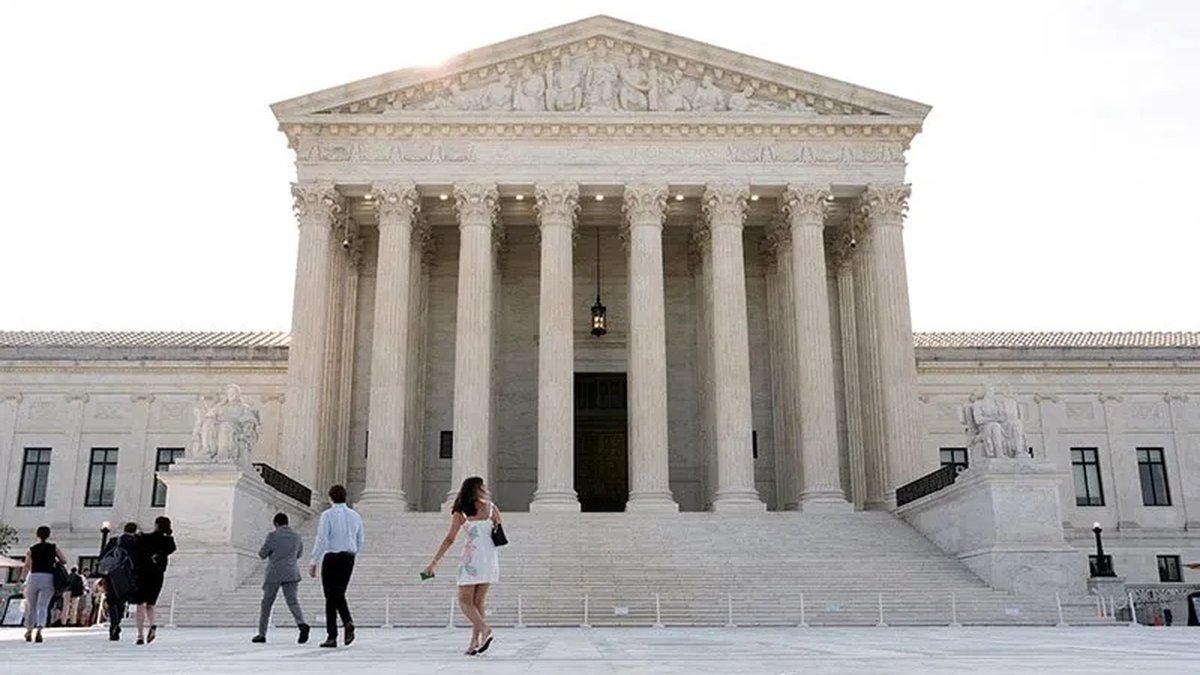
WASHINGTON (OSV News) — The U.S. Supreme Court on June 30 took up a case regarding whether state and local bans on semiautomatic rifles, sometimes called assault weapons, violate the Second Amendment.
The case concerns a state ban on the AR-15 and other semiautomatic firearms in Connecticut and a similar ban in Cook County, Illinois, which includes Chicago.
The court took up the case the same day it issued major rulings finding President Donald Trump’s executive order limiting birthright citizenship violated the 14th Amendment, and upholding West Virginia and Idaho state laws requiring student athletes to compete on sports teams that correspond to their biological sex rather than their self-identified gender.
The high court will hear the semiautomatic rifles case during its next term, which typically begins in October.
According to Giffords — a group that works to prevent gun violence led by former Rep. Gabrielle Giffords, D-Ariz., who survived a shooting — 11 states and the District of Columbia, have enacted laws that generally ban the sale, manufacture, and transfer of firearms categorized as assault weapons. Two other states, Minnesota and Virginia, have some additional restrictions.
Connecticut first enacted a ban on semiautomatic weapons in 1993. The state increased those restrictions after the 2012 mass shooting at Sandy Hook Elementary School in Newtown, Connecticut, when a gunman armed with an AR-15-style rifle equipped with large capacity magazines killed 26 children and teachers. It was among the deadliest school shootings in U.S. history.
USCCB has called for a national ban on assault weapons
The U.S. Conference of Catholic Bishops has called for a national ban on assault weapons, a term that refers to military-style semiautomatic rifles, shotguns, and pistols fed by ammunition magazines of various capacities, arguing in favor of a federal assault weapons ban similar to the one they supported in the 1994 crime bill. That legislation had a sunset provision, and Congress allowed it to expire in 2004 without renewal.
That law, the Public Safety and Recreational Firearms Use Protection Act, commonly called the Federal Assault Weapons Ban, banned about a dozen specific firearms and features on guns, however, the law’s effectiveness was debated as modifications to those features were adapted.
However, a 2004 study on the effectiveness of the ban, which was federally funded by the National Institute of Justice at the Department of Justice, found that the number of gun crimes involving assault weapons decreased by 17% in a sample of six U.S. cities: Baltimore, Miami, Milwaukee, Boston, St. Louis, and Anchorage.
The U.S. bishops have also supported other gun safety measures, including universal background checks and limitations on civilian access to high-capacity ammunition magazines, which allow a shooter to maintain a consistent rate of fire over a longer period of time without having to reload.
Kate Scanlon is a national reporter for OSV News covering Washington. Follow her on X @kgscanlon.
Tags: Gun Violence, U.S. Supreme Court
Sentinel — Human
This text exhibits strong journalistic grounding, utilizing specific historical data and multiple organizational references typical of human news reporting. There are no significant forensic indicators of synthetic generation.