Frida-Mania Hits MoMA
A collaboration with the Metropolitan Opera’s costume designer, this exhibition is an irresistible marketing opportunity at best.
When El Último Sueño de Frida y Diego arrived at the San Francisco Opera in 2023, one critic suggested that its staging, with its arresting tableaux blending imagery from the work of both Frida Kahlo and Diego Rivera, would be fit for a museum exhibition. Taking the cue, the Museum of Modern Art has mounted just such a show.
Frida and Diego: The Last Dream, which opened this past weekend, coincides with a new production of the critically acclaimed opera scheduled for the Metropolitan Opera in May. It is billed as a “first-of-its-kind collaboration” between the two institutions, a modest, cross-disciplinary experiment of sorts for which MoMA invited renowned British stage and costume designer Jon Bausor to help transition his vision from the stage to the gallery. But whereas the original production of El Último Sueño de Frida y Diego was lauded for its fresh take on the tortured romance of the two artists, the accompanying exhibition for this new production is a clumsy interpolation.
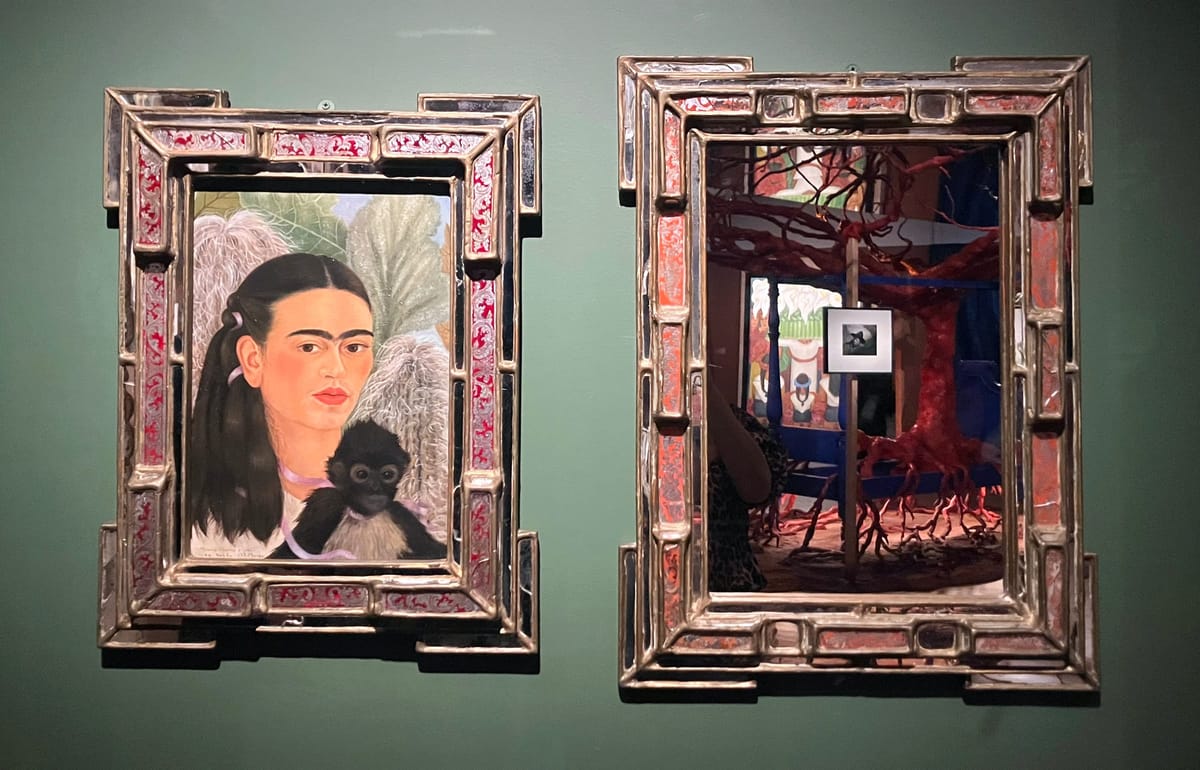
A miniature set model from the opera’s stage design — an eerily lit tree of life emerging from cracked earth with vein-like branches framed by wooden scaffolding and blue tarp walls — greets visitors in the lobby. Coupled with a short promotional video featuring the award-winning production team, idling visitors are effectively marketed the opera before even entering the gallery. Once inside, however, the theatrical design feels misguided. The last thing we need to see in New York City is more cheap scaffolding, even if logically recontextualized as a makeshift memorial for the two artists, with accent lighting befitting an altar. Or to stare at ruffled blue tarp drapes reimagined as a framing device. In one instance, though, the rupture of the oil painting “Self-Portrait with Cropped Hair” (1940) — Kahlo’s post-divorce rebuke of Rivera in which she appears short-haired, wearing a suit rather than her traditional guise — briefly parts the curtained walls successfully for a dramatic effect.
The tree of life also becomes even more figurative in the gallery space, where we encounter a wooden bed frame, the site of Kahlo’s physical confinement after countless surgeries, and the ceiling mirror she used to paint herself. Both evoke Frida’s physical and emotional pain, while also inducing the desire to take selfies. Otherwise, the exhibition reshuffles works from the collection galleries to some effect. There is a seemingly appropriate pairing of overlapping political sensibilities where Kahlo’s “Self-Portrait On The Border Between Mexico And The United States” (1932) and Rivera’s “Agrarian Leader Zapata” (1931) meet — the former a self-referential, anti-imperialist sentiment in diminutive form and the latter heroically tinged with Mexican national pride, with a grander sense of scale. However, the creation of “Self-Portrait On The Border" coincides with Rivera’s work on the Detroit Industry Murals (1932–33) and clearly expresses her resistance to the modern industry that her husband venerated. It’s a false impression of political alignment. Similarly, Rivera’s costume and set design sketches for the Mexican composer Carlos Chávez’s ballet score Caballos de vapor (Horse-Power, 1926–32) are consistent with the exhibition’s interdisciplinary theme, but not much else.
Still, Frida-mania may not care for nuance unless it sells, which was very much the case at MoMA. When I visited on the afternoon of the public opening, the gallery was dutifully filled to capacity, at times forcing visitors to sign up for a waitlist. Overall, the exhibition struggles to convey an intense, complicated love affair while only dabbling in cultural specificity — like seating in the form of an Aztec pyramid, which is clean, minimalist, and a bit gimmicky. Frida and Diego: The Last Dream is, at best, an irresistible marketing opportunity.
That said, go see the opera. That is the point, after all.
Frida and Diego: The Last Dream continues at the Museum of Modern Art (11 West 53rd Street, Midtown, Manhattan), through September 12. The exhibition was curated by Beverly Adams and Jon Bausor with Caitlin Chaisson and Rachel Remick.
Facts Only
• The Metropolitan Opera's costume designer, Jon Bausor, collaborated with the Museum of Modern Art on an exhibition titled "Frida and Diego: The Last Dream."
• The exhibition opened at MoMA in New York City this past weekend.
• The show coincides with a new production of the critically acclaimed opera "El Último Sueño de Frida y Diego" scheduled for the Metropolitan Opera in May.
• The exhibition was curated by Beverly Adams and Jon Bausor, along with Caitlin Chaisson and Rachel Remick.
• The exhibit features works from the collection galleries and includes a miniature set model from the opera's stage design.
• The show includes overlapping political sensibilities between Frida Kahlo and Diego Rivera's work.
• Frida-mania may not care for nuance unless it sells, according to the article.
• The exhibition was marketed heavily, with visitors forced to sign up for a waitlist at times.
• The exhibition continues through September 12 at MoMA (11 West 53rd Street, Midtown, Manhattan).
• The production of "El Último Sueño de Frida y Diego" is scheduled for May at the Metropolitan Opera.
• El Último Sueño de Frida y Diego arrived at the San Francisco Opera in 2023.
Executive Summary
The exhibition "Frida and Diego: The Last Dream" has been met with mixed reviews, with some critics praising its visually striking set design while others have found it lacking in depth. The show coincides with a new production of the critically acclaimed opera "El Último Sueño de Frida y Diego," which is scheduled for the Metropolitan Opera in May. While the exhibition showcases works from the collection galleries and includes overlapping political sensibilities between Frida Kahlo and Diego Rivera's work, it has been criticized for its clumsy interpolation and failure to convey an intense, complicated love affair. Despite these criticisms, the show continues through September 12 at MoMA, making it a must-see for fans of Frida Kahlo and Diego Rivera.
Context: The exhibition is part of a growing trend in popular culture that celebrates Frida Kahlo's life and work, often without critically examining her complex and troubled legacy. This phenomenon has been dubbed "Frida-mania," which prioritizes sales over nuance.
Patterns detected: none
Full Take
The exhibition's marketing strategy is a prime example of how manipulation can be used to sell an idea or product. By forcing visitors to sign up for a waitlist at times, the show creates a sense of urgency and scarcity that drives attendance. This tactic is reminiscent of a "Kafka trap," where the reader or viewer becomes trapped in a cycle of waiting and wanting more, rather than critically engaging with the content.
Moreover, the exhibition's focus on Frida-mania as a driving force behind its success highlights a broader cultural issue: the commercialization of art and history. When museums prioritize sales over critical examination, they create an environment where nuance is lost and depth is sacrificed for spectacle.
The production of "El Último Sueño de Frida y Diego" at the Metropolitan Opera in May will likely follow a similar pattern, using emotional exploitation and manipulation to drive attendance. Will this narrative be part of a coordinated influence campaign? It's unclear, but one thing is certain: the true value of these exhibitions lies not in their commercial success, but in how they challenge our understanding of Frida Kahlo and Diego Rivera's legacy.
Bridge questions:
* What are the cultural implications of prioritizing sales over nuance in art and history?
* How can we critically engage with popular culture without becoming trapped in a cycle of exploitation?
* What alternative narratives about Frida Kahlo and Diego Rivera could be explored, and how might they challenge our current understanding?
Sentinel — Human
While the article shows signs of being human-written, there are still indications of possible AI-assistance or manipulation in its sentence length variance. However, the coherence and coordination dimensions suggest a high likelihood of human authorship.