By providing your information, you agree to our Terms of Use and our Privacy Policy. We use vendors that may also process your information to help provide our services.
The title of the Hirshhorn Museum’s exhibition “Big Things for Big Rooms” can sound blustery in a town of the genuinely colossal. Nearby, DCA-bound planes look like toys whirling around the Washington Monument. Abraham Lincoln’s mere knuckle, presiding over the National Mall, comes out the winner in most size-ups. Here, the favored scale of homes for football-team owners and Jordanian royalty alike is the faux-Versailles grandiosity of Potomac’s ersatz palaces.
The exhibit’s title may be a nod to the Museum of Modern Art’s 1983 show “Big Pictures by Contemporary Photographers,” which featured Tina Barney, Cindy Sherman, and other artists confronting the technical challenge of making larger-than-life photographs. But today, in a city still crawling with National Guardsmen, the “big” sounds more politically coded. It suggests less a democratic capaciousness or celebration of Whitmanian multitudes and more the braggadocio of our huckster-in-chief. This is the era, after all, of big, beautiful bills and big ballrooms (“I doubled the size of it, you dumb person”); statuary gardens of “American Heroes” (one dreads the prospect of one day finding near the Mall the diminutive Emily Dickinson looming large next to a ChatGPT-spun plaque); and a 250-foot “Arc de Trump” passing committee review, while the swimming-pool paint on the Lincoln Memorial reflecting pool is already wearing.
With an octagonal Ultimate Fighting Championship cage recently assembled on the White House lawn — perhaps the modern-day Gesamtkunstwerk we deserve — it might seem artists have ceded the category of the big to other precincts of culture, or to cretins. Perhaps this is why the ten works of installation art occupying the third floor of the Hirshhorn can feel remote from where we find ourselves today.
The art itself is large enough, adding up to a loosely historical survey of immersive installations from the 1960s to the present, with each big artwork allotted, as billed, a big room. First, there is the monumental rendered lush, and almost delicate. A 1969 drape painting by Sam Gilliam graces the entry room, color-drenched in the unpretentious way of a drop cloth — but on the scale of Princess Di’s bridal train and sagging under its own couture-like grandness as it bunches and spreads across the room’s corner. Gilliam’s work signals the 1960s epiphany that released art from being pinned respectably to the wall, transforming the gallery space by dissolving the artwork into the environment. Like a soaring piece of tie-dye vandalism, it provides a sense of rough-hewn grandeur.
The show canvasses other varieties of bigness — even that which verges on the flickery transcendent. In the last room, Paul Chan reimagines a version of the Rapture (“The 7 Lights,” 2005–07) in which God snatches up our worldly goods in a heavenly ascent while rejecting humans, who plummet down—refracted shadows and light tumbling across a reconstructed Last Supper table, unstoppable and impalpable. When the work debuted two decades ago, it seemed to conjure bodies falling from the twin towers on 9/11, a resonance that has somewhat softened with time. Today the upward-floating objects can more readily evoke the holographic rush of online or iPhone images, texts, posts, data, digital scattershot, into which we are losing ourselves more and more. What can bigness mean when the heft of things, of matter itself, has turned so precarious? It is as if the Concrete art heralded by Allan Kaprow—“[a]n odor of crushed strawberries, a letter from a friend, or a billboard selling Drano . . . a bowler hat” — has vanished into the thin air of Chan’s projection. Where Gilliam’s drape conjures a colossus weaver, requiring us to project ourselves onto a superhuman scale, Chan’s work suggests the physical world fading into the play of shadows.
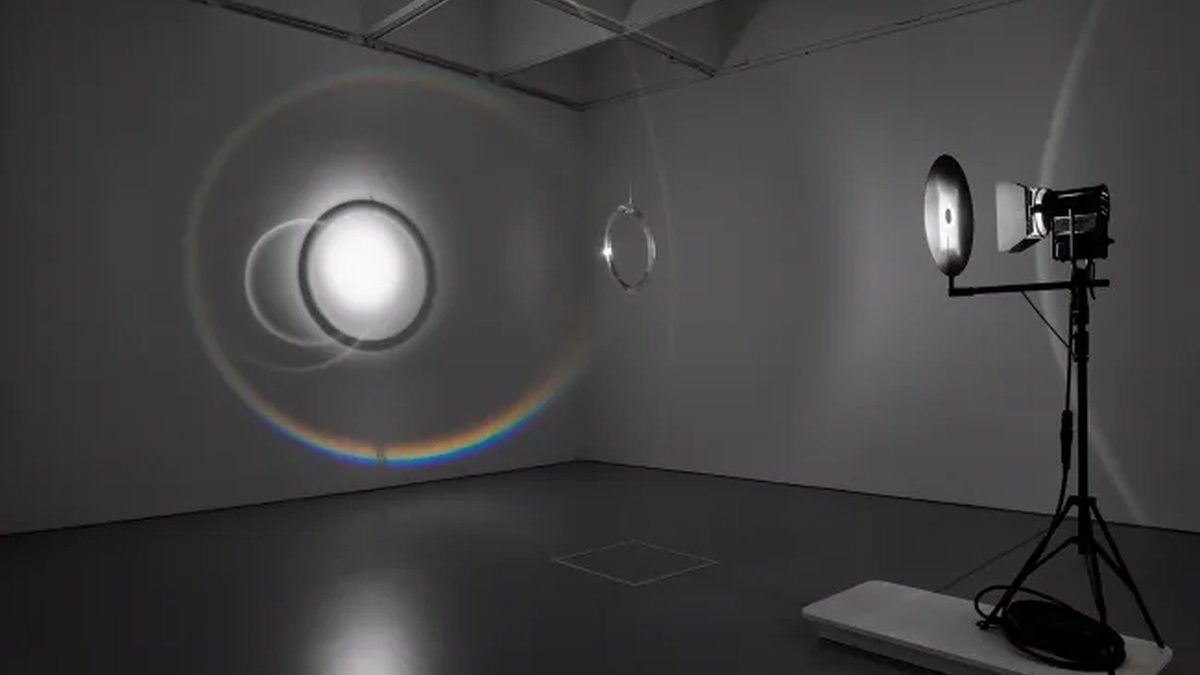
In between these two bookends, each artwork gets a room of its own. This can make for oddly disjunctive viewing, rather like going into different hotel rooms and finding utterly different guests in each. In one darkened room, Olafur Eliasson’s Round Rainbow, 2005, aims a spotlight on a suspended, rotating glass ring that refracts a rainbow drifting across the walls, like a looking glass made for giants. Two doors down, Rashid Johnson’s The Changes, 2025, a stacked-crate pyramid of palm fronds and potted plants, provides an almost too clean-cut, well-regulated garden — Ikea Minimalism meets natural abundance. Sheer volume makes the difference. You enter the prim gallery room and chance on a thirty-foot tower of green. That’s one definition of surprise.
Other pieces struggle to redefine their allotted space and to make their mark — the big rooms vanquishing the big things. The inert fluorescent tubes of Dan Flavin’s 1967 “monument” for V. Tatlin make the viewer only more aware of the hygienic blankness of the museum’s interior, like a night-light left glowing in a vacant apartment, mostly emphasizing what’s gone. Nearby, Lygia Clark’s hair-thin golden threads, crossing the corner like a spiderweb, and Robert Irwin’s dissolving frosted disk prove so subtle they could be missed — a curator’s mirages. Richard Long’s long line of white stone, installed in another large, windowless gallery, is liable to appear less like Land art and more like a convention center landscaping show — you might feel you’ve left the museum for a suburban Bethesda patio (the opposite of Mount Parnassus).
It comes as a disappointment to learn that, per the Hirshhorn’s telling, today’s practitioners of the big average around fifty years of age (Chan, Eliasson, Johnson, and Mika Rottenberg). The show aspires to tell a story of installation art emerging from the laboratory of life in the 1960s, when artists became dazzled by space and objects of the everyday — in Kaprow’s words, “the world we have always had about us but ignored.” Another version might have focused, more acidly, on the swings of New York real estate. A number of artists and critics, most notably Josh Klein in his blockbuster October essay “New York Real Estate and the Ruin of American Art,” have discussed a slide to the artistically diminutive, overdetermined by questions of rent, square footage, and public space. Big art sprang out of big studios, garages, and warehouses, available because Manhattan was not merely a playground for the rich. These spaces of the storied 1960s led to ecstatic experimentation — to, say, Gordon Matta-Clark sawing a waxing gibbous moon out of the side of an abandoned pier on the Hudson River. If the bigness in our era’s politics compensates for a lack of vision through try-hard fashion — mere crass ostentation as decoy or circus — the installation art showcased at the Hirshhorn helps pay homage to the expansiveness that can follow from a fairer social contract.
And yet art has a way of scrambling any overly reductive notions of big and small, of the miniature and the fecund. One of the biggest pieces of art I have seen of late — in the scope it conjures and in imaginative impact — is the span of five gizmos, each measuring approximately 1½ x ½ x ½”. A new project by Chan, featured in the May issue of Artforum, presents an array of ice whistles, as tiny and surprisingly colorful as Pez machines, taken out of their tense and grisly contexts. They leap from the wall (or 3D printer), managing to evoke a scale that connects the smallest of ornaments to the theater of streets, crowds, and smoke-clouds — as though a bauble could summon the whole body politic.
Chan is an artist who has made breather sculptures that move like car dealers’ inflatable tube men, who is attuned to the shadow of a passing cloud, who has admitted to the flight of fancy of suspending belief in the day’s breeze to better allow himself to imagine tree branches moving autonomously. The whistles present an obvious continuation of his long-running occupation with pneuma, breath or wind: that which cannot be gauged with a tape measure. Chan’s unheard whistles aim for boundlessness, and don’t need anything jumbo to make their bid. With a minimum of fuss or strain, they manage to admit the whole outer world into the panorama, while still allowing the artist to play, coyly, with color, symmetry, adornment.
But pure bigness, gigantic forms, the desire to remake and scale, still have their appeal. The show forces one to wonder whether, squeezed between the pressure of a corny, big-state aesthetic and punitive market forces, art must inevitably tend to the smaller or more elusive, whether as a survival mechanism or a badge of integrity. Even so, to avoid the thought that UFC CEO Dana White may be the last standing avant-garde installation artist, one can only hope that the Hirshhorn’s show is art’s own rope-a-dope, and that the dream of the expansive will not be surrendered to the most bastardized of its available forms, arch and all.
Noelle Bodick is a writer living in Washington, DC.
Sentinel — Human
This text exhibits strong human authorship, characterized by a highly specific intellectual voice, complex metaphorical linking, and idiosyncratic emphasis that moves beyond standard synthetic patterns.