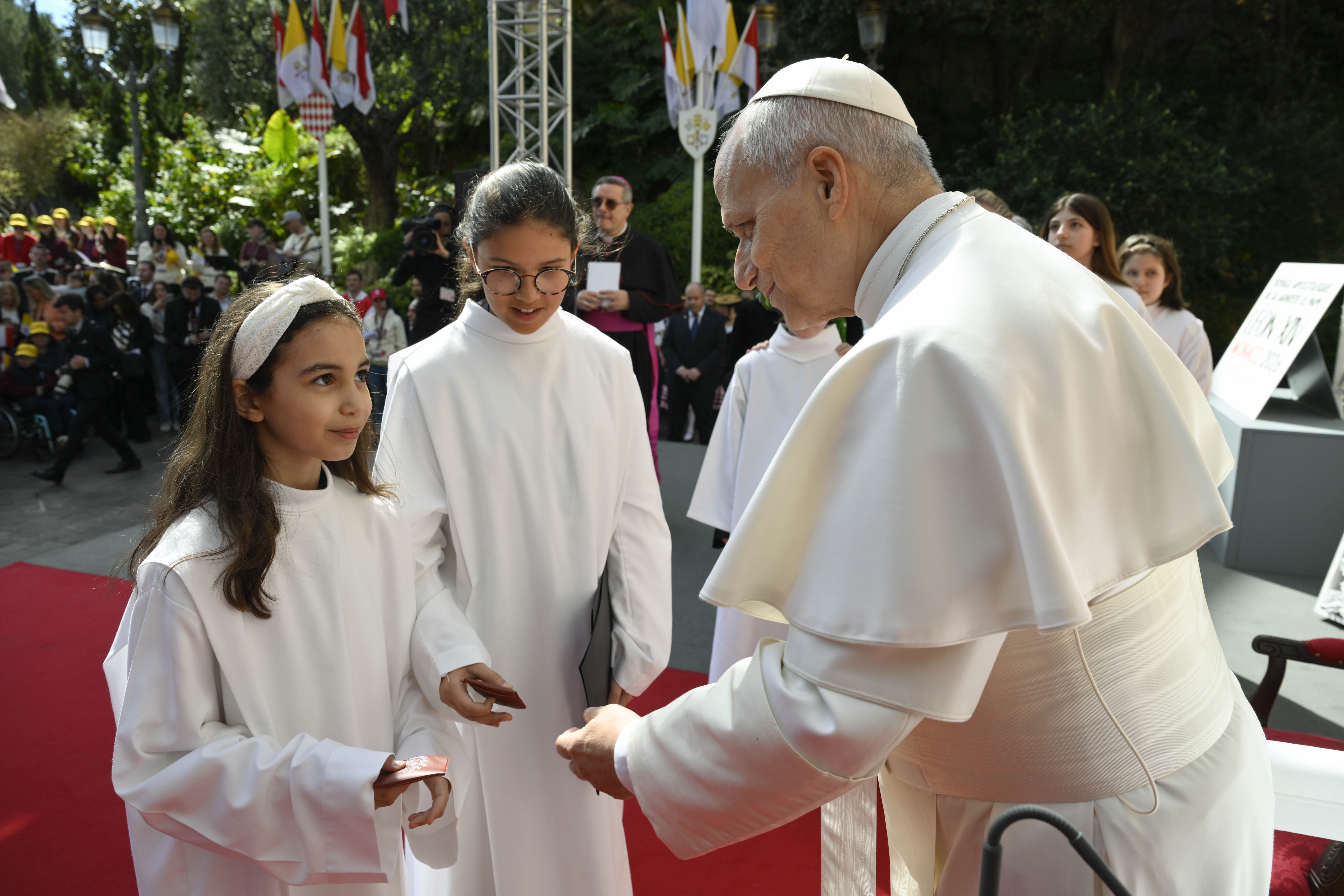
Pope Leo XIV concluded his one-day trip to Monaco on March 28, wrapping up a whirlwind visit that included meeting with the countryʼs royalty and holding Mass in Louis II Stadium.
The Holy Father became the first pope to visit the European micro-state in nearly 500 years. He appealed to the wealthy nation to spread the Gospel and become vessels of Godʼs love and generosity.
Pope Leo XIV flies into Monaco aboard the papal helicopter, Saturday, March 28, 2026. | Credit: Vatican Media
Pope Leo XIV meets Prince Albert II and Princess Charlene in Monaco, Saturday, March 28, 2026 | Credit: Vatican Media
Pope Leo XIV shakes the hand of Princess Gabriella, Countess of Carladès, in Monaco, Saturday, March 28, 2026 | Credit: Vatican Media
Pope Leo XIV greets crowds in Monte Carlo in Monaco, Saturday, March 28, 2026 | Credit: Vatican Media
Pope Leo XIV prays at the Cathedral of the Immaculate Conception in Monaco, Saturday, March 28, 2026 | Credit: Vatican Media
Pope Leo XIV greets crowds in Monaco on Saturday, March 28, 2026 | Credit: Vatican Media
Pope Leo XIV greets a baby on the streets of Monaco, Saturday, March 28, 2026 | Credit: Vatican Media
Pope Leo XIV views dancers during public festivities in Monaco, Saturday, March 28, 2026 | Credit: Vatican Media
Pope Leo XIV processes during Mass at Louis II Stadium in Monaco, Saturday, March 28, 2026 | Credit: Vatican Media
Pope Leo XIV elevates the chalice during Mass at Louis II Stadium in Monaco, Saturday, March 28, 2026 | Credit: Vatican Media
Pope Leo XIV waves from aboard his helicopter upon departure from Monaco Heliport in Monte Carlo, Monaco, on Saturday, March 28, 2026. | Credit: Valery HACHE / AFP via Getty Images)
The Holy Father urged Catholics in Monaco to “announce the Gospel of life, hope and love” and defend the dignity of human beings from birth to death.
Facts Only
Pope Leo XIV visited Monaco on March 28, 2026.
The visit lasted one day and was the first papal trip to Monaco in nearly 500 years.
He met with Prince Albert II, Princess Charlene, and Princess Gabriella, Countess of Carladès.
A Mass was held at Louis II Stadium in Monaco.
The Pope prayed at the Cathedral of the Immaculate Conception.
He greeted crowds in Monte Carlo, including shaking hands with a baby.
He observed public festivities featuring dancers.
The Pope urged Catholics to "announce the Gospel of life, hope and love" and defend human dignity.
He appealed to Monaco to spread the Gospel and act as vessels of generosity.
He departed via papal helicopter from Monaco Heliport in Monte Carlo.
Photographs of the visit were credited to Vatican Media and Valery HACHE/AFP via Getty Images.
Executive Summary
Pope Leo XIV made a historic one-day visit to Monaco on March 28, 2026, marking the first papal visit to the micro-state in nearly 500 years. The trip included meetings with Monaco’s royal family—Prince Albert II, Princess Charlene, and their daughter Princess Gabriella—as well as a public Mass at Louis II Stadium. The Pope emphasized themes of spreading the Gospel, defending human dignity, and embodying generosity, addressing both the wealthy nation’s residents and the broader Catholic community. His itinerary featured symbolic gestures, such as praying at the Cathedral of the Immaculate Conception and greeting crowds in Monte Carlo, including a notable interaction with a baby. The visit concluded with his departure via papal helicopter, captured in widely circulated images. While the event was framed as a spiritual and diplomatic milestone, the Pope’s call for Monaco to leverage its wealth for moral purposes introduces a subtle tension between material prosperity and religious duty.
The visit’s brevity and high-profile nature suggest a carefully orchestrated diplomatic and pastoral mission, though the long-term impact of the Pope’s appeal remains uncertain. The absence of controversy or dissent in the coverage reflects either genuine unity or a curated narrative, leaving open questions about how Monaco’s elite might respond to the call for greater generosity.
Full Take
This papal visit to Monaco is a masterclass in symbolic diplomacy, blending spiritual leadership with a subtle challenge to one of the world’s wealthiest enclaves. The strongest version of this narrative—its steelman—is that Pope Leo XIV used the platform to bridge the Catholic Church’s moral authority with Monaco’s global influence, framing wealth not as an end but as a tool for divine purpose. The imagery of the Pope greeting a baby or praying in a cathedral reinforces a message of humility and universal care, while the stadium Mass signals inclusivity. Credit is due for the Vatican’s ability to stage such events with precision, leveraging visuals and rhetoric to amplify its message.
Yet the pattern scan reveals potential layers of framing. The emphasis on Monaco’s wealth as a "vessel of generosity" could be read as a soft-power nudge—ARC-0037 *Virtue Signaling by Proxy*—where the Pope’s words serve as a moral benchmark for the elite, creating pressure without direct confrontation. The lack of critical voices or counter-narratives in the coverage might indicate ARC-0012 *Curated Consensus*, where dissent is omitted to maintain an unblemished image. The historical rarity of papal visits to Monaco (500 years) also invites ARC-0041 *Scarcity Framing*, where the event’s uniqueness amplifies its perceived significance.
Rooted in the Catholic tradition of *preferential option for the poor*, the Pope’s appeal echoes centuries of tension between spiritual ideals and material power. The unstated assumption is that Monaco’s wealth is morally neutral until directed toward charitable ends—a paradigm that both flatters and challenges the principality’s self-image. The implications for human dignity are clear: the call to defend life "from birth to death" aligns with Vatican doctrine but also subtly critiques Monaco’s reputation for luxury and exclusivity. Who benefits? The Vatican gains moral high ground; Monaco’s royalty gains papal legitimacy. Who bears costs? Potentially, the status quo of wealth concentration, if the appeal spurs real redistribution.
Bridge questions: How might Monaco’s elite interpret "generosity"—as philanthropy or systemic change? What voices are missing from this narrative—critics of papal authority, Monaco’s non-Catholic residents, or economic justice advocates? Would evidence of Monaco’s increased charitable giving post-visit strengthen or complicate the Pope’s message?
Counterstrike scan: If this were an influence campaign, the playbook would involve using the Pope’s moral authority to pressure Monaco into financial or political concessions, framed as voluntary piety. The actual content aligns partially—soft pressure is present, but no overt coercion or manipulative framing is detected. The narrative remains within the bounds of traditional papal diplomacy.
Sentinel — Human
The article appears to be human-written. The writing style shows variation in sentence length, personal voice, and idiosyncratic emphasis, which are not typical of AI-generated content.