-
Click here to listen to this article - Share via
- Downtown Los Angeles struggles with retail vacancy as high as 40% after the COVID-19 pandemic, prompting major brands like Nike to abandon their storefronts.
- San Francisco’s Vacant to Vibrant program has helped revitalize downtown by offering free rent, grants and mentoring to small businesses opening pop-up shops.
- Downtown L.A. advocates want to adopt a similar program to subsidize retailers, fill vacant storefronts and revitalize the neighborhood’s walkability as well as its restaurant scene.
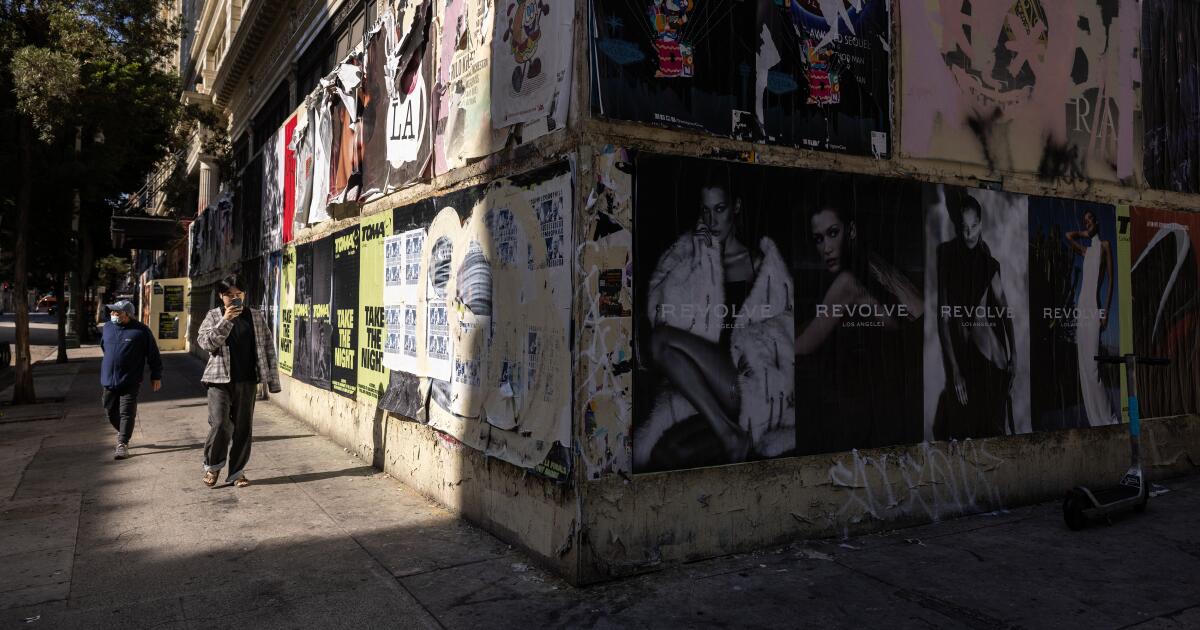
As much of downtown L.A. continues to feel dark and deserted, local businesses want the city to steal San Francisco’s secret for firing up foot traffic.
The tech mecca has slowly begun to emerge from one of the country’s deepest declines in downtown retail, in part through a program that peppered the city with subsidized pop-up shops.
The Vacant to Vibrant program turned abandoned spaces into bakeries, bookstores, cafes, chocolateries, galleries and other things.
Local entrepreneurs were given grants and support from the city and charities, as well as months of free rent to set up shop. The idea is to leverage empty storefronts to build buzz and entice more shoppers to city sidewalks.
While San Francisco is still far from its pre-pandemic peaks, backers say the program has brightened struggling retail areas.
“We’re creating a window on what downtown could look like,” said Simon Bertrang, executive director of SF New Deal, the nonprofit behind Vacant to Vibrant. The hollowing-out created by COVID-19 could be an opportunity to turn downtown San Francisco into a “mixed-use neighborhood with a lot of small businesses and maybe more residential,” he said.
Both L.A. and S.F. have grappled with keeping stores and restaurants in their business districts since the pandemic emptied office buildings. While most employees are working from the office again, a significant number are still working from home, and many aren’t coming in every weekday. The diminished presence of workers continues to make it hard on the lunch spots, bars and shops that rely on them to survive.
Though it is difficult to compare how businesses are doing in each downtown, there are some indicators that San Francisco has been growing more in the last year.
Reservation platform OpenTable said online reservations in the Northern Californian city shot up more than 20% compared with most months last year. Reservation growth in L.A. was capped below 10% for most of the same period.
Downtowns across the country need to find solutions, experts warn, as dark storefronts can lead to a downward spiral, with companies hesitant to lease office space in vacant areas.
Retailers are already opting out of downtown L.A. due to its slow recovery from the pandemic shutdown, said real estate broker Derrick Moore of CBRE, who helps arrange commercial property leases.
“A lot of operators are just electing to skip over downtown,” he said. “They’re leasing spaces elsewhere, where they feel they have a greater chance at higher sales.”
Brands have headed to more vibrant, nearby neighborhoods such as Echo Park and Silver Lake because of downtown’s weaker business.
Downtown Los Angeles residents, businesses and other city boosters want to try to prime the pump, using a program like San Francisco’s to help small businesses take over vacant storefronts and turn the lights back on, said Cassy Horton, co-founder of the Downtown Residents Assn.
Surveys by the group have found that what residents love most about downtown is its walkability, restaurants, bars and coffee shops, she said.
“I love being able to live a lifestyle where I can run all of my core errands within a couple blocks,” Horton said. “I don’t have a car.”
Retail property vacancy downtown could be as high as 40%, Moore said, with some neighborhoods, such as the Historic Core, suffering more than others. Nike recently closed its store on Broadway.
“Downtown’s commercial vacancy crisis is visible on every block,” a recent report by the residents’ group said.
The report called for a “safe sidewalks” public safety campaign to work in tandem with a plan to bring back retail tenants.
In San Francisco, participating businesses can get their feet wet with a three-month pop-up to test the waters in a high-traffic location with low financial overhead and technical support from SF New Deal and the mayor’s office.
Businesses are offered grants to operate, help with lease negotiations, assistance with obtaining city permits, insurance, marketing support, business mentoring, and three to six months of free rent.
The intention is to transition many of the pop-ups into long-term leases, creating permanent fixtures in the downtown landscape. So far, more than 10 of the 40 small businesses that started as pop-ups have moved on to multiyear leases with their landlords.
Property owners with storefronts they need to fill receive funding to cover the cost of preparing the space for tenants and other property expenses, help with city permits and other support.
San Francisco launched the program in 2023 with $700,000 and contracted with SF New Deal, which focuses on supporting small businesses in the city.
The program is also supported by corporate philanthropy from Wells Fargo, JPMorgan Chase, Visa, Gap and others.
Among the first stores to open through the program was Devil’s Teeth Baking Co., a popular bakery in the Outer Sunset neighborhood that established an outpost in the moribund Financial District and brought followers with it.
“Suddenly, there are lines out the door on the weekend” of people waiting for breakfast sandwiches, Bertrang said.
The bakery now has a long-term lease, as do other graduates of the program, including Mello flower shop, arts-and-crafts studio Craftivity and Whack Donuts.
San Francisco’s business centers were particularly hard-hit by the pandemic as its technology companies quickly adapted to remote work and kept at it even as the crisis eased, triggering widespread office and retail vacancies.
“San Francisco had the worst return-to-work situation in the nation,” Bertrang said. “It was the most extreme version of what L.A., New York and other cities in our country are dealing with.”
Representatives of nearly 40 organizations in cities across the country have reached out to him for advice on how similar programs might work in their stricken neighborhoods.
Among them was downtown L.A. business advocacy group Central City Assn., which has called for L.A. to subsidize retailers’ rents to help fill vacant storefronts in key corridors. It is working with city officials, looking into a program like Vacant to Vibrant for Los Angeles.
Adding businesses to the streets while improving public safety would help halt the “downward spiral and turn it into more of a virtuous cycle,” said Nella McOsker, president of the association.
“San Francisco has demonstrated this larger ripple effect of success,” she said. “This is really, really doable in targeted pockets of downtown,” she said.
Nick Griffin of the business improvement district DTLA Alliance said activating storefronts is a worthy goal as long as the city first makes the streets both safe and pleasant for pedestrians.
The city needs to provide clean sidewalks, street lighting and graffiti removal before consumers and businesses return, he said.
“San Francisco was the poster child for the doom loop and has pivoted to downtown recovery,” he said. “ We are building that story right now.”
Facts Only
Downtown Los Angeles has a retail vacancy rate as high as 40% post-COVID-19 pandemic.
Major brands like Nike have closed their storefronts in downtown L.A.
San Francisco’s Vacant to Vibrant program offers free rent, grants, and mentoring to small businesses opening pop-up shops.
The program has helped revitalize downtown San Francisco by filling vacant storefronts with bakeries, bookstores, cafes, and galleries.
Local entrepreneurs in San Francisco receive grants, free rent for three to six months, and support with permits and marketing.
Over 10 of the 40 small businesses that started as pop-ups in San Francisco have transitioned to long-term leases.
The program is funded by $700,000 from the city and corporate philanthropy from companies like Wells Fargo, JPMorgan Chase, and Visa.
Downtown L.A. advocates are proposing a similar program to subsidize retailers and fill vacant storefronts.
OpenTable data shows San Francisco’s restaurant reservations increased over 20% compared to last year, while L.A.’s growth was below 10%.
The Downtown Residents Association in L.A. found that residents value walkability, restaurants, bars, and coffee shops.
Nike recently closed its store on Broadway in downtown L.A.
The Central City Association in L.A. is working with city officials to explore a program like Vacant to Vibrant.
San Francisco’s program aims to transition pop-ups into permanent businesses to revitalize downtown areas.
Executive Summary
Downtown Los Angeles is facing a severe retail vacancy crisis, with rates as high as 40% in some areas, as major brands like Nike abandon their storefronts. Meanwhile, San Francisco has seen some success in revitalizing its downtown through the Vacant to Vibrant program, which provides grants, free rent, and mentoring to small businesses opening pop-up shops. The program has helped fill vacant spaces with bakeries, cafes, and galleries, with over 10 of the 40 participating businesses transitioning to long-term leases. Downtown L.A. advocates are now pushing for a similar initiative to subsidize retailers and restore foot traffic, emphasizing the importance of walkability and local businesses to residents.
The contrast between the two cities is notable. San Francisco’s restaurant reservations have surged over 20% compared to last year, while L.A.’s growth remains below 10%. Both cities struggle with reduced office occupancy post-pandemic, but San Francisco’s program has demonstrated a potential path forward. L.A.’s Central City Association and other groups are exploring how to adapt this model, though challenges like public safety and street conditions remain. The goal is to create a "virtuous cycle" of business activity and pedestrian engagement, but success will depend on addressing broader urban issues beyond just filling storefronts.
Full Take
The strongest version of this narrative highlights a pragmatic solution to urban decay: leveraging vacant storefronts to incubate small businesses, thereby revitalizing downtown areas. San Francisco’s Vacant to Vibrant program is framed as a replicable model, with measurable success in transitioning pop-ups to permanent leases and boosting foot traffic. The article credits corporate and city collaboration, along with targeted subsidies, for this progress. Downtown L.A.’s advocates are positioned as proactive, seeking to adapt this strategy to their own struggles with high vacancy rates and declining retail interest.
However, the narrative leans heavily on the "success story" framing, which may overlook systemic challenges. For instance, San Francisco’s program is still in its early stages, and its long-term sustainability is unclear. The article acknowledges that San Francisco’s recovery is far from complete, yet the emphasis on its 20% reservation growth versus L.A.’s 10% could imply a false binary—either a city is "recovering" or "failing." Additionally, the focus on small businesses as a panacea risks downplaying broader issues like public safety, housing affordability, and corporate flight, which are briefly mentioned but not deeply interrogated.
The root cause here is the post-pandemic shift in urban economics, where remote work has hollowed out downtowns reliant on office workers. The assumption is that small businesses can single-handedly restore vibrancy, but this ignores the structural dependence of retail on foot traffic from commuters. The implications for human agency are mixed: while the program empowers small entrepreneurs, it also places the burden of revitalization on them rather than addressing larger policy failures.
Bridge questions: What role should corporate landlords play in subsidizing vacancies, given their stake in property values? How might this model adapt to cities with less corporate philanthropy or weaker local governments? Would a focus on residential conversion of commercial spaces be a more sustainable solution than retail subsidies?
Counterstrike scan: If this were an influence campaign, the playbook would emphasize "local solutions" to deflect from systemic issues, using selective data (e.g., reservation growth) to create urgency. The actual content aligns partially—it does highlight a local initiative—but it also acknowledges broader challenges, avoiding outright manipulation. The tone remains constructive rather than exploitative.
Patterns detected: ARC-0024 Ambiguity (selective use of growth metrics without full context), ARC-0043 Motte-and-Bailey (framing small business support as the sole solution while broader issues are relegated to secondary concerns).
Sentinel — Human
The article shows strong human hallmarks—personal voices, uneven pacing, and localized context—with minimal stylometric or coordination red flags. Likely human-written with minor editorial formulaicity.