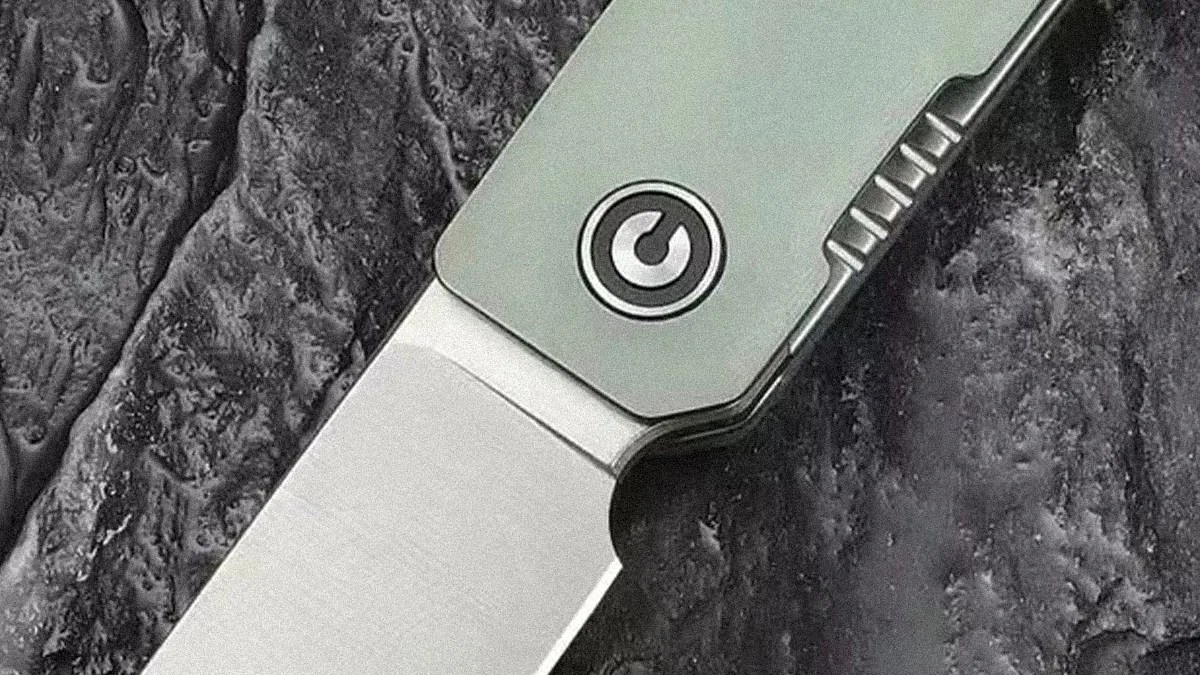
So it is that Civivi and CRKT added natural G10 to tiny gentleman’s knives while Kizer reimagined a fan favorite as an ultra-minimalist folder with premium steel and a surprisingly low price.
At the same time, Opinel introduced a charming aprés-ski snack set and We Knife dropped an eye-popping feat of engineering that transforms from EDC to tactical in seconds.
Get the lowdown on those noteworthy releases and more below.
Knafs Doodler
Knafs has been a staple of the EDC industry for some years now, but the brand’s latest, the Doodler, marks a potential shift for the brand. It represents a move away from the brand’s familiar Lander silhouette into a new realm: gentleman’s knives. This particular knife combines throwback midcentury design cues with an S35VN blade, G10 handle, swappable inlays and a pen hidden away in the handle (adding some extra multi-functionality).
Made of Artisan Cutlery’s affordable, reliable AR-RPM9 steel, this fine folder’s 3.15-inch blade adopts the clip-point shape of a classic Bowie knife, its stonewashed finish nicely complemented by the stainless steel of the subtly ergonomic handle. Meanwhile, the button lock not only makes one-handed retraction easy but also serves as a secondary deployment method, after the ambidextrous thumb studs.
The CEO has been a stalwart in CRKT’s lineup since 2019, when the Richard Rogers design won Best Buy of the Year at Blade Show and began begetting a whole family of spinoffs. The latest is this 1.6-ounce small wonder featuring a 2.36-inch drop-point blade made of stonewashed 14C28N steel, a discreet rear flipper and a very on-trend handle material, natural G10. The jade-colored scales get a boost in grip from a wavy texture while a stainless steel clip makes pocket carry easy.
This is the first collaboration between Vosteed and Nick from the Stassa23 YouTube channel (and Nick’s first fixed-blade design). But the Inferno isn’t your typical fixie; it’s designed around EDC utility, embodying it with a much more compact form-factor that’s good for common, detail work. While its blade measures only 3.57 inches, it’s still thick and crafted from durable, stonewashed 14C28N steel, making it plenty strong for chopping work, should you need it. It also gets a grippy Micarta handle that offers plenty of grip and an omnidirectional rotating Kydex sheath (a proprietary Vosteed invention).
Civivi’s Kukei is based on one of the most iconic folding knives of all time, the Japanese Higonokami. While it retains the signature angularity and overall vibe (including a signature reverse tanto blade), it also gets some noteworthy updates, like modern Nitro-V steel, a liner lock (the original is a friction folder) and new handle materials. Most noteworthy for this edition is the natural G-10 handle scales, which put it on trend for this year and give it a subtle jade color.
This innovative design improves upon the classic keyring, which for all its convenience can be easily warped and wreck your fingernails. Thanks to ultralight spring-grade SUS304 stainless steel twisted into a wave-shaped structure, the Painless Key Ring offers twice the strength, half the weight and natural gaps that are easier to use and more accommodating to thicker keys.
Opinel expanded its classic Picnic+ Collection with the Charcuteski Set, designed for slope-side snacking. The compact and functional set includes a No.08 Stainless steel folding knife with engraved handle, displaying ski designs. The knife is ideal for slicing cheese, bread and additional snacks, while the Picnic+ Spoon and Fork Inserts allow for convenient digging in. The kit comes in a microfiber cloth carrying case for ease transport on the mountain.
Tacray’s Tiran II is a high-performance knife with aggressive, futuristic styling, a convenient button lock and a glass breaker tip on its butt. It’s also thinner and lighter than most other knives in its class, giving it an easy-carrying edge. But perhaps the most interesting thing about it is that it comes in three distinct configurations. While they share the same DNA, each has its own merits, be that a zirconium handle, copper-coated blade (designed to age) or durable blacked-out finish.
Kizer’s Drop Bear silhouette is undoubtedly one of its most popular and versatile silhouettes. This knife has been turned into a fixed blade, utility knife and more. Now, it has been given an ultra-minimalist, button-locking, folding makeover in the Drop Bear Zero. And while the sleek styling is definitely a highlight, it’s made even better by its exceptional materials, which you’d likely expect to find on a far more expensive knife (including Elmax or M390 super steel).
The Atlas is such a Böker staple, more than two dozen variations are currently available on the brand’s site. The latest might be the greatest, thanks to a ceramic-coated, army green stainless steel handle that adds a distinctive military-inspired flair to the fan favorite. This edition also features a 2.95-inch drop-point blade made of Swedish 12C27 steel with a scratch-resistant PVD coating, a nail nick for two-handed opening, slipjoint mechanism, lanyard hole and reversible tip-up clip.
The idea of “morphing” knives has been a relatively constant curiosity in the EDC industry over the course of the last few years, ushered forth largely by the CRKT Provoke. And We Knife has dabbled before, crafting a knife called the Typhoeus that sees a fixed blade that transforms into a push dagger. However, the NexoMorph is the next logical technological step, which adds the knife’s ability to fold in on itself like a traditional pocket knife, as well as transform into a push dagger. It also has a titanium handle, M390 blade and simple push-button operation.
Now managing editor, Steve has served in a variety of roles with GP since 2019. Having previously written and edited for such publications as Men’s Health, Men’s Journal, Esquire and ESPN, he enjoys covering a range of topics — but mostly those pertaining to cycling, snow sports, pocket knives and motos — and dreams of a utopian world in which everyone’s bike seat is at the proper height.
Want to stay up to date on the latest product news and releases? Add Gear Patrol as a preferred source to ensure our independent journalism makes it to the top of your Google search results.
Facts Only
* Civivi released the Kukei, a folding knife with an S35VN blade and natural G10 handle.
* CRKT launched the CEO, a small fixed blade knife with a 14C28N blade and G10 handle.
* Kizer introduced the Inferno, a compact fixed blade knife with a 14C28N blade and Micarta handle.
* Civivi released the Doodler, a gentleman’s knife with an S35VN blade, G10 handle, and pen.
* We Knife released the NexoMorph, a transforming knife with a titanium handle and M390 blade.
* Opinel introduced the Charcuteski Set, a ski-themed snack set with a No.08 stainless steel knife.
* Tacray released the Tiran II, a high-performance knife with a zirconium handle and a glass breaker tip.
* Kizer released the Drop Bear Zero, a minimalist folding knife with an Elmax blade.
* Böker released the Atlas, a variation with a ceramic-coated handle.
* Vosteed and Nick from Stassa23 collaborated on the Inferno.
* The Painless Key Ring is made from SUS304 stainless steel.
Executive Summary
Full Take
The article presents a snapshot of a rapidly evolving EDC knife market, revealing a potent confluence of trends: premium materials, miniaturization, and an embrace of historical design motifs. The “morphing” knife concept, previously pioneered by CRKT, is being revisited with We Knife’s NexoMorph, signifying a technological aspiration within the space. This isn't simply about making better knives; it’s about responding to a perceived demand for greater utility and aesthetic refinement, a demand likely fueled by the continued success of brands like Civivi and Kizer. The inclusion of the Charcuteski Set and the Doodler highlights a diversification of the EDC niche beyond pure functionality, tapping into aspirational imagery – the “après-ski” lifestyle, the gentleman’s pursuit of multi-tool elegance.
The repeated emphasis on materials like Elmax and M390 points to a growing willingness among consumers to invest in higher-performing steels, driven perhaps by marketing narratives surrounding "super steels" and perceived performance benefits. However, the persistent reliance on established brands like Opinel suggests a conservative element within the market, reinforcing familiar design language and materials. The introduction of the Painless Key Ring, while technically innovative in its construction, seems almost tangential – a minor product diverting attention from the core trend of high-performance folding knives. A deeper pattern emerges: brands are using technological "hooks" – transformable knives, integrated tools – to justify premium pricing and create buzz. The entire collection feels like a carefully curated demonstration of innovation intended to capture attention and establish brand presence within the fiercely competitive EDC landscape.
Patterns detected: ARC-0043 Motte-and-Bailey – The article layers claims of innovation and trendsetting without fully substantiating the extent to which these knives represent truly novel developments. The description of the NexoMorph, for example, relies heavily on evocative language ("next logical step") without providing details of its mechanics. ARC-0024 Ambiguity – Many of the materials and features described (e.g., “natural G-10 handle scales”) are vague and lack specific technical specifications, creating a sense of aspirational luxury without concrete information.