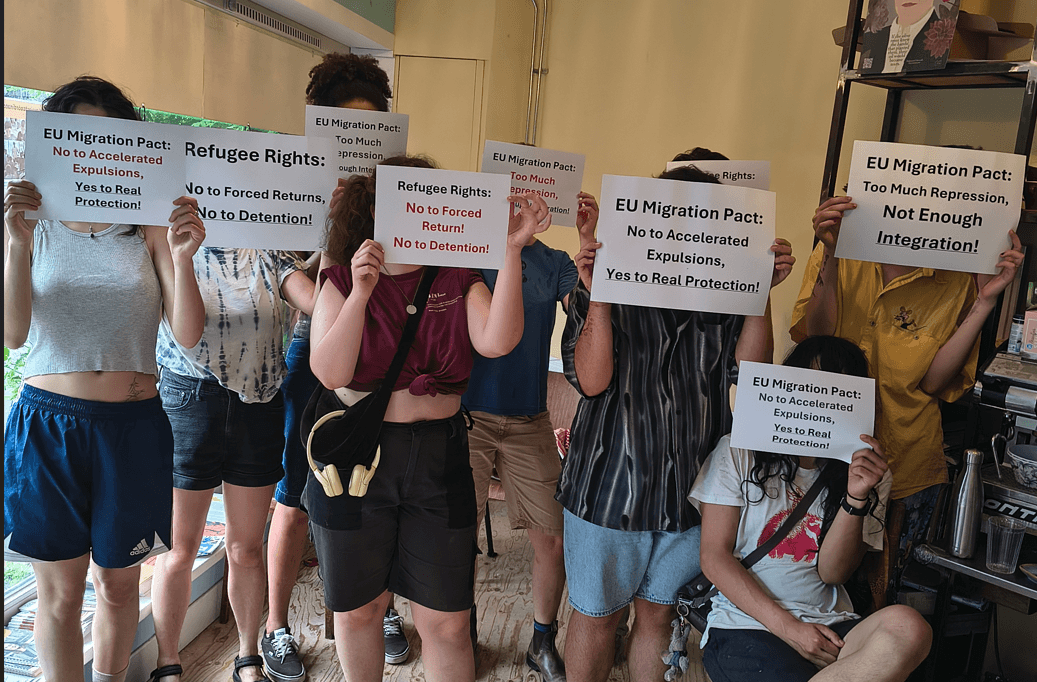
Europe likes to see itself as a moral power. From Brussels to Strasbourg, European leaders regularly invoke human rights, international law and democratic values as the foundations of the European project. Yet when it comes to the new migration and asylum pact, the gap between rhetoric and reality has become increasingly difficult to ignore.
A pact built on control, not protection
On paper, the EU’s new Migration and Asylum Pact is advertised as a pragmatic compromise among the different member states and ideological currents. But in reality, it marks a turning point in Europe’s migration narrative: a subtle but profound shift from viewing asylum as a legal and humanitarian duty to framing migration as a threat to be contained. The architecture is clear: border management takes precedence, while the right to seek asylum becomes conditional, expedited, and ultimately, more vulnerable. It’s no wonder that human rights, students, and humanitarian groups, such as Caritas, Save the Children, and the International Rescue Committee, as well as think tanks, such as the Migration Policy Group, have sounded the alarm; not only is this a technical reform, it’s a signal that Europe is embedding the logic of deterrence into its core. The rhetoric of solidarity remains, but the operational logic now runs on displacement, restriction, and control.
This is not just bureaucratic reform. From an international relations perspective, the pact exposes a Europe in retreat, a bloc more preoccupied with domestic political backlash than with upholding the legal norms enshrined in its founding treaties and the humanitarian and asylum conventions. While this may ease anxieties at home, it comes at a price: the EU’s standing as a global champion of human rights, humanitarian law, and the legacy of the Refugee Convention is visibly eroded. When the protection of the vulnerable is relegated to a secondary concern behind border security, Europe dangerously brings the far-right ideas to mainstream policies.
Fast-track procedures, detention, and the erosion of safeguards
Perhaps the most alarming aspect is the expansion of screening and fast-track border procedures. Officially, these measures promise efficiency. In reality, they can create de facto detention at the border, including for families and children, while reducing access to legal aid, appeal rights and proper reception conditions. A system that trades fairness for speed isn’t delivering justice; it’s managing risk under the guise of governance. The consequences are all too real: people with valid protection claims may find themselves swept into summary procedures, with barely a chance to explain the danger they face if they are sent back.
One of the Pact’s most troubling legacies may be its impact on racial justice. By widening screening powers to include undocumented persons within member states, not just at the border, authorities are given sweeping discretion over whom to stop, check, and detain. In practice, this opens the door to racial profiling and creates a climate of suspicion for racialized communities, including EU citizens and legal residents who may be singled out based on appearance, language, or perceived origin. From a legal perspective, this stands in stark tension with the non-discrimination principles that underpin both EU law and international asylum standards, which are built to protect individuals, not to encourage collective suspicion. It is hard not to think that Trump’s ICE policy is not landing in Europe.
Externalisation, legal loopholes and Europe’s shrinking credibility
The Pact also doubles down on the politics of externalisation. Expanding the “safe third country” concept and allowing member states to pay their way out of relocating asylum seekers shifts responsibility outward, onto neighbours beyond the EU’s borders, rather than sharing it fairly among member states. This may be politically convenient, but it’s strategically corrosive. Europe is not addressing the root causes of displacement; it is outsourcing the consequences. What emerges is a migration regime increasingly reliant on third countries whose human rights records are weak or, at best, inconsistent, all while Europe insists it is upholding its own values.
Here, the contradictions of Europe’s international politics become impossible to ignore. A Union that champions the rule of law abroad, while building a system of border prisons, emergency derogations, and legal grey zones at home, risks losing the moral authority it once commanded. The new crisis, force majeure, and so-called “instrumentalisation” clauses are especially troubling, opening the door for governments to delay asylum or justify pushbacks under vaguely defined emergencies. In effect, loopholes become the policy. The message to the world is unambiguous: Europe’s promise of protection is reliable only when it’s easy. Europe’s commitment to protection is conditional when pressure rises. That damages its authority not only in migration diplomacy, but across the wider humanitarian system.
But it doesn’t have to be this way. A different path remains possible: one that starts with dignity, due process, and real accountability. It would mean investing in genuine reception capacity, ensuring that legal aid and NGO access are not afterthoughts, and opening more legal pathways: resettlement, humanitarian visas, family reunification, and labour migration. This wouldn’t mean removing control from migration policy; it would simply reaffirm the core principle that control must always remain compatible with law.
The most uncomfortable truth about the Migration and Asylum Pact isn’t that it marks a far-right takeover of Europe. It’s that ideas once seen as fringe are now finding a home at the political centre of EU politics. In the end, this pact may not be remembered as a solution to Europe’s migration challenges, but as a milestone in the slow erosion of the very values Europe has long claimed as its own.
Facts Only
The EU has adopted a new Migration and Asylum Pact.
The pact emphasizes border management and control over asylum protection.
Human rights groups, including Caritas, Save the Children, and the International Rescue Committee, have criticized the pact.
The pact introduces fast-track border procedures and expanded screening powers.
Detention at borders may apply to families and children, with reduced access to legal aid and appeal rights.
Authorities gain discretion to stop, check, and detain undocumented persons within member states, not just at borders.
The pact allows member states to pay third countries to take asylum seekers instead of relocating them internally.
Emergency clauses enable governments to delay asylum processing or justify pushbacks under vaguely defined crises.
The pact has been criticized for undermining EU principles of non-discrimination and international asylum standards.
The Migration Policy Group and other think tanks have raised concerns about the pact’s deterrence-focused logic.
The pact’s measures include widening the "safe third country" concept to shift responsibility outward.
Critics argue the pact aligns with far-right ideas, embedding deterrence into mainstream EU migration policy.
Executive Summary
Full Take
The EU’s Migration and Asylum Pact reflects a broader paradigm shift in European politics, where migration is increasingly framed as a security issue rather than a humanitarian obligation. The strongest version of this narrative presents the pact as a necessary compromise to manage political pressures and streamline asylum processes. However, the emphasis on deterrence—through fast-track procedures, detention, and externalization—risks normalizing policies that prioritize control over protection. This aligns with patterns of systemic mission drift, where stated humanitarian values are undermined by operational logic focused on restriction and displacement.
The pact’s reliance on emergency clauses and legal loopholes creates a framework where protections become conditional, eroding the EU’s moral authority. The expansion of screening powers within member states, not just at borders, raises concerns about racial profiling and the disproportionate targeting of marginalized communities. This echoes historical patterns of securitization, where fear of "the other" justifies exceptions to legal and ethical norms.
The implications extend beyond migration policy. By outsourcing responsibility to third countries with questionable human rights records, the EU risks complicity in systems that may violate international law. The long-term cost is a loss of credibility in advocating for human rights globally. Who benefits from this shift? Politically, it may ease domestic pressures, but the human cost—reduced protections for vulnerable populations—is significant.
Bridge questions: How might the EU reconcile its humanitarian rhetoric with the operational realities of this pact? What alternative frameworks could balance border management with genuine protection? Would the pact’s measures hold up under legal challenges based on non-discrimination principles?
Counterstrike scan: A coordinated influence campaign pushing this narrative might exploit fears of migration to justify erosion of rights, using emergency clauses to normalize exceptions. The actual content aligns with this pattern but appears to reflect genuine policy trade-offs rather than a deliberate disinformation play. The concern lies in the structural alignment between far-right rhetoric and mainstream policy, not overt manipulation.
Patterns detected: ARC-0024 Ambiguity (vague emergency clauses), ARC-0043 Motte-and-Bailey (humanitarian rhetoric vs. restrictive policies)
Sentinel — Human
The text demonstrates the characteristics of human-authored political commentary, employing sophisticated synthesis and a distinct voice to build an argumentative critique of EU migration policy.