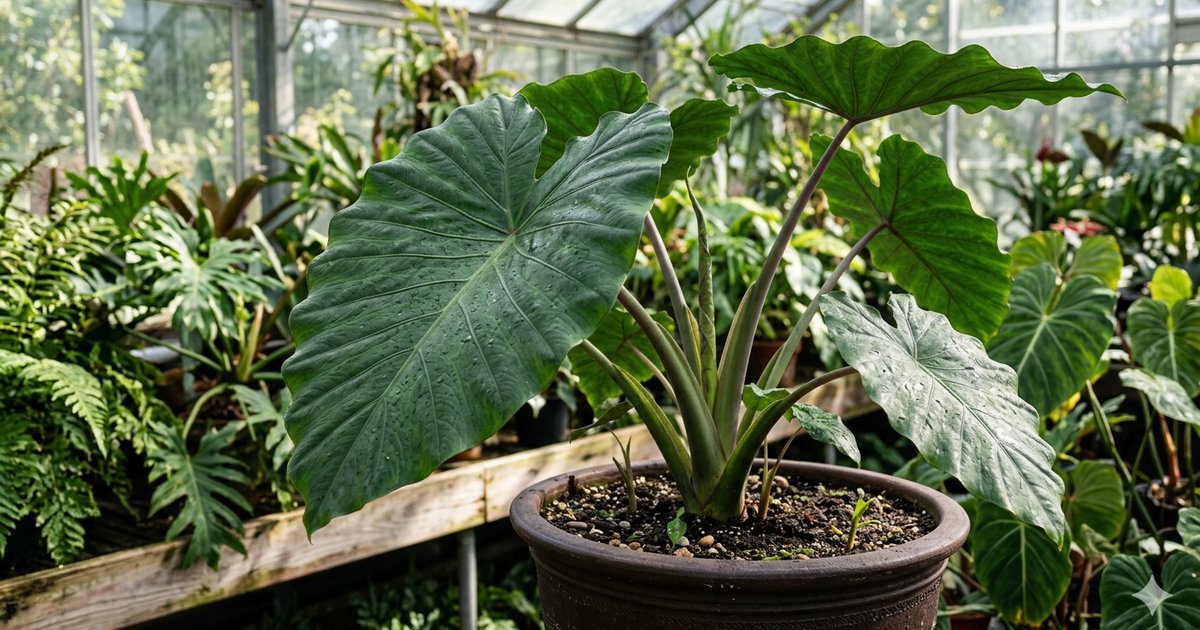
In the deliberate brightness of Fort Collins summers, where sun can feel both generous and uncompromising, some plants do not merely adapt to the landscape—they reshape its sense of scale. Elephant Ear, with its oversized foliage and architectural sweep, belongs to that category. It does not whisper into a garden composition. It expands it.
Where many annuals work through detail, Elephant Ear works through volume.
A Study in Scale
Elephant Ear (commonly Colocasia or Alocasia, depending on variety) is defined first and foremost by its leaves. Large, heart-shaped, and dramatically veined, they can feel almost sculptural in their presence. In some cultivars, the foliage is glossy and deep green; in others, nearly black or marked with metallic undertones.
In a Fort Collins garden context, this creates an immediate shift in perception:
- It introduces large-scale structure in a seasonal landscape
- It creates instant focal points without flowers
- It establishes tropical visual language in a temperate climate
It is not subtle. It is intentional.
A Plant That Rewrites Space
Elephant Ear behaves less like a bedding plant and more like a living installation. One well-placed specimen can redefine an entire container or garden corner.
Its impact is spatial as much as botanical:
- A small patio becomes a green room
- A mixed container becomes a vertical and horizontal composition
- A garden bed gains a central axis of attention
It doesn’t decorate space—it organizes it by sheer presence.
Container Culture in Northern Colorado
In Fort Collins, Elephant Ear is best understood as a container or seasonal accent plant rather than a permanent landscape resident. The climate is too cold for year-round outdoor survival, but that limitation becomes a design advantage.
Container growing allows for:
- Seasonal mobility (sun, shade, wind protection as needed)
- Controlled moisture in a dry climate
- Easy winter transition indoors or storage of tubers
Large pots or architectural planters are especially effective, as they match the scale of the plant itself. Small containers tend to diminish its character.
Light, Water, and the Language of Growth
Elephant Ear is a plant of abundance, but that abundance is conditional. It responds directly to environmental generosity.
- Light: Partial shade to bright, filtered light; protection from harsh afternoon sun is often beneficial
- Water: Consistently moist soil; it prefers stability over cycles of dryness
- Soil: Rich, organic, and moisture-retentive but well-structured
- Temperature: Thrives in warmth; growth accelerates noticeably in peak summer conditions
In Fort Collins’ dry air, watering consistency becomes the defining factor between survival and spectacle.
Designing with Mass and Contrast
Elephant Ear is most compelling when used as a counterweight. Its large foliage invites pairing with finer textures, lighter forms, or more delicate bloom structures.
From a Plantorium palette perspective:
- With Calibrachoa or trailing petunias
Cascading color softens the base while the Elephant Ear asserts vertical dominance above.
- With Coleus
Patterned foliage becomes intricate detail beneath a broad canopy of green scale.
- With ornamental grasses
Movement meets mass—fine linear motion against broad, still surfaces.
- With Dusty Miller
The contrast becomes tonal as well as structural: silver restraint against deep tropical volume.
In each case, Elephant Ear functions as the “large gesture” in the composition.
Seasonal Rhythm and Temporary Grandeur
In Colorado’s climate, Elephant Ear exists in a deliberate seasonality. It is planted after frost danger has passed and removed or stored before cold returns. This temporary nature is not a limitation—it is part of its design value.
Its lifecycle tends to follow a clear arc:
- Early season: slow emergence, anticipation building
- Mid-summer: rapid expansion, peak structural presence
- Late season: full maturity, often reaching maximum dramatic effect just as other plants begin to soften
The garden becomes more theatrical during its presence, then more contemplative after its departure.
Care as Support, Not Control
Elephant Ear rewards attentive but uncomplicated care. It is less about precision and more about consistency.
Key practices include:
- Maintaining even soil moisture without saturation
- Providing space for leaf expansion without crowding
- Feeding lightly during active growth for sustained vigor
- Removing damaged leaves to preserve visual clarity
Its maintenance philosophy is simple: support the scale, do not constrain it.
The Aesthetic of Boldness
Not every garden element needs to be restrained, subtle, or transitional. Elephant Ear represents the opposite principle: that scale itself can be a form of meaning.
It introduces a kind of visual confidence that is rare in temperate garden design. A single leaf can read as architecture. A cluster can feel like landscape design in miniature.
It is not trying to be delicate. It is trying to be legible from across the space.
Final Thoughts
In Fort Collins gardens, where composition often balances drought, sun, and seasonal change, Elephant Ear brings a different vocabulary—one of expansion, mass, and presence.
Placed near the brightness of flowering annuals or the disciplined structure of foliage companions like Dusty Miller, it changes the grammar of the space around it. Everything else becomes relative to its scale.
And when it is gone at season’s end, the absence is almost instructive. The garden feels larger again, but also quieter.
A reminder that sometimes the role of a plant is not permanence, but transformation.
Facts Only
* Colocasia or Alocasia is the plant species referred to as Elephant Ear.
* Large, heart-shaped leaves with dramatic veining are characteristic of Elephant Ear.
* It acts as an instant focal point without flowers and establishes a tropical visual language in a temperate climate.
* Container growing allows for seasonal mobility, controlled moisture, and easy winter transition indoors or storage of tubers.
* Elephant Ear is grown in Fort Collins as a container or seasonal accent plant due to the cold climate.
Executive Summary
In this article, Elephant Ear is highlighted as a striking and impactful plant that can significantly alter the visual landscape of gardens in Fort Collins, Colorado. The plant, often referred to as Colocasia or Alocasia, is defined by its large, heart-shaped leaves with dramatic veining that create a sculptural presence. It introduces large-scale structure, acts as an instant focal point without flowers, and establishes a tropical visual language in a temperate climate.
The article discusses the spatial impact of Elephant Ear, which behaves less like a bedding plant and more like a living installation. A single specimen can redefine an entire container or garden corner, creating a green room, vertical and horizontal compositions, and central axes of attention. Its care requirements involve maintaining even soil moisture without saturation, providing space for leaf expansion without crowding, feeding lightly during active growth for sustained vigor, and removing damaged leaves to preserve visual clarity.
Elephant Ear is typically grown in containers or as a seasonal accent plant in Fort Collins due to the climate being too cold for year-round outdoor survival. Container growing allows for seasonal mobility, controlled moisture in a dry climate, and easy winter transition indoors or storage of tubers. The article suggests pairing Elephant Ear with finer textures, lighter forms, or more delicate bloom structures to create contrast and visual interest.
The lifecycle of Elephant Ear follows a clear arc from slow emergence in early season, rapid expansion during mid-summer, reaching peak structural presence, full maturity, and eventual removal or storage before cold returns. The article suggests that the temporary nature of Elephant Ear is part of its design value and contributes to its theatrical presence in a garden.
Full Take
The article presents Elephant Ear as a transformative element in Fort Collins gardens, reshaping the sense of scale and introducing a bold visual language that contrasts with the typically drought-resistant plants common in the region. The plant's large foliage invites pairing with finer textures or more delicate bloom structures to create visual interest and balance.
The article also highlights the importance of understanding the plant's care requirements, such as maintaining even soil moisture without saturation, providing space for leaf expansion, and feeding lightly during active growth. The temporary nature of Elephant Ear is framed as part of its design value, contributing to its theatrical presence in a garden that changes throughout the season.
However, it's worth considering the potential drawbacks of such a dramatic plant in a garden setting. While Elephant Ear can create a striking visual impact, it may overshadow other plants and disrupt the overall balance of a garden composition. It is also dependent on consistent care to maintain its appearance, which could be challenging for some gardeners.
Additionally, the article's focus on pairing Elephant Ear with finer textures or delicate bloom structures suggests a preference for traditional, ornamental gardening practices. This raises questions about the potential impact of such practices on local ecosystems and the role of native plants in promoting biodiversity.