Latest News
Bridgit Mendler Outlines Northwood’s Vision for Rapidly Deployable Ground Infrastructure
Bridgit Mendler detailed how she and the team at Northwood Space are working to solve the “gnarly problem” of satellite ground infrastructure by developing an end-to-end ground system built for rapid deployment.
“There will continue to be exponentially more spacecraft going up into orbit,” she said. “We’re going to lose track of that if the ground systems are still ballooning in cost. So, you need to be able to build something that can actually match that proliferation.”
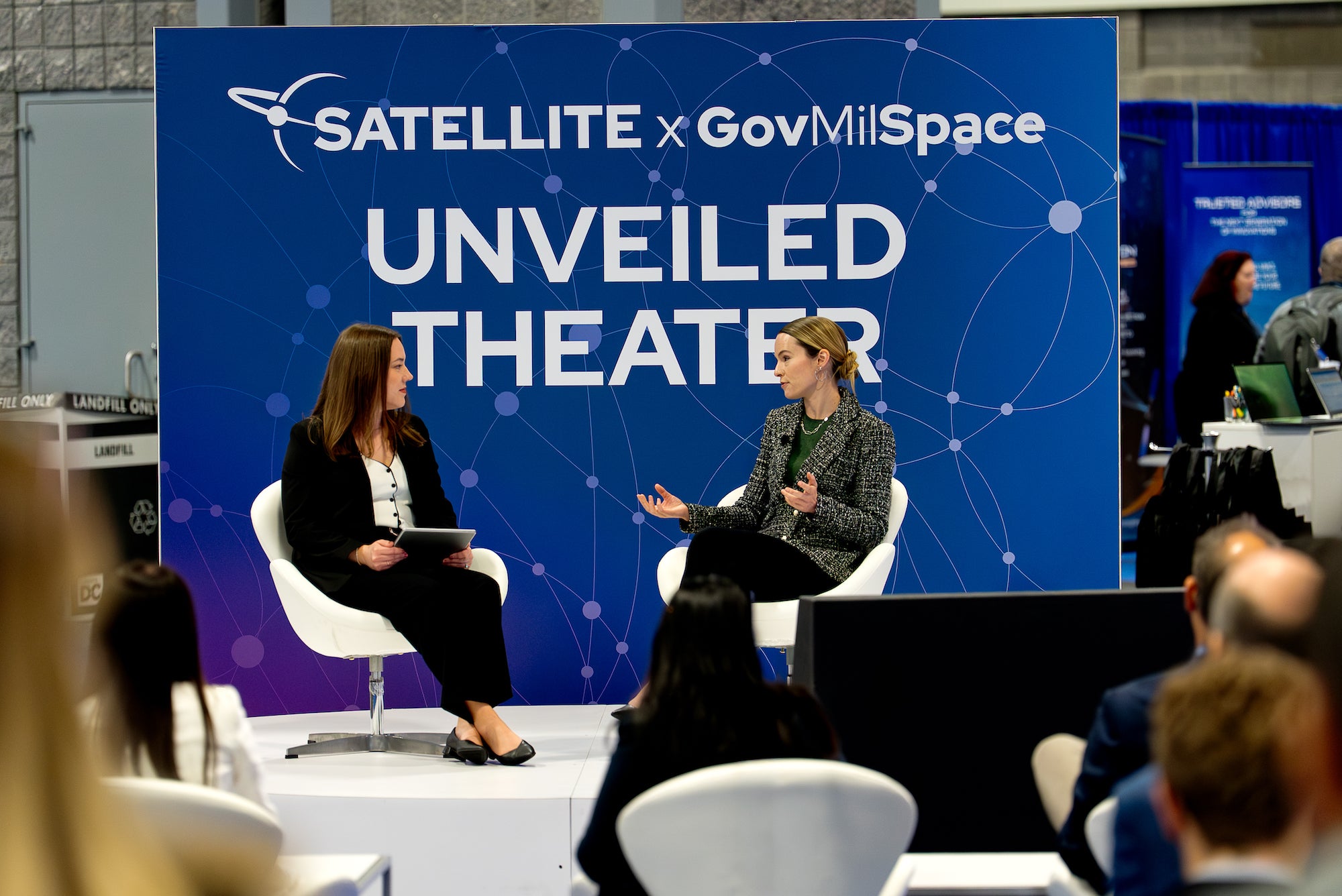
Mendler brought star power to SATShow’s closing fireside chat on Thursday, where she discussed her path from Disney actress and singer to MIT graduate and founder of Northwood Space.
Raised in an engineering household, Mendler returned to her technical roots after a career in entertainment. Northwood was born from her exposure to space through MIT, her husband and CTO Griffin Cleverly’s space tech background, and a pandemic project that made her realize “the ground needed to have its own transformation,” similar to launch and satellite manufacturing.
“We want ground to be like cloud in the sense where it is immediately available,” said Mendler, describing the need to streamline satellite resource allocation, capacity planning, and the physical infrastructure complexities of the ground segment.
“Ground is a gnarly problem,” she continued. “We want to be a partner to companies so that they can think about what does ground enable, as opposed to what are all the pain points and sticking points.”
Northwood, which raised $100 million in Series B funding in January, has already deployed operational Portal phased array units in Australia and one other continent, Medler said.
The first Portal system took three months from manufacturing to delivery to installation, Mendler said, with the first eight units produced in a four-week manufacturing sprint.
She described it as “a good starting point,” noting the Portal design criteria was for a modular system as easy to install as a refrigerator. According to earlier reports, one site was installed in 12 hours and began communicating with satellites the next day.
Northwood was recently selected by the U.S. Space Force to provide its Portal phased array system for the Satellite Control Network (SCN). The contract includes S-band links for telemetry, tracking and communication (TT&C). The company reports operating primarily in S-band and X-band from Low-Earth Orbit (LEO) to Geostationary Orbit (GEO).
Mendler announced Northwood just secured a new 180,000-square-foot manufacturing facility to support production of hundreds of antennas. To keep pace the company is taking advantage of high-volume commercially available components for rapid manufacturing and supply chain resilience, she said.
In the coming year, Mendler said Northwood’s top priority is transitioning the company into production, scale and operations to handle customer missions. The company is also working toward additional global deployments.
As ground segment deployment has taken members of Northwood’s team to far-flung locations, Mendler shared her team has started an internal ‘Northwood Naturalist Society’ Slack channel to document local wildlife across their deployment locations.
“We currently have five entities in different countries and we’ll be doing a lot of different global deployments this year,” she said. “So, looking forward to more flora and fauna around the world.”
Stay connected and get ahead with the leading source of industry intel!
Subscribe Now
Facts Only
Bridgit Mendler is the co-founder and CEO of Northwood Space.
Northwood Space is developing a rapidly deployable ground system for satellite infrastructure.
The company aims to address the increasing number of spacecraft in orbit.
Mendler has a background in entertainment (Disney actress) and engineering (MIT graduate).
Her husband, Griffin Cleverly, serves as Northwood’s CTO and has a space tech background.
Northwood raised $100 million in Series B funding in January.
The company has deployed operational Portal phased array units in Australia and one other continent.
One Portal system was installed in 12 hours and began communicating with satellites the next day.
Northwood was selected by the U.S. Space Force to provide Portal systems for the Satellite Control Network (SCN).
The contract includes S-band links for telemetry, tracking, and communication (TT&C).
Northwood operates primarily in S-band and X-band, covering LEO to GEO orbits.
The company secured a new 180,000-square-foot manufacturing facility to produce hundreds of antennas.
Northwood plans to scale production and expand global deployments in the coming year.
The company has an internal "Northwood Naturalist Society" Slack channel to document wildlife at deployment sites.
Executive Summary
Full Take
The strongest version of this narrative positions Northwood Space as a disruptive innovator in satellite ground infrastructure, addressing a critical bottleneck in the space industry. Mendler’s transition from entertainment to engineering lends a compelling personal story to the company’s mission, while the rapid deployment of Portal systems and the U.S. Space Force contract provide tangible validation. The comparison to cloud computing frames ground infrastructure as a scalable, on-demand utility, which aligns with broader trends in tech democratization. However, the narrative leans heavily on Mendler’s star power and the company’s ambitious vision without delving into potential challenges, such as regulatory hurdles, competition, or the long-term viability of modular ground systems.
Patterns detected: ARC-0024 Ambiguity (lack of detail on technical or financial risks), ARC-0043 Motte-and-Bailey (broad vision of "ground as cloud" without specifics on implementation trade-offs).
The paradigm driving this narrative is the commercialization of space, where private companies aim to solve infrastructure gaps left by traditional aerospace players. The unstated assumption is that ground infrastructure can scale as seamlessly as cloud services, ignoring the physical and geopolitical complexities of global satellite networks. Historically, this echoes the dot-com era’s overpromising on infrastructure-as-a-service, where execution often lagged behind hype.
For human agency, this could democratize satellite access but also centralize control in the hands of a few infrastructure providers. The benefits accrue to companies needing rapid, cost-effective ground solutions, while costs may fall on smaller players priced out of the market or regions with limited deployment options. Second-order consequences could include increased space debris if ground systems enable even faster satellite proliferation without corresponding orbital management.
Bridge questions: How does Northwood’s modular approach compare to existing ground infrastructure solutions in terms of cost and reliability? What geopolitical or regulatory barriers might hinder global deployment? What evidence would change your assessment of Northwood’s long-term viability?
Counterstrike scan: A coordinated influence campaign would amplify Mendler’s celebrity status to overshadow technical scrutiny, emphasize the "cloud-like" analogy to create unrealistic expectations, and downplay competitors or risks. The actual content aligns partially with this pattern—Mendler’s background is highlighted, and the vision is framed optimistically—but it does not actively suppress counterarguments or manipulate data. The narrative remains within the bounds of legitimate corporate messaging.
Sentinel — Human
The analysis indicates that the article is likely to have been written by a human journalist. The text shows variations in sentence length, a clear personal voice, and original arguments, which are signs of human authorship.