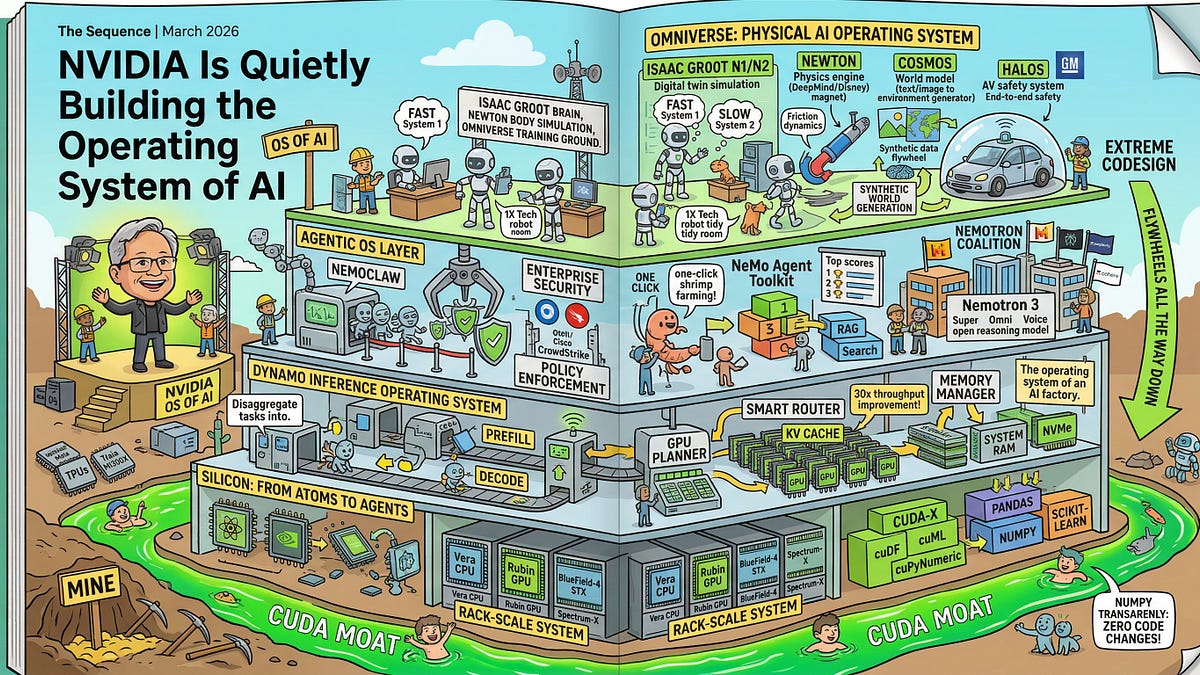
From Atoms to Agents
There’s a pattern in computing that repeats every few decades. A hardware company ships a breakthrough chip. Developers write software for it. Then the hardware company realizes the software layer is where the real lock-in lives, and starts building it themselves. Intel did it with compilers. Apple did it with iOS. NVIDIA is doing it right now with AI — except they’re doing it at a scale and speed that makes the previous examples look quaint.
At GTC 2026 last week, Jensen Huang stood on stage for two hours and barely talked about GPUs. He talked about an operating system for AI factories. He talked about agentic AI platforms. He talked about inference serving frameworks and enterprise security stacks and robot foundation models. The GPU — the thing that made NVIDIA a trillion-dollar company — was almost an afterthought. Buried under seven new chips, five rack-scale systems, and a software ecosystem so vertically integrated it makes Apple look open.
This is the thesis: NVIDIA has gone from selling the best pickaxes in the gold rush to owning the mine, the refinery, the supply chain, and the storefront. And the most underappreciated part of this transformation is the software. To see why, you have to look at what shipped across two consecutive GTCs — 2025 and 2026 — and understand how the releases fit together into a coherent platform play.
Facts Only
Jensen Huang is the CEO of NVIDIA
NVIDIA showcased an operating system for AI factories at GTC 2026
Emphasis was placed on agentic AI platforms and other software solutions
The company's strategy involves controlling the process of creating and deploying AI
This shift began two years ago with NVIDIA aiming to control various aspects of AI
Executive Summary
Full Take
By analyzing this article, we can observe that NVIDIA is evolving its business model from a hardware-focused company to one that encompasses software and services related to artificial intelligence. This transition echoes patterns seen in previous technological shifts, where companies such as Intel and Apple moved towards controlling the software layer for their respective industries. However, NVIDIA's approach appears to be more aggressive and comprehensive, aiming to control every aspect of AI from hardware to software, including the supply chain and storefront.
Patterns detected: ARC-0024 Ambiguity (the article does not explicitly state that NVIDIA will replace GPU sales with their new software-centric approach, leaving room for interpretation), ARC-0038 Vagueness (the term "AI factories" is not clearly defined).
The implications of this shift could have significant ramifications for the AI industry. If successful, NVIDIA may consolidate power and create a monopoly in the field. This could stifle competition and potentially limit innovation. On the other hand, having a single dominant player in the AI space might facilitate standardization and streamline the development of AI technologies.
Bridge Questions: How will NVIDIA's transition impact the broader AI ecosystem? What are the potential benefits and drawbacks of having one dominant player in the AI industry?