Stay Up to Date
Submit your email address to receive the latest industry and Aerospace America news.
If human settlements are one day established on Mars, what kind of roving robot could help astronauts with surface science or pinpointing deposits of valuable resources? A wheeled rover? A rotorcraft, perhaps?
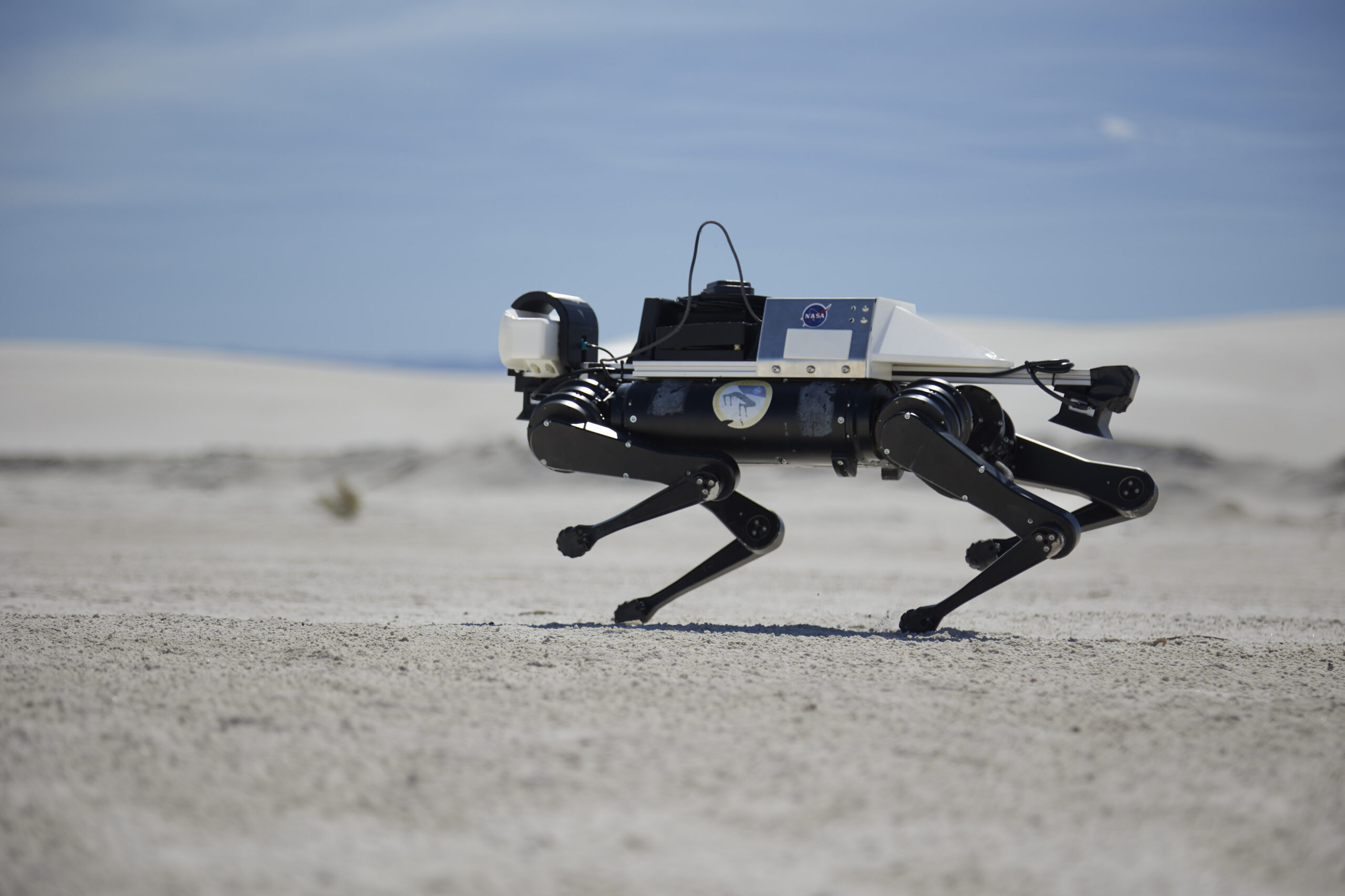
According to research presented earlier this month at the Human-Robot Interaction conference in Edinburgh, a battery-powered version of man’s best friend, a robotic dog — more formally known by roboticists as a quadruped — is emerging as the strongest contender.
The finding was among the conclusions drawn from an analog Mars mission, conducted in August by Ian Rankin and colleagues at Oregon State University, alongside scientists from the NASA Johnson Space Center and the University of Southern California, in the gypsum sand dunes of White Sands National Park in New Mexico.
“We deployed the quadruped at White Sands to learn how astronaut scientists and robots can work together to collect data, selecting White Sands as its dunes are similar to those we see on Mars,” Rankin, the lead author of the study and a researcher in human-robot collaboration in Oregon State’s Robotics Decision Making Laboratory, told me by email during the conference.
Key to this human-machine collaboration, he said, was path-planning based on input from three analog Mars mission scientists, who identified zones of interest for the robot to explore. The researchers also found that autonomous path-planning software could suggest on-the-fly modifications to the robot’s route, based on the stiffness of the particular surfaces that was detected via the robot’s leg motors.
This allowed the quadruped to help the scientists make decisions about where best to take soil condition measurements and enabled it to make similar decisions on its own. “We found our process of allowing scientists to specify goals worked, and the robot was able to take measurements that helped the scientist make further data collection decisions,” Rankin said.
But why a quadruped? This was not work that a wheeled rover, like a Spirit or Opportunity, or a rotorcraft like the Ingenuity Mars Helicopter could have done so easily, Rankin said, noting that “The main science instrument was the legged locomotion itself.”
“Since the quadruped is a direct-drive robot, it enables the [electric] current usage by its motors to be used to collect soil property measurements with every footstep, enabling science measurements to be taken by just walking.” This would be a vast departure from today’s Mars missions, “where taking a new scientific measurement requires stopping the robot and spending valuable time and resources on it.”
In other words, the quadruped itself is partly a scientific instrument: a terrain sensor that generates data at each foot fall. “We showed from our trip to White Sands that scientist astronauts and robots can work well together. The robot-scientist team can understand [analog] Martian soil properties better together than individually,” Rankin said.
But how many robots can one scientist handle? Some experts have suggested swarms of these craft could fan out across the surfaces of the moon or Mars in search of precious resources. The Korea Advanced Institute for Science and Technology, for instance, has proposed dispatching rover swarms to search for lunar water ice.
It’s not out of the question that multiple quadrupeds could be fielded on Mars, so that a lone surface scientist can explore more territory, Rankin said. “Our work did not look at controlling a large number of robots. But we do allow control of the robot to come from mission control for the prior planning of the robot’s path, so this type of tasking could potentially scale up.”
He added: “Ask me again in a couple years and I may have a different answer.”
About Paul Marks
Paul is a London journalist focused on technology, cybersecurity, aviation and spaceflight. A regular contributor to the BBC, New Scientist and The Economist, his current interests include electric aviation and innovation in new space.
Related Posts
Stay Up to Date
Submit your email address to receive the latest industry and Aerospace America news.
Facts Only
Ian Rankin led the study at Oregon State University
Conducted an analog Mars mission in August 2021
Collaborated with NASA Johnson Space Center and the University of Southern California
Used a battery-powered quadruped robot for data collection
Quadruped's direct-drive motors used to take soil condition measurements
Three scientists provided input for path-planning based on zones of interest
Autonomous software suggested route modifications based on terrain detection
Executive Summary
Full Take
The study presented at the Human-Robot Interaction conference in Edinburgh showcases a potential future application of quadruped robots in Mars exploration. By integrating robotics with human scientists, the team was able to gather data more efficiently than traditional methods. The quadruped's unique design allows it to function as both a rover and a soil condition sensor, minimizing the need for separate equipment.
However, questions remain about scalability and coordinating multiple robots in a swarm-like fashion. While the study did not explore this aspect, potential extensions could involve managing larger teams of quadrupeds to cover more ground and gather data more rapidly.
It's also important to consider the ethical implications of relying on artificial intelligence and robotic systems in human exploration missions. Ensuring that these tools augment rather than replace human decision-making is crucial for maintaining the agency and autonomy of astronauts in space.
Patterns detected: ARC-0024 Ambiguity (The study did not explore scaling up the use of multiple quadrupeds, leaving room for interpretation), ARC-0036 Future-Oriented Narrative (Emphasis on potential future applications of quadruped robots in Mars exploration).
Sentinel — Human
Based on stylometric analysis, coherence, and coordination indicators, this article is likely human-written. The author demonstrates a balanced perspective, provides personal voice, and cites specific sources.