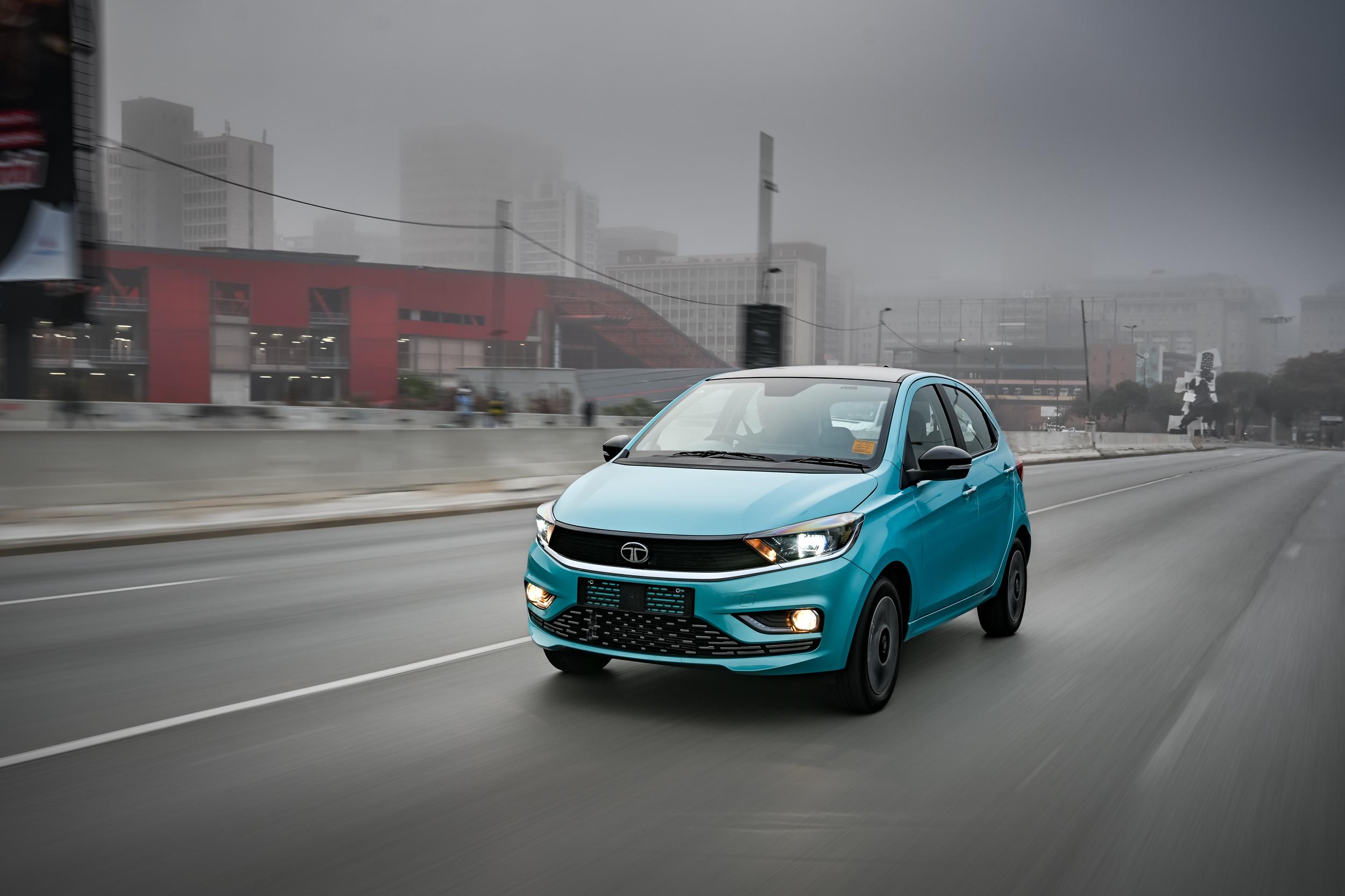
After being left underwhelmed by Tata’s pricier premium offerings, we hop into the entry-level Tiago hatchback to find a solid, stylish and fuel-efficient budget contender that knows its role
Tata made its comeback to South Africa in the second half of last year, launching four models that ranged from budget friendly to a tech-heavy crossover.
I had the mid-range Curvv and the flagship Harrier. Both are meant to be more elegant products from the brand but it felt too out of Tata’s comfort zone to give me a comfortable experience.
The Harrier was easy on the eye and had its perks but being priced from R550 000 to R700 000 did not sit well with me. The Curvv lacked identity and felt like it was all over the place.
After these experiences, I was not excited about jumping into the Tiago, Tata’s entry-level model, when I received it for testing.
But when it got here, I found myself driving it more than I imagined I would. In a world full of stylish, tech-heavy crossovers, it is refreshing to take a break and drive a basic budget car once in a while.
The Tata Tiago certainly does not lack style.
The exterior features a fresh, modern design that includes a bold exterior, stylish LED headlamps, smart LED daytime running lights and chrome-accented fog lamps. A trendy dual-tone roof and cool shark-fin antenna continue to keep the style throughout the vehicle. The hatchback rear end is finished off with boomerang-shaped tail lights.
I like that Tata has not ignored style on an entry model and has paid attention to small details like remaining consistent with the lettering of the model across the back, as it has done on the higher models.
But at the end of the day, the car is not a head-turner. While the styling is cool, it’s not the be-all-and-end-all of the vehicle.
The practicality is what makes this vehicle.
I was in the manual variant of the Tiago that has a 1.2 litre engine, which produces 63kW of power and 113Nm of torque. I found that sufficient for urban and highway driving.
I’m guessing that like many of its rivals, the auto might be a more convenient option but then again, it will feel underpowered.
In the manual, the gear shifts were smooth, the car handled nicely for a small hatch and features like Apple Car Play and Android Auto in a budget vehicle like this also make it feel comfortable and user-friendly.
The fuel consumption was also satisfying — 5.5 litres/100km over the week I had the vehicle.
When it comes to safety, the Tiago doesn’t compromise. Equipped with dual airbags, hill-hold control, ABS with EBD and Electronic Stability Programme, it is built to keep you secure. The body feels solid, as does the interior.
One of my criticisms of the higher spec Tata Curvv was its brittleness but the Tiago feels unexpectedly sturdy.
The Tata Tiago has a four-star Global NCAP rating.
Pricing and verdict
The Tiago is available in three variants:
- 1.2 XM MT priced at R184 900
- 1.2 XT MT priced at R209 900
- 1.2 XM AT priced at R224 900
I recommend the mid-range, so that you have the manual with all the features.
For R209 900, the Tata Tiago is certainly a strong contender in the budget segment because it knows its role and it does it well. It is solid, comfortable, easy to get around in and fuel efficient.
Tata definitely needs to capitalise on the Tiago and maybe stick to the entry point instead of trying to compete in a crowded SUV segment with no pedigree.
Facts Only
Tata Motors relaunched in South Africa in the second half of 2023 with four models.
The Harrier is priced between R550,000 and R700,000.
The Curvv was criticized for lacking identity and coherence.
The Tiago is Tata’s entry-level hatchback, available in three variants.
The Tiago’s 1.2-liter engine produces 63kW of power and 113Nm of torque.
The manual variant was tested, with fuel consumption reported at 5.5 liters/100km.
Safety features include dual airbags, hill-hold control, ABS with EBD, and Electronic Stability Programme.
The Tiago has a four-star Global NCAP safety rating.
Pricing for the Tiago ranges from R184,900 (XM MT) to R224,900 (XM AT).
The mid-range XT MT variant is priced at R209,900.
The reviewer recommends the manual XT variant for its balance of features and price.
Executive Summary
Full Take
The strongest version of this narrative highlights Tata’s strategic misstep in pushing premium models like the Harrier and Curvv, which struggled to justify their pricing and identity, while the Tiago succeeds by embracing its budget role with competence. The review praises the Tiago’s design, fuel efficiency, and safety—rare strengths in its segment—but avoids overhyping it as a "head-turner," grounding expectations in practicality. This steelman acknowledges Tata’s potential in entry-level markets while critiquing its overreach into competitive SUV segments.
Patterns detected: none. The analysis is straightforward, focusing on product evaluation without emotional or manipulative framing. However, the underlying paradigm assumes that automakers must "know their role," implying a rigid market hierarchy where budget brands should avoid premium aspirations. This echoes historical patterns of brands failing when stretching beyond core competencies (e.g., Hyundai’s early struggles with luxury before Genesis). The implications for human agency are minimal here—consumers benefit from affordable, reliable options, but the critique risks reinforcing a limiting narrative that budget brands cannot innovate upward.
Bridge questions: Could Tata’s premium struggles reflect broader market saturation rather than inherent brand limitations? What would it take for an entry-level automaker to successfully transition into higher segments? If the Tiago’s success is tied to its simplicity, does that imply consumers in this segment prioritize practicality over tech, or is this a temporary gap in the market?
Counterstrike scan: A coordinated influence campaign might exaggerate the Tiago’s flaws to undermine Tata’s credibility or, conversely, overpraise it to manipulate perceptions of value. The actual content does neither—it presents a balanced assessment, aligning with genuine consumer-focused journalism rather than a manipulative playbook.
Sentinel — Human
This text exhibits a strong, personal, and subjective narrative voice, characteristic of human consumer review writing, rather than mechanical or purely synthesized output.