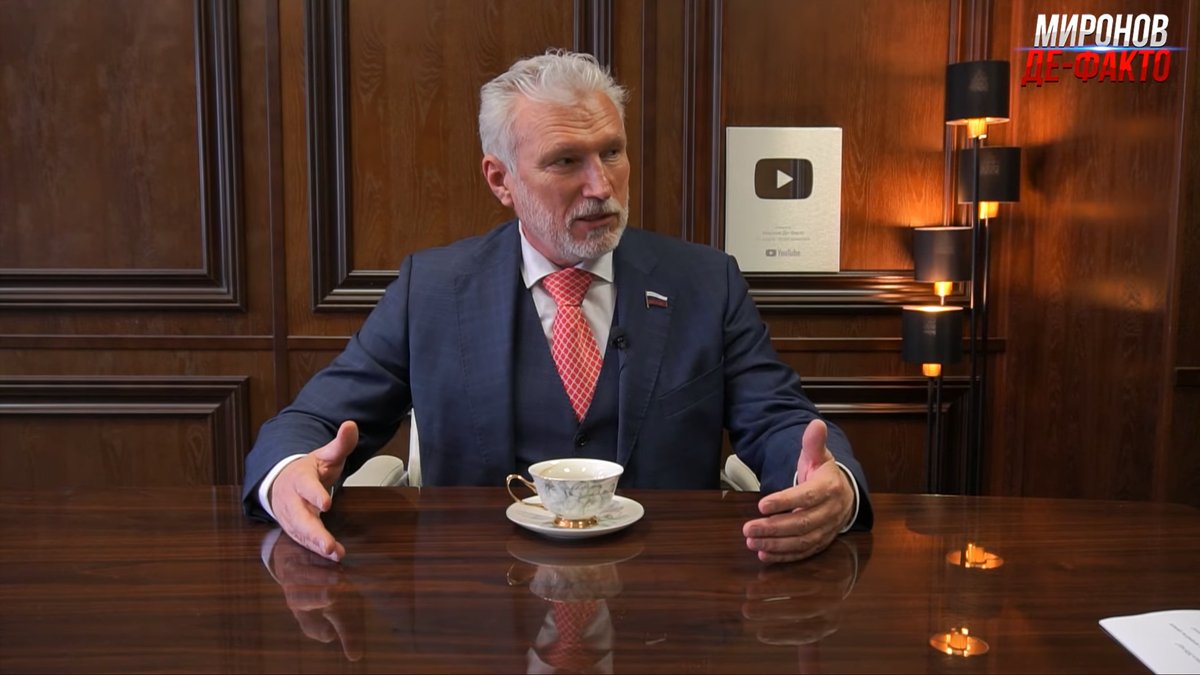
Alexei Zhuravlev, a lawmaker in the Russian State Duma, said it would be acceptable to exterminate up to half of Ukraine’s population to eradicate what he called “Nazism.”
During an interview, blogger Ivan Mironov asked Zhuravlev, “How many Nazis do you think there are in Ukraine now?” Zhuravlev then claimed the figure had once been around 2 percent but was now “perhaps 20-30%.”
JOIN US ON TELEGRAM
Follow our coverage of the war on the @Kyivpost_official.
When Mironov asked whether they should all be exterminated, Zhuravlev responded by saying “desirably.”
“All Nazis must be exterminated. All of them. You see, even if it’s 50 percent – even 50 percent – they must be exterminated... So that this plague won’t be there, so that no one will threaten us,” he said.
According to Zhuravlev, he had personally witnessed atrocities allegedly committed by Ukrainians.
“I saw with my own eyes when these bastards come and hang everyone in sight – Russian, non-Russian, regardless of your views,” he claimed.
“If this plague isn’t eradicated from there, it will remain forever,” he added.
Zhuravlev acknowledged that some Ukrainians could change their views but insisted that those who did not should be killed.
“If they don’t change their minds, they must be destroyed, of course,” he said.
When Mironov asked how to distinguish a “fascist” from a non-fascist, Zhuravlev said the presence of a weapon was the defining criterion.
“If he has a machine gun, yes, he must be destroyed. What’s there to distinguish? If you see him, kill him,” Zhuravlev said.
2 Killed, 20 Injured in Russian Morning Missile Attack on Kharkiv
He then reiterated that those unwilling to “change their minds” should either be deported or killed.
“If you don’t want to change your minds, you must either be expelled from there or destroyed,” he said.
Similar statements from Kremlin officials
Russia has long relied on the “Nazism” narrative to justify its invasion of Ukraine, going as far as listing the “denazification” of Ukraine as an official war goal.
Russian President Vladimir Putin has repeatedly invoked the Soviet Union’s victory over Nazi Germany to justify Russia’s 2022 full-scale invasion, portraying Kyiv as a Nazi state in need of “denazification” – a claim widely rejected by independent experts, Ukraine, and its Western allies.
Other senior Kremlin officials have also used the claim to deny Ukraine’s right to exist as a sovereign nation.
In January 2024, former Russian President and current deputy chairman of Russia’s Security Council, Dmitry Medvedev, denied Ukraine’s right to exist as an independent state and warned that continued resistance to Russia’s invasion would result in the destruction of the Ukrainian nation.
“The existence of Ukraine is fatally dangerous for Ukrainians... they will understand that life [with Russia] in a large common state, which they do not want very much now, is better than death. Their deaths and the deaths of their loved ones. And the sooner Ukrainians realize this, the better,” Medvedev wrote on Telegram.
Later that same month, Putin claimed that Ukraine “glorifies” Adolf Hitler’s SS units and vowed to “eradicate Nazism” while opening a memorial marking the 80th anniversary of the end of the siege of Leningrad.
“The regime in Kyiv glorifies Hitler’s accomplices, the SS,” Putin said, adding that Russia would “do everything possible to suppress and finally eradicate Nazism.”
Critics have accused the Kremlin of exploiting the legacy of WWII to justify its war against Ukraine and intensify political repression at home.
While Russia celebrates the Soviet Union’s victory over Nazi Germany as a cornerstone of its national identity, historians note that the Kremlin largely avoids discussing controversial episodes such as the 1939 Molotov-Ribbentrop Pact, which saw the USSR cooperate with Nazi Germany to carve up Poland, and the 1940 Katyn massacre of more than 20,000 Polish officers by then-Soviet leader Joseph Stalin’s secret police.
Not even Russians knew what “denazification” meant
But in May 2022, a few months after the full-scale invasion started, the Kremlin had reportedly reduced its public use of the “denazification” term as it proved ineffective in domestic propaganda.
Investigative outlet Proekt, citing Kremlin sources, reported that internal polling conducted shortly after the invasion showed many Russians neither understood nor could explain what “denazification” meant.
According to Proekt, about a week after the war began, the Kremlin commissioned confidential telephone surveys asking respondents about key propaganda messages.
Four sources – including a senior media executive, a sociologist, and political strategists close to the Kremlin – told the outlet that respondents struggled to explain the term and even had difficulty pronouncing it.
One source said the findings left Kremlin officials scrambling for a replacement narrative.
“We searched for new words every week, but couldn’t find anything suitable,” the source told Proekt.
Ultimately, the Kremlin reportedly decided to sharply reduce the use of the word “denazification” in public messaging. However, it could not abandon the term entirely because, as one source put it, “the goal stated by the president cannot simply be forgotten.”
You can also highlight the text and press Ctrl + Enter
Sentinel — Human
The article is a synthesis of highly charged political rhetoric and documented Kremlin positioning, written in a journalistic style that suggests human assembly rather than pure generative output.