May 8, 2026 | Policy Brief
Taiwan Authorizes New Defense Spending To Counter Chinese Coercion
May 8, 2026 | Policy Brief
Taiwan Authorizes New Defense Spending To Counter Chinese Coercion
Taiwan will ramp up arms purchases following the approval of new defense spending.
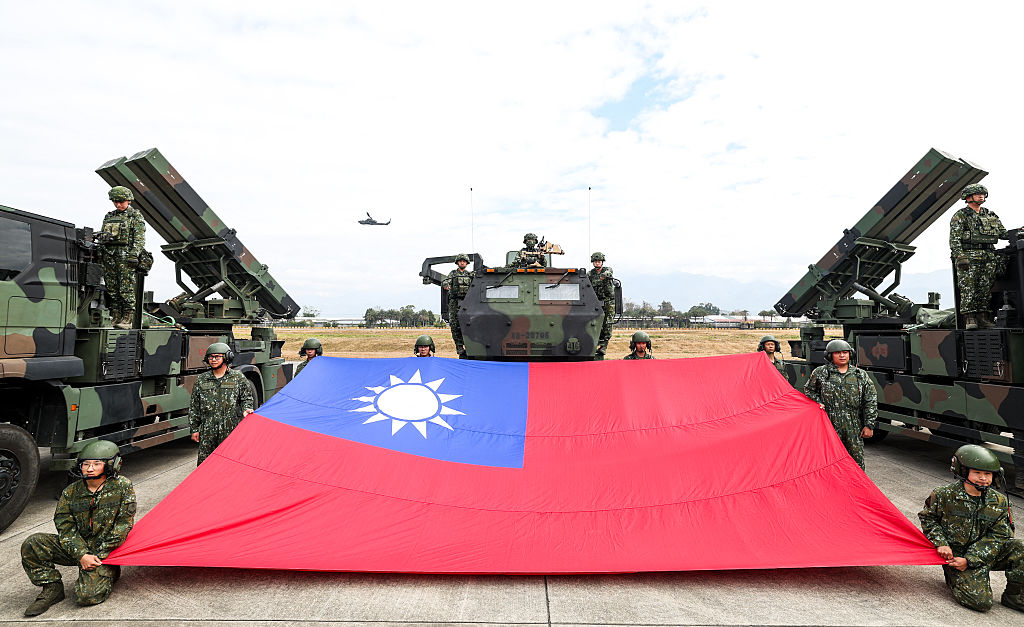
On May 8, Taiwan’s legislature passed a $25 billion supplement to the island’s annual defense budget, ending months of debate over the appropriations package. The spending bill, which will run from 2026 to 2033, was passed unanimously by the opposition after all government representatives abstained from voting due to its diminished size compared to President Lai Ching-te’s initial $40 billion proposal.
The funds are essential for purchasing critical U.S. arms, but the supplement’s size will hinder further investment in Taiwan’s indigenous defense industrial base and the island’s capacity to rapidly procure critical systems.
Defense Supplement Covers Critical U.S. Arms
The defense supplement covers both previously authorized U.S. arms sales and an arms package likely coming within the next several months. Roughly $11 billion of the budget will be used to pay for HIMARS rocket systems, Javelin anti-tank missiles, howitzers, and loitering munitions whose sale was initially announced by the Trump administration in December 2025. The remaining spending will likely be directed toward acquiring medium- and low-altitude air defense systems and replenishing the island’s stockpile of anti-armor missiles, though the State Department has reportedly stalled its approval of the package in advance of President Donald Trump’s meeting with Chinese paramount leader Xi Jinping next week.
The supplement is a significant compromise for Taiwan’s political parties, which heavily debated the need for additional spending beyond the island’s annual military budget. While lower than the ruling Democratic Progressive Party’s initial proposal of $40 billion, the budget is a significant increase over the opposition’s lower counteroffers, which largely centered on an additional $11 billion supplement coupled with further funding on a case-by-case basis tied to specific U.S. offers.
Taiwan’s Defense Spending Relies on the U.S. Industrial Base
In addition to providing critical platforms for Taiwan to counter rising Chinese coercion, the supplement ties Taipei’s further spending to the future of the U.S. defense industrial base.
Though the size of the supplement ensures that the next two major arms packages will not impact base spending, Taipei’s expenditures fail to build on previous progress toward domestic industrial production, particularly for drones and air defense systems. This issue has grown more salient as Taipei has sought to export its drone systems abroad via its non-Chinese-focused “non-red” supply chain initiative, an effort intended to place its defense industry on a more sustainable commercial footing.
As such, even as Taiwan’s base defense spending continues to rise in absolute terms, Taipei remains reliant on the U.S. Foreign Military Sales (FMS) process to acquire complex systems from Washington, meaning that any slowdown in American production has significant ripple effects for the island’s procurement process. While the Trump administration proposed dramatically raising defense spending to $1.5 trillion in the coming fiscal year, including significant increases for munitions production, the island has previously struggled to receive platforms in a timely fashion, including F-16 Block 70/72 fighter aircraft and components for its fleet of Abrams tanks.
The size of the supplement will also harm direct commercial sales between U.S. defense firms and Taiwan. While Taipei has increasingly used this method to sidestep delays inherent in the FMS process, particularly to obtain American-produced drones, the supplement will not provide additional funding for these purchases, significantly diminishing a key avenue for rapid procurement.
Taipei and Washington Should Coordinate To Assess Key Defense Priorities
The cross-party agreement on defense spending will ensure that Taipei maintains its place within American order books, a critical asset amid surging U.S. defense spending and the ongoing strain of precision-munitions shortages following the Iran war. However, the size and scope of the supplement may hamper Taiwan’s capacity to rapidly deliver capabilities to the island.
Alongside coordinating on procurement cycles to ease their respective appropriations processes, both Washington and Taipei should prioritize defense-related expenditures in future budget requests, particularly those related to cyber resilience, energy storage, and joint production of drones and other unmanned systems necessary to confront Chinese aggression.
Jack Burnham is a senior research analyst in the China Program at the Foundation for Defense of Democracies (FDD). For more analysis from Jack and FDD, please subscribe HERE. Follow FDD on X @FDD. Follow Jack on X @JackBurnham802. FDD is a Washington, DC-based, nonpartisan research institute focusing on national security and foreign policy.
Facts Only
* On May 8, 2026, Taiwan's legislature passed a $25 billion supplement to the annual defense budget.
* The spending bill covers the period from 2026 to 2033.
* Approximately $11 billion of the budget will be used for U.S. arms purchases, including HIMARS rocket systems, Javelin anti-tank missiles, howitzers, and loitering munitions.
* The remaining spending will likely focus on acquiring medium- and low-altitude air defense systems and replenishing anti-armor missile stockpiles.
* The supplement represents a compromise among political parties regarding defense spending.
* The defense spending ties further investment to the future of the U.S. defense industrial base.
* Taiwan relies on the U.S. FMS process to acquire complex systems.
* The supplement does not provide additional funding for commercial sales between U.S. defense firms and Taiwan.
Executive Summary
Full Take
Sentinel — Human
This text reads as a well-researched policy brief, structured around concrete financial details and geopolitical dependencies, indicating a high likelihood of human authorship or heavy human editing.