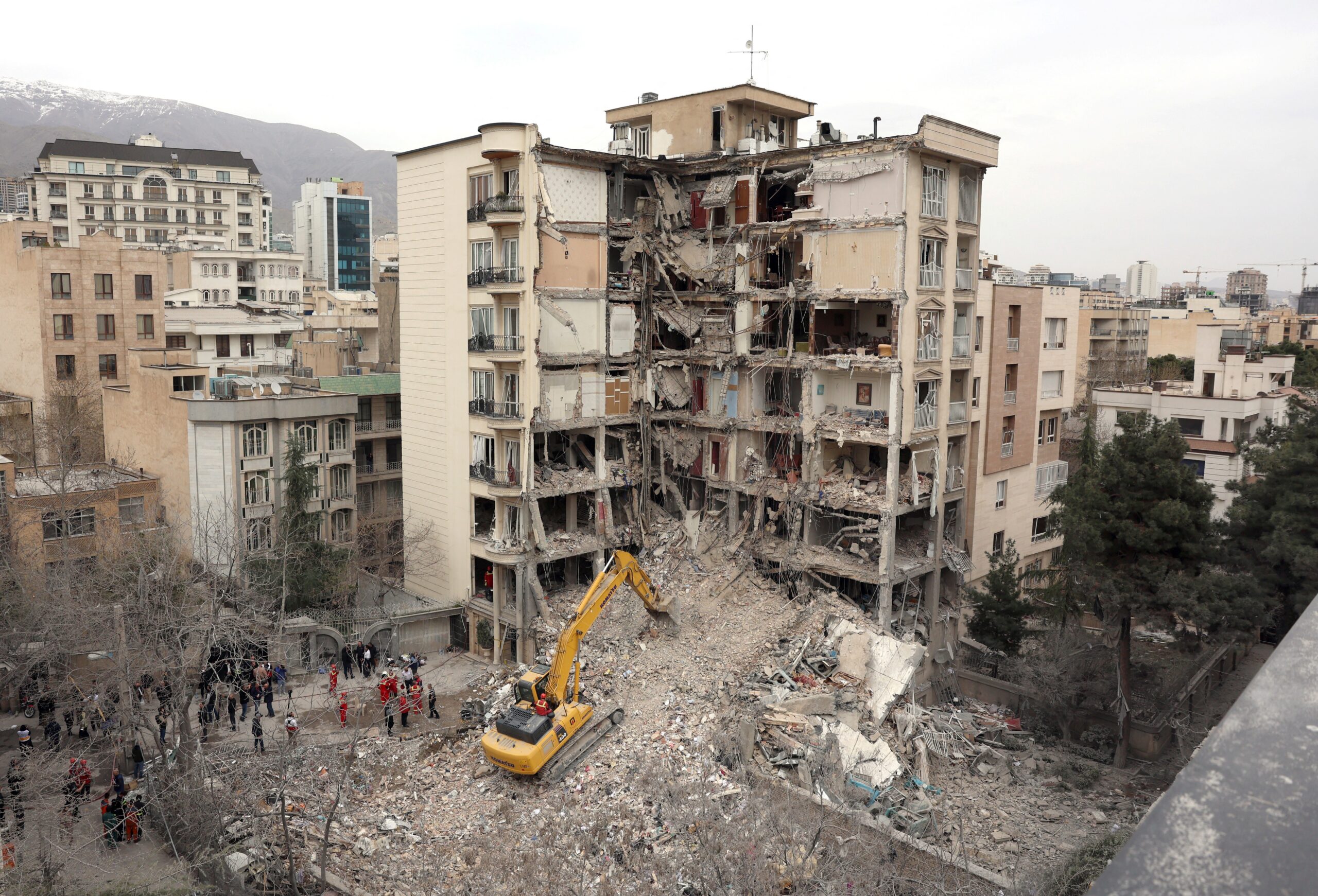
The Islamic Republic has become more radical while retaining its strike capabilities.
President Donald Trump says that Iran “is totally defeated and wants a deal.” Iran says that the fact the U.S. is “talking about negotiation now is exactly an admission of defeat,” since, at the start of the war, the U.S. demanded “unconditional surrender.”
Iran has been pounded during the month-long war. But they have not been defeated. The U.S. risks leaving Iran wounded but intact and able to restock its missiles and rebuild its civilian nuclear program.
The U.S. says it has achieved “most,” or even “all” of its “military objectives in Iran.” But Iran is still capable of firing missiles and drones. Last Friday, six ballistic missiles and 29 drones were launched at a U.S. air base in Saudi Arabia, injuring at least 15 troops. Multiple refueling aircraft were damaged, and an E-3 AWACS Sentry aircraft was obliterated.
And Iran’s forward deterrent network of partners has proven to be less degraded than the U.S. had believed. The Lebanese militant group Hezbollah has launched hundreds of waves of attacks since the war on Iran began, with over 70 percent of those using missiles Hezbollah was believed no longer to possess. Projections indicate that if Hezbollah sustains the current pace of its operations, the number of attacks would be greater than the response it had mounted in the previous round of conflict in 2024.
Other Iranian partners too have joined the fight. Iraqi militias have launched drone strikes on U.S. bases in the region. And last Saturday, the Yemeni Houthis entered the war, firing barrages of ballistic missiles at Israel.
If this network and the missile program are not removed by war, they are unlikely to be entirely removed in negotiations. The U.S. has had trouble understanding in Iran the same thing it has had trouble understanding in Russia’s war on Ukraine. Russia and Iran see their wars as existential. In an existential war, you do not negotiate away your core security concerns.
An Iran stripped of both its ballistic missiles and its network of militant group partners would be defenseless against future attacks. Tehran is not going to negotiate away the combination of those defenses.
Though the war on Iran is falling short of making things better for the United States, it could still make things worse, though Trump doesn’t seem to recognize that possibility. The president claims the U.S. has achieved regime change in Iran:
We’ve had regime change…. the one regime was decimated, destroyed. They’re all dead. The next regime is mostly dead. And the third regime, we’re dealing with different people than anybody’s dealt with before. It’s a whole different group of people. So I would consider that regime change.
It’s not. The people of Iran have not taken to the streets, the government shows no signs of significant fracturing, and the transition to a new supreme leader went smoothly with the selection of Mojtaba Khamenei, the son of Iran’s assassinated Ayatollah Ali Khamenei. Trump had insisted that he be personally involved in the selection of the new leader and specifically declared Mojtaba Khamenei unacceptable. What we see in Iran is not regime change but defiance and regime continuity.
Vali Nasr, a professor of International Affairs and Middle Eastern Studies at Johns Hopkins, says that the new leader is “a man of the regime, closely associated with its core values and institutions and his father’s legacy. He has been selected not to break with all that but to preserve it.” Mojtaba Khamenei is a hardliner who was a close adviser to his father. He studied Islamic law under some of Iran’s most hardline clerics. The war on Iran and the killing of its leader are not moving Iran down a road of change, but a road of hardening.
Other replacements of killed leaders also suggest a hardline shift in Iran that could make the future worse, not better, for the United States. Ali Larijani, the assassinated secretary of Iran’s Supreme National Security Council, favored talks with the U.S. and had the rare ability to build the sort of consensus inside Iran that could have facilitated a possible diplomatic solution to the war, according to Iran expert Trita Parsi. Eldar Mamedov, non-resident fellow at the Quincy Institute, says that Larijani was a relative moderate who was “accustomed to dealing with the West” and who “wielded significant influence” in Iran. While not a reformer, Larijani was a pragmatist who helped make the 2015 Iran nuclear deal palatable and passable in the Iranian legislature. He was an academic and politician. His successor, Mohammad Bagher Zolghadr, is a former commander of Iran’s Islamic Revolutionary Guard Corps. Zolghadr is very close to Mojtaba Khamenei and has always been aligned with the hardliners in the political establishment. His political pedigree is said to be radical.
The U.S. has not changed the Iranian regime. But it has altered it—toward a more hardline identity. And that is not the only way escalations produce unintended consequences and, potentially, make it harder for the U.S. to get out of the war on Iran.
Subscribe Today
Get daily emails in your inbox
As mentioned, escalations have already triggered the Houthi ballistic missile threat. Now Trump has threatened that if “a deal is not shortly reached” the U.S. will respond by “blowing up and completely obliterating… Kharg Island.” But the Houthis and Iran have already warned that if the U.S. launches a ground attack or attempts to take or block Kharg Island, the Houthis could close the Bab el-Mandeb Strait, further choking the global supply of oil.
If Trump green lights Pentagon plans for a potential limited ground invasion involving special operations forces, Marines, and soldiers, the U.S. could find itself caught in a quagmire in Iran. The U.S. has sent around 10,000 additional troops to the region. Iran says it is ready and will “set them ablaze.” Reports claim that Iran has mobilized over a million fighters to face any American ground invasion. Leaders in Tehran believe that, while the U.S. has air dominance, Iran has ground dominance and drawing the Americans into a ground war could draw Washington into precisely the war that Trump has promised to avoid.
The U.S. has, so far, failed to achieve its goals in Iran. Iran retains civilian nuclear enrichment knowledge. Far from regime change, the regime continues, and looks to be evolving to become still more hardline. It retains the capacity to hit targets with its missiles and to effectively mobilize its network of forward deterrence partners. Trump continues to claim the U.S. is negotiating while simultaneously escalating his war threats. Negotiations may offer the only way out. Escalation may lead the U.S. only deeper into the quagmire of a costly war that will set its military and political objectives back even further.
Facts Only
President Trump claims U.S. has achieved regime change in Iran, but this is not accurate as the Iranian government remains intact and shows no signs of significant fracturing.
The U.S. has pounded Iran during the month-long war, but Iran has still been able to fire missiles and drones. Six ballistic missiles and 29 drones were launched at a U.S. air base in Saudi Arabia last Friday, causing injuries and damage.
The Lebanese militant group Hezbollah has launched hundreds of waves of attacks since the war on Iran began, with over 70% using missiles believed no longer to be in their possession.
Iraqi militias have launched drone strikes on U.S. bases in the region, and the Yemeni Houthis entered the war by firing ballistic missiles at Israel last Saturday.
The new Iranian Supreme Leader, Mojtaba Khamenei, is a hardliner who was a close adviser to his father and studied Islamic law under some of Iran's most hardline clerics. His selection indicates a shift toward a more hardline identity in Iran.
Executive Summary
Full Take
The article presents a complex picture of the ongoing conflict between the U.S. and Iran, highlighting the resilience of Iranian forces and concerns about the potential for a quagmire for the U.S. The escalation of military actions by both sides raises questions about the effectiveness of this approach in achieving U.S. goals. Additionally, the continuity of the Iranian regime following the assassination of one of its leaders suggests that the U.S.'s objectives may be further out of reach than initially thought.
Patterns detected: ARC-0043 Motte-and-Bailey (Trump's claims of achieving regime change while simultaneously escalating war threats), ARC-0024 Ambiguity (the unclear definition of "regime change" and the continuing presence of the Iranian government).
The article does not provide a comprehensive analysis of the root causes driving this conflict or its implications for human agency and dignity. It also does not raise any bridge questions to invite independent inquiry. However, it does present a balanced narrative that acknowledges multiple perspectives and raises concerns about the potential for an unintended escalation of the conflict.
Sentinel — Human
The text exhibits signs of human authorship, with variable sentence length, personal voice, and the absence of mechanical argumentative structures. However, it is important to remember that machine-generated content can also exhibit these traits in certain contexts.