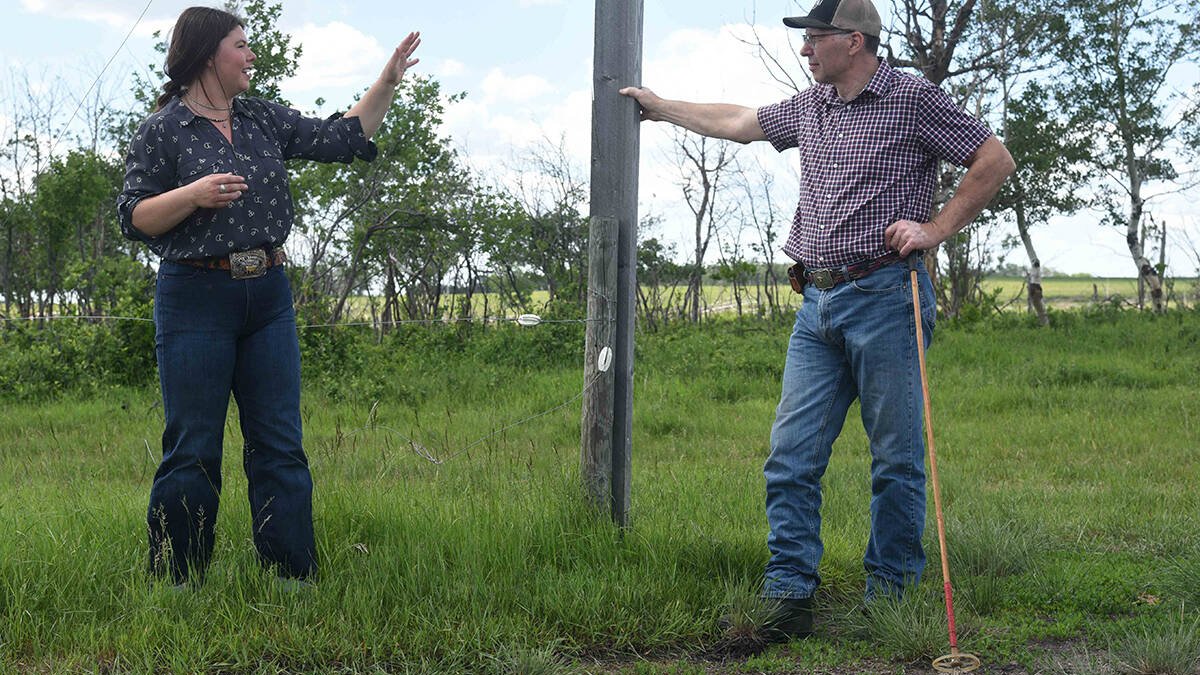
Owners of a fourth-generation ranch in Saskatchewan say they are guided by principles that are rooted in the grass
5 hours ago
7 min read
ROSTHERN, Sask. — Barry Lehmann shakes his head as he wonders why he calved in February for so many years.
When he and his family shifted calving to May and June, they discovered a better way to work with nature.
“We’re calving in sync with nature. You couldn’t pay me enough to go back to calving in February,” he said, as he stood between the house and barn at the four-generation homestead.
Lehmann and his daughter Morgan’s home quarter was the second of two stops for the June 15 Guardians of the Grasslands Tour.
The Saskatchewan Cattle Association hosted the day-long event, which involved a bus load of producers, industry representatives and forage specialists.
It was designed to highlight the role of beef farmers and ranchers as modern pastoralists and long-term stewards of Saskatchewan’s grazing landscapes.
It coincided with the United Nations declaration of 2026 as the International Year of Rangelands and Pastoralists.
“This event highlighted the importance of Saskatchewan’s grasslands and the role of ranchers as modern-day pastoralists. Participants explored how well-managed grazing lands support healthy ecosystems and species at risk, while gaining a firsthand appreciation for the passion ranchers have for caring for their land and livestock and for passing it on to the next generation,” said Jenna Sarich, technical consultant for Public and Stakeholder Engagement, a division of the Canadian Cattle Association.
Lehmann said it’s necessary to challenge convention, which has become a defining characteristic of their operation, SaskValley Shorthorns and Circle L Ranch near Rosthern.
The cow-calf operation runs commercial and purebred Shorthorn cattle, backgrounds its calves and grasses its yearling heifers.
Four generations of the Lehmann family built a cattle operation grounded in stewardship, innovation and long-term thinking.
Lehmann said their success is measured by more than pounds of beef or market prices.
“As a farmer, we have to pass this land on to the next generation in as good or better condition than we received it,” he said.
“The second thing is the well-being of people and livestock. The third thing is we have to be profitable. It’s a business.”
Those principles guide every decision on the ranch, from grazing management and pasture rejuvenation to winter feeding strategies and succession planning.
The family story stretches back nearly 140 years.
“My great-grandfather emigrated from Germany in 1888 and he homesteaded three miles north of the town,” said Barry.
“He bought this land in 1915.”
Today, Lehmann and his brothers operate the ranch alongside a new generation that is preparing to take over. Among them is daughter Morgan, a graduate student at the University of Saskatchewan, whose passion for cattle and grasslands is helping shape the ranch’s future.
The move away from February calving marked an important turning point for the operation around 2000.
“When I was a kid, Dad had probably 70 cows or so, and we calved in February, normally, because that’s just what everybody did,” said Morgan.
As the herd expanded, the family faced a choice of rebuilding facilities or calving at a different time of year.
The decision transformed their operation.
“Labour is the number one thing,” said Barry. “The fact that I don’t like getting up at two o’clock in the morning and checking if calves have been born in 30-below weather or not, that’s a big one.”
Looking back, he understands that tradition often kept producers like him tied to practices that no longer made sense.
“It’s partly a case of human nature. This is the way we’ve always done things, so we’re just going to continue doing them that way,” he said
It’s the same willingness to rethink old assumptions that shapes the family’s approach to grazing.
Much of the ranch consists of tame pasture, and the family also helps manage community pasture land near the South Saskatchewan River.
Father and daughter said they are constantly experimenting with ways to improve forage production while protecting soil health.
“You’re looking at somebody who is always interested in learning. I do all kinds of what I call farmer experiments,” said Barry.
One of those experiments involved investing in a sod-seeding drill to rejuvenate aging pastures with minimal soil disturbance.
“We’ve only been trying it for a few years,” said Barry.
“A few things haven’t worked, and a few things hopefully are working.”
“Eventually we’re going to figure out how to rejuvenate our pastures without disking them up and seeding directly into the sod.… it’s a good thing for the land if you can get a better stand of grass without cultivating.”
Perennial legumes such as alfalfa and cicer milkvetch play a key role.
“Legumes have the ability to literally grab nitrogen (nitrogen fixation) out of the air, funnel it through the plant and into the ground,” said Barry.
“The grasses then get the benefit of having nitrogen available for them.”
The family is also increasing grazing intensity while extending rest periods.
“More animals on a smaller piece of land for a shorter duration is so much better for your grass management,” said Morgan.
“It encourages rejuvenation and promotes longer rest.”
Added Barry: “We will probably leave the cows on anywhere from one to two weeks, depending on the size, the number of cows, the stand of the grass. There are all kinds of variable factors that come into play…. I would absolutely love if we could take a big patch and not touch it for a year.
“I think that would be good for the root system. The general rule of thumb is the more plant material above ground, the better your root system. I think it’s good for the plants if you were able to let it rest for one year.”
Their focus on efficiency extends into winter feeding. Twelve years ago, the ranch began using standing corn as a winter feed source.
“Years ago, we used to bale about 3,000 round bales. Now we bale about 300,” he said.
Instead of hauling feed daily, cattle graze standing corn behind temporary electric fences.
“In an hour and a half, we’ve got our herd fed for three or four days,” he said.
“The amount of labour, the amount of fuel, the amount of wear and tear on equipment has gone down drastically.”
The approach supports both profitability and stewardship.
“Regardless of your profitability, you have to maintain your land, your grasses, your infrastructure,” said Barry.
“If we were to abuse our grass and overgraze it, when the time came, we wouldn’t have the ability to carry the number of cows that this place could carry.”
That long-term mindset also shapes how the family views variations in cattle markets.
“You want to be profitable long term. You have to take a long-term approach in all aspects of ranching, not only just the financial side, but the grass side, the cattle side, everything.”
Morgan has adopted the same outlook through graduate research that examines how extreme weather affects cow-calf operations.
“After I’ve done my master’s, my plan is to come back to the farm and farm full time,” she says.
“I’m very, very excited to come back.”
For Barry, that commitment represents the ultimate measure of success.
“I’m looking forward to the day when I can retire and turn this place over to somebody a lot smarter than me,” he said with a smile.