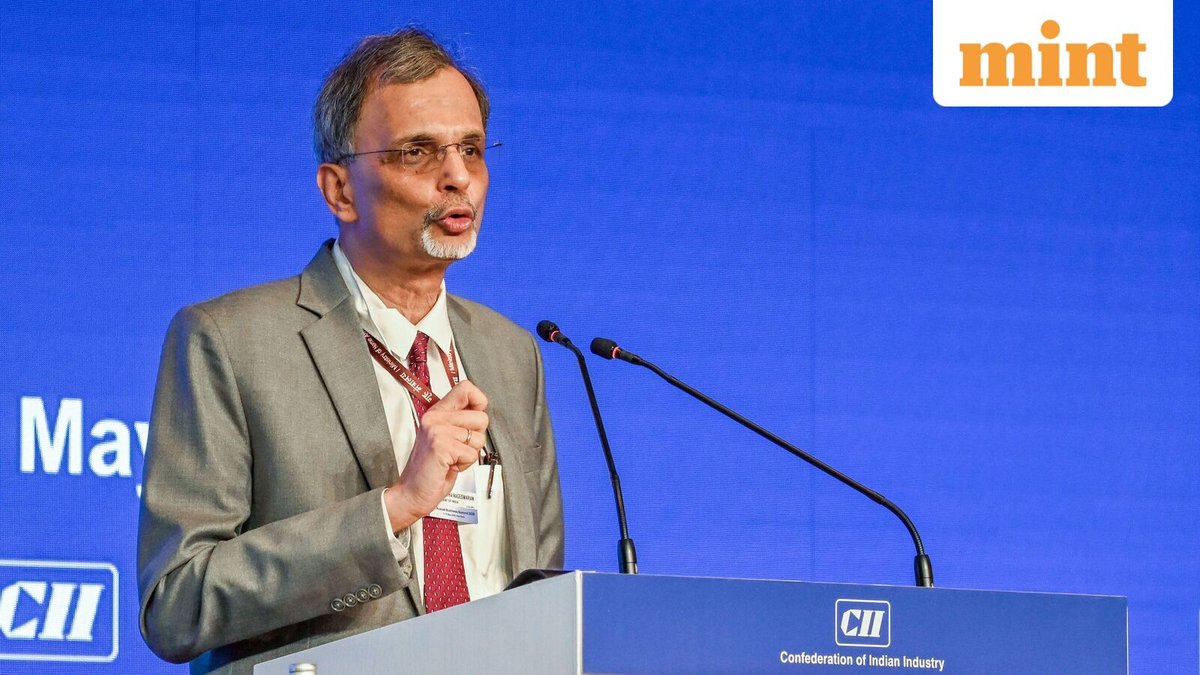
Data centres and artificial intelligence “raises the value of each person who works there” rather than replacing jobs, believes V Anantha Nageswaran, Chief Economic Advisor (CEA) to the Indian government, ANI reported today. The view comes amid concerns over the growth of AI global capability centres (GCC) in India.
Speaking at the GCC Business Summit hosted by the Confederation of Indian Industry (CII) on 9 July he said that AI requires human oversight and thus AI should be treated as a tool and not as “fate”.
Nageswaran further noted that while cheap automation could take over routine, repetitive, and rule-bound tasks, well-run centers will the tech to enhance human roles. “Artificial intelligence requires human oversight to design, train, test, and govern the systems. AI does not therefore empty these centers. In the centers that are run well, the AI raises the value of each person who works there. So the risk is there, but that is not destiny. The centers that stand still will suffer. The centers that move up will thrive,” he stated.
Further, Nageswaran feels that how countries adopt and apply AI will have significant impact on the future. “A country that treats a powerful technology as fate will end up being shaped by it. A country that treats AI as a tool will shape it instead. India must be in the second group,” he added.
The economist added that India hosts around 50% of the world's GCCs — more than 2,000 centres employing 20 lakh employees, and sector revenue above $60 billion, which contributes close to 2% to the GDP, as per the report. Nageswaran further said that more than 1,200 of these centres perform advance AI work and machine learning (ML), which establishes the country as the second largest enterprise AI talent base globally.
“Global firms first came to India for cost. They stayed for capability. That's an important difference. A cost advantage can be copied by the next low-cost country. A capability advantage is harder to build and harder to lose as well,” he stated.
Nageswaran further added that global banks run trading platforms in Mumbai and Bengaluru, car makers design embedded systems in Chennai and Pune, and semiconductor firms conduct chip design locally. He also pointed to German firm Merck's new campus in Bangalore, which holds the company's largest concentration of digital capability worldwide, making India its fourth largest workforce hub.
“Success can breed complacency. The advantage we hold today was built over time, but it can also erode. Other countries are watching us and copying us. Our costs are rising. In some skills, our talent is already scarce,” he warned.
The CEA noted that "what began as support became engineering and what began as engineering became product and what began as a back office became in many firms the place where global decisions are now made."
“The benefit has flowed both ways. Global firms got world class work done at a fair price and Indian professionals got careers they could not have imagined one generation earlier. GCC roles today often pay much more than traditional services jobs. Our goal should never be to make our people work like machines. Our goal should be to use machines so that our people are freed to do more of what only people can do, to reason, to decide, to take responsibility, and to exercise wisdom,” Nageswaran concluded.
(With inputs from ANI)
Jocelyn Fernandes is a journalist and editor with nearly 13 years of experience covering the business, corporate, economy and markets beats in news.<br> As chief content producer for around three years at Livemint (Hindustan Times), Jocelyn publishes breaking stories, explainers, features and live blogs on a range of business and economy topics, including the Budget, corporate developments, stock markets, income tax, money and personal finance, cryptocurrency, government policy, impact of US tariffs, international developments and more.<br> Jocelyn's writing philosophy is focused on delivering news in an accurate and accessible format for readers. She thus focuses her news coverage on explainers and FAQs in order to breakdown business, corporate, economic, and policy topics that are of importance to everyday readers.<br> She holds a Bachelors in Mass Media (BMM) and Post Graduate Diploma (PGD) in Journalism and Communication and has previously written for online business and markets news site Moneycontrol (Network18), Business-to-business (B2B) trade publications — the industry magazines Power Today and Solar Today (ASAPP Media), and the national news agency United News of India (UNI).<br> Outside of work, Jocelyn keeps up-to-date with local and international news, enjoys reading fiction books, novels and short stories, and enjoys movies, travelling and art. <br> She can be found on X and LinkedIn, and reached by email: <a href="jocelyn.fernandes@htdigital.in">jocelyn.fernandes@htdigital.in</a> <br> X/ Twitter handle: <a href="https://x.com/scribeJocelyn">@scribeJocelyn</a> <br> LinkedIn: <a href="https://in.linkedin.com/in/jocelyn-fernandes-journalist">LinkedIn</a>
Catch all the Business News, Market News, Breaking News Events and Latest News Updates on Live Mint. Download The Mint News App to get Daily Market Updates.
Oops! Looks like you have exceeded the limit to bookmark the image. Remove some to bookmark this image.
Sentinel — Human
This text appears to be well-sourced, nuanced reporting on an economic commentary, exhibiting the characteristic structure and expert voice of established journalism rather than synthetic generation.