The 28th Edition of the Cartier Prize for Watchmaking Talents of Tomorrow
Video report of Cartier's initiative to support future young talents, rewarding both technical and creative ingenuity.
Several initiatives exist to promote the development and future of watchmaking, as well as to discover and support the talents of tomorrow. This is crucial to nurture the next generation of watchmakers and protect the art we love and share here on MONOCHROME. Among these initiatives is one that is particularly inspiring, the Cartier Prize for Watchmaking Talents of Tomorrow. A discreet one, even though it has existed since 1995, it invites young watchmakers to transform a movement around a defined theme, rewarding both technical and creative ingenuity. On 24 June 2026, we attended the Cartier Prize for Watchmaking Talents of Tomorrow ceremony.
The Cartier Prize for Watchmaking Talents of Tomorrow
Launched in 1995, the Prize embodies Cartier’s commitment to preserving centuries-old savoir-faire while fostering creativity and innovation among the next generation. This year, eleven young watchmaking apprentices and technicians from France, Switzerland and Belgium were invited to express their creativity around a fixed theme, as entrants were asked to create a piece based on the motion of a pendulum, on the theme “Shifting the balance: Reading and understanding time differently”, or how to move beyond our traditional approach to understanding time.
This creative vision lies at the heart of Cartier’s watchmaking world, as evidenced by the mystery clocks, the Révélation d’une Panthère watch, the Santos Dumont Rewind and the Tank à Guichets. This brief is quite different from what often happens and is in line with Cartier’s approach to watchmaking. Starting with an idea, an inspiration, and not with technicalities. While in the watch world, the starting point is often to make the next rattrapante or tourbillon… that was not the starting point here! Although the timepiece created by one of the winners even features a double rattrapante (which you cannot even see, as it’s discreetly hidden).
The 11 finalists were given eighty hours over three months and a CHF 500 budget to turn their vision into reality, and they were allowed to find a mentor for support. Participants had to base their creation on a Cartier desk clock movement.
As explained by Kari Voutilainen, a member of the 2026 jury, with whom we spoke in our video, the level of creativity and execution across the board was impressive! All the more considering that most entrants are students and during the same period, they also have classes and exams.
Apprentice Watchmakers Prize: Aymeric Peters
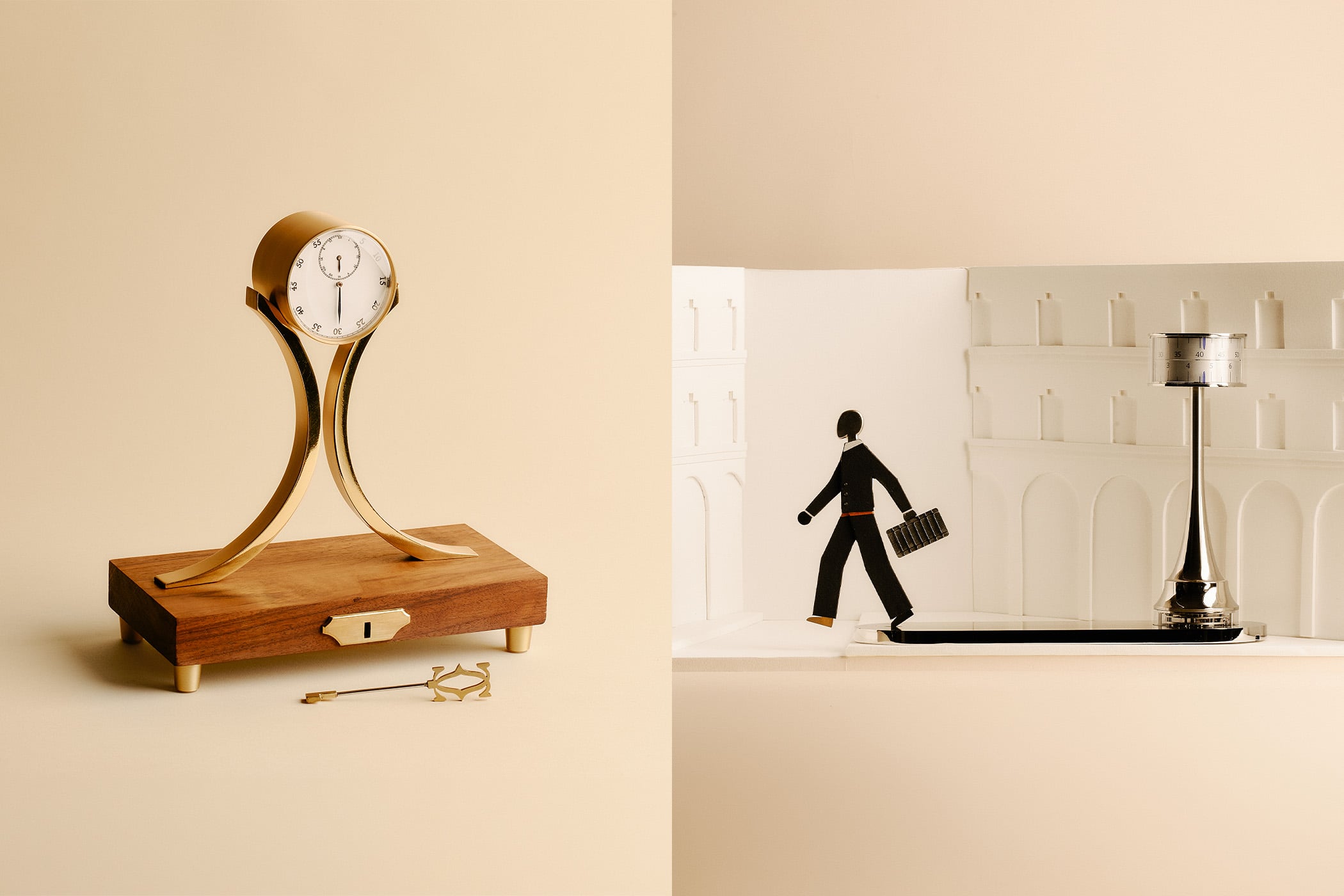
The first prize, which covers the Apprentice Watchmakers category, was awarded to Aymeric Peters from IATA, in Namur, Belgium, for Silence Choisi (Chosen Silence), a clock that suspends time and only shows it on demand. Inspired by clocks from the late 19th and early 20th centuries, made from a combination of wood and brass. Interestingly, this clock features not one but two rattrapante mechanisms to switch from the ‘suspended time’ to indicating the actual time, after the key at the clock’s foot is turned.
The hour and minute hands, placed in a regulator layout, are both pointing downwards, and when the key is inserted and turned, the hands jump into their correct position to indicate the time. The base Cartier movement is running to control the timekeeping part, while the display module allows for the hand to freeze back when not needed.
Technicians Prize: Arthur Choquet
The other winner, who was part of the Technicians category, is Arthur Choquet, from the Lycée Jean Jaurès in Rennes, France, who won first prize with his creation Un Instant (A Moment), a clock that invites us to measure time during a suspended moment. As explained by Arthur, there were three inspirations behind his clock. First was the origin of the Cartier Maison, with its Parisian roots and its architecture, as well as the Art Nouveau lights of its street. Second was the famous photograher Henri Cartier-Bresson. And finally was the duality between the character that is stopped in time and the continuous motion of the time displayed by the clock shaped like a traditional Parisian street lamp.
Note that applications for the 29th edition of the Prize will open next autumn. For more details about the Cartier Prize for Watchmaking Talents of Tomorrow, please visit prixcartiertalentshorlogersdedemain.com.
Facts Only
* The event was the Cartier Prize for Watchmaking Talents of Tomorrow.
* The prize was launched in 1995.
* Eleven young watchmaking apprentices and technicians from France, Switzerland, and Belgium were invited to participate.
* Entrants were asked to create a piece based on the motion of a pendulum around the theme “Shifting the balance: Reading and understanding time differently.”
* Finalists had eighty hours and a CHF 500 budget to execute their vision and find a mentor.
* Participants were required to base their creation on a Cartier desk clock movement.
* Aymeric Peters won the Apprentice Watchmakers Prize with Silence Choisi.
* Arthur Choquet won the Technicians Prize with Un Instant.
* Peters’ creation featured two rattrapante mechanisms to switch between suspended time and actual time.
* Choquet’s inspiration included the origin of the Cartier Maison, Henri Cartier-Bresson, and the duality of stopped time and continuous motion.
Executive Summary
Full Take
The narrative positions watchmaking genius as a dichotomy between technical execution and creative vision. The prize rewards the transformation of a physical mechanism (the pendulum) into an abstract philosophical concept ("Shifting the balance"), suggesting that true mastery lies not merely in mechanical precision but in conceptual understanding. This framing implicitly prioritizes artistic, conceptual thinking over traditional, purely technical skills by explicitly stating that starting with an idea and inspiration is more valuable than focusing solely on mechanisms like rattrapantes or tourbillons.
This emphasis creates a subtle hierarchy: the creative interpretation (the resulting art) supersedes the pure mechanical know-how, even when the final product must necessarily be built upon a recognized Cartier movement. The winners’ success relies not just on their ability to execute complex mechanics but on successfully weaving personal historical and artistic narratives—linking time measurement to Parisian architectural roots or photographic philosophy—into the physical object.
The core implication is that value in high-end craft production is shifting from internal technical refinement toward external contextual meaning. This pattern suggests an attempt to rebrand traditional technical skill as a mere foundation upon which high-level, abstract creative genius is built, potentially serving to elevate the perceived status of artistic direction over pure engineering capability. The question for observers is whether this transition genuinely fosters broader technical development or merely repackages mechanical achievement within a more palatable aesthetic framework.
Sentinel — Human
This text exhibits high human journalistic quality with specific details and sourced quotes, suggesting it is original reporting rather than synthetic generation.