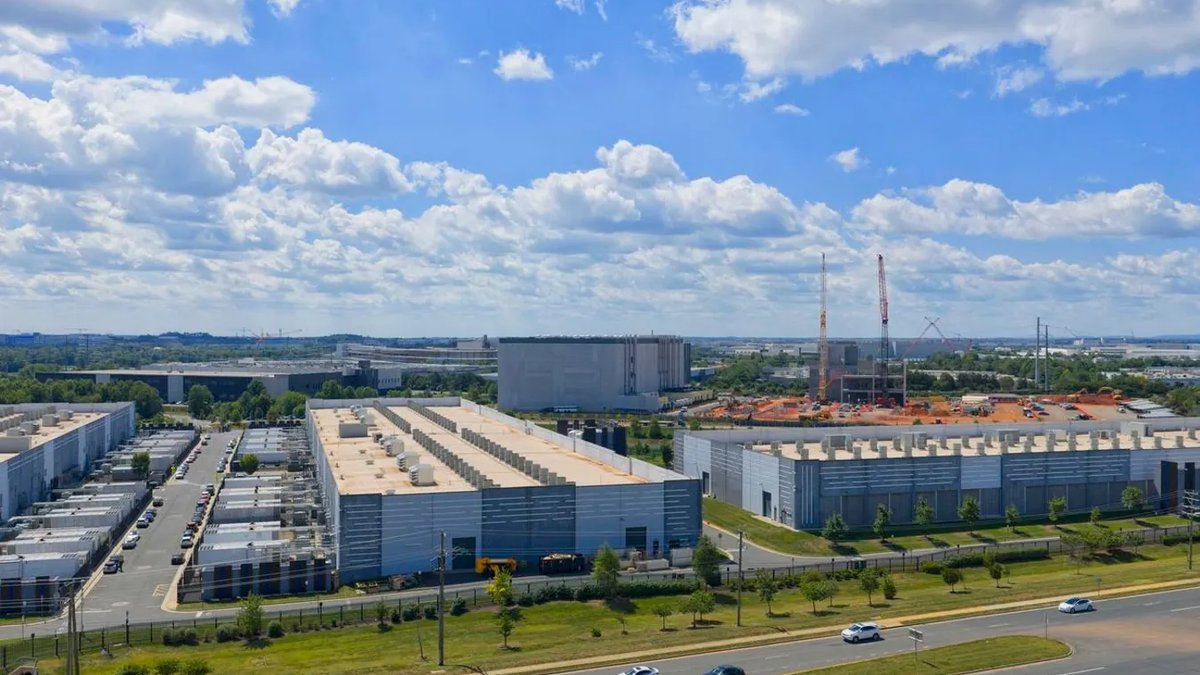
If you've driven past a big windowless building, you've probably seen a data center. Chances are you're relying on one right now, without giving it a thought.
For most of the internet era, these buildings stayed out of sight. However, now data centers suddenly seem to be everywhere. The short answer as to why is scale: a surge in AI and cloud demand has made them one of the most talked-about and fought-over pieces of modern infrastructure.
What Is A Data Center?
A data center is a purpose-built building that runs large numbers of computers reliably, securely and around the clock. Inside are the servers, storage and networking gear that do the work, plus the heavy-duty cooling, backup power and physical security that keep them running.
One can be as small as a server room or as large as a windowless campus the size of several stadiums, wrapped in cooling, batteries, generators and high-capacity links to the internet and the grid. Software runs the show, spreading out the workload, flagging failures and handling security.
None of this is new; companies have run them for decades to keep websites, email and business software online. What's changed is the size and the job: early sites mostly stored files, while many of today's biggest are built to train and run AI, and those workloads need far more power and specialized hardware than ordinary websites once did.
What Are Data Centers Doing?
Data centers store data and run the software behind the services people use all day. Stream a show, send an email, tap a card at checkout, back up a photo or ask an AI a question, and somewhere a data center does the work and sends it back almost instantly.
The core jobs are storing data, processing it and moving it across networks. They host the cloud platforms companies rent instead of running their own servers, and they stream video, clear payments, keep business systems online and now train and run AI models. They also handle quieter work, from corporate databases to the cybersecurity systems that guard them. As AI has grown, much of the new capacity goes to the specialized chips it depends on.
The Most Common Types Of Data Centers
There's no single kind of data center. Most fall into a handful of categories that differ by who owns them, who uses them and how big they get: enterprise, colocation, hyperscale, cloud and edge. Hyperscale sites, especially the ones built for cloud and AI, are behind much of today's building spree.
In practice the lines blur, since one company often uses several at once, but these labels cover the main models.
Enterprise Data Centers
An enterprise data center is built, owned and run by a single organization for its own use. Banks, hospitals and government agencies often keep their own so sensitive systems and data stay under their direct control, usually on their own property.
These are usually smaller than commercial mega-campuses and sized to one company's needs. The catch is cost: you're paying for all the space, power and staff yourself, which is why many now rent cloud or colocation space instead.
Colocation Data Centers
A colocation data center rents space, power and cooling to many customers, who bring their own servers. Think of it as the commercial real estate of computing: the operator supplies the building, power, cooling and network access, and tenants own the gear inside.
It's a good fit for companies that want professional-grade facilities without building one, and these sites cluster in major connectivity hubs. The biggest colocation operators are specialized real estate firms: Equinix operates more than 270 data centers globally, while Digital Realty lists more than 300.
Hyperscale Data Centers
Hyperscale data centers are the giants: enormous campuses run by a handful of tech companies to deliver cloud and AI at massive scale. The “big three” are Amazon Web Services, Microsoft Azure, and Google Cloud, and a single site can cover millions of square feet.
These are the ones driving today's building boom, and they carry some of the biggest power demands of any type. Operators chase cheap electricity, cooler weather, tax breaks and fiber, which is why so many cluster in places like Northern Virginia. Because each company runs its own campuses, hyperscalers can standardize their hardware and squeeze out efficiencies smaller operators can't match.
Cloud Data Centers
A cloud data center delivers computing as an on-demand service. Instead of owning hardware, customers rent servers, storage and software over the internet and pay only for what they use.
Cloud and hyperscale overlap a lot, but they aren't the same idea: cloud is the service model, while hyperscale describes the size and operating style of the building. Cloud is where many businesses now run much of their software, since it lets a startup or a Fortune 500 scale computing more quickly than building it themselves.
Edge Data Centers
Edge data centers are small sites placed close to users to cut delay. Instead of routing every request to a faraway mega-campus, they handle time-sensitive work nearby, which matters for video, gaming, live streaming and connected devices.
They're often no bigger than a shipping container, and telecom carriers and cloud providers keep rolling them out as more apps need instant responses. Edge sites don't replace hyperscale campuses; they handle the last mile while the big facilities do the heavy lifting.
Why Are So Many New Data Centers Being Built?
Many data centers are going up because demand for computing is climbing on every front, and AI has poured on fuel. Cloud adoption, streaming, digital payments, remote work, business software and cybersecurity were all growing steadily before generative AI added a fresh wave of demand.
For years, operators clustered near cheap power, cooler weather and fiber hubs like Northern Virginia. Now they’re pushing into Texas, the Midwest, and rural areas with land and electricity to spare. Paying for it are the hyperscalers, cloud and colocation developers, plus infrastructure investors, private equity firms and power developers.
By one widely reported estimate, Amazon, Microsoft, Google and Meta are projected to spend more than $700 billion on AI infrastructure in 2026, up sharply from about $410 billion the year before. The building can go up in a couple of years, but lining up land, permits, grid interconnection, power contracts and cooling can drag things out.
The Controversy Behind Data Centers
Data centers are controversial because they can be a tax windfall and a grid headache at the same time. They bring construction work, tax revenue and fresh infrastructure, but they also lean hard on electricity, water and land while employing relatively few people once they're running.
The local upside is real: years of construction work, a handful of skilled permanent jobs, and infrastructure a small town might never fund on its own. But the costs land elsewhere. The largest campuses can draw hundreds of megawatts, enough to rival a small city. That strains the grid and raises an awkward question about who pays for the upgrades, the developer or everyone else through their utility bill.
Water use swings widely. A single large data center can consume millions of gallons a day, as much as a town of tens of thousands. Noise, land and tax breaks add friction, too. Virginia's data-center sales-tax break alone cost the state an estimated $1.6 billion in the most recent fiscal year. And the pushback is growing: active local and state moratoriums or restrictions climbed from a handful in 2025 to roughly 78 a year later. None of this makes data centers uniformly good or bad. It makes them a negotiation.
For a community, the useful questions are concrete: how much power it needs, where it comes from, how cooling water is handled, who pays for grid upgrades and what comes back in tax revenue.
AI Is Reshaping The Future Of Data Centers
AI is the biggest new force remaking data centers, fueling their growth and forcing a rethink of how they're built. Training a model, then running it to answer prompts (inference), takes specialized chips, denser racks and far more power than ordinary computing, pushing operators toward liquid cooling and new energy sources.
Will that pace hold, or level off? Nobody really knows. Goldman Sachs estimates U.S. data center power demand could rise from about 31 gigawatts in 2025 to 66 gigawatts by 2027, but that depends on how fast the physical build-out can follow. Big projects such as the OpenAI-, Oracle- and SoftBank-backed Stargate initiative are already described in gigawatts, not server counts. For the rest of us, the payoff could be faster, smarter AI and higher energy bills to match.
Power Is Now The Real Bottleneck
For years the real constraint on AI was chips. Now it’s shifting to power. In many markets, developers can line up land and hardware faster than they can secure grid interconnection, transformers and firm power. In some regions, connecting a large new load to the grid can take years, and lead times for high-voltage transformers now stretch well beyond a year. That mismatch is why a growing number of operators are building their own power on site rather than waiting in line.
The question is no longer only who can buy the most chips. It's who can secure reliable power fast enough to use them. That's pushing campuses toward regions with spare generation, and some operators to lock in their own supply, from gas to nuclear.
A data center is where the digital world turns physical: the buildings behind streaming, banking, cloud software and AI. They're multiplying because demand keeps climbing and AI is hungry for computing power. While they create real value, they also burn through a lot of energy, water, and land. Unfortunately, that tension isn't going away.
Sentinel — Human
This analysis presents a well-structured argument about the physical and energetic reality of data centers, grounded in specific industry examples and policy conflicts, suggesting human authorship.