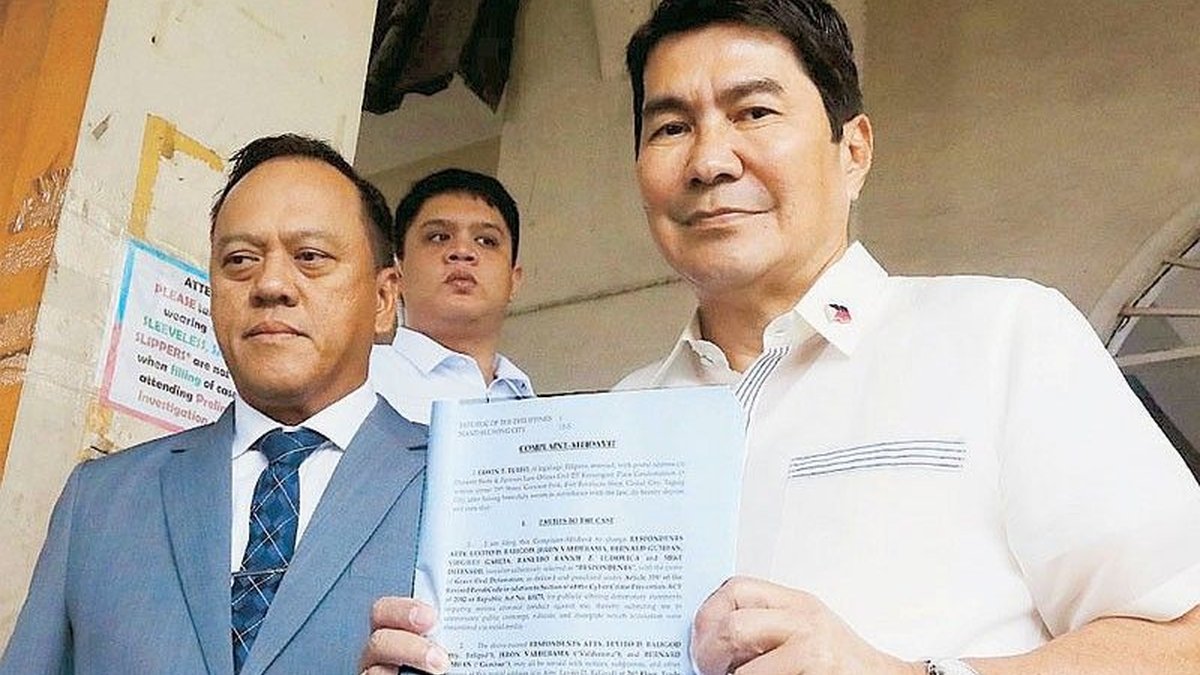
MANILA, Philippines — Sen. Erwin Tulfo filed criminal complaints yesterday for grave oral defamation in relation to the Cybercrime Prevention Act of 2012 against detained former lawmaker Mike Defensor, lawyer Levito Baligod and several others over allegations linking him to the alleged flood control fund scam.
Tulfo personally filed the complaint before the Mandaluyong City Prosecutor’s Office against Defensor, Baligod, self-proclaimed former bodyguards Jeron Valderama and Bernard Gumban, Quezon City Councilor Ranulfo Ludovica, lawyer Virgilio Garcia and other respondents.
The complaint stemmed from statements made during a June 16 gathering at the Doublegem EDSA Garden Events Place in Mandaluyong that was originally branded as a Senate Blue Ribbon subcommittee hearing but proceeded as a press conference after no senator attended.
In his complaint-affidavit, Tulfo alleged that the respondents publicly accused him of involvement in alleged irregularities in flood control projects.
He said the statements were livestreamed and widely circulated on social media, damaging his reputation.
Denying the accusation, Tulfo said: “Why would I receive a suitcase of cash when I don’t even have any flood control projects? If that were true, my name should have already surfaced during the first flood control hearing.”
He maintained that his name did not appear in the General Appropriations Act or the National Expenditure Program for infrastructure projects either during his term as congressman or after he was elected senator.
“I have no infrastructure projects, no flood control projects, no farm-to-market roads. None at all. I didn’t get even a single centavo from government projects. So why would I receive this huge amount of money from Zaldy Co? I received nothing,” Tulfo said.
He asked prosecutors to find probable cause and file charges against the respondents for violating Article 358 of the Revised Penal Code in relation to Section 6 of Republic Act 10175, or the Cybercrime Prevention Act.
Last month, the senator filed a separate oral defamation complaint against the same group before the Pasay City Prosecutor’s Office.
Defensor and three others were arrested for plunder on Monday.
Defensor is among the campaign donors of Sen. Rodante Marcoleta in the 2025 midterm elections.
Based on Marcoleta’s public admission, the three contributed P75 million for his senatorial bid.
- Latest
- Trending
Facts Only
* Sen. Erwin Tulfo filed criminal complaints for grave oral defamation.
* The complaints were filed against detained former lawmaker Mike Defensor, lawyer Levito Baligod, Jeron Valderama, Bernard Gumban, Quezon City Councilor Ranulfo Ludovica, lawyer Virgilio Garcia, and others.
* The basis of the complaint involved public accusations linking the respondents to irregularities in flood control projects.
* The statements originated from a June 16 gathering at the Doublegem EDSA Garden Events Place in Mandaluyong.
* Tulfo alleged the defamatory statements were livestreamed and circulated on social media.
* Tulfo stated he received no funds from government projects, including flood control projects or farm-to-market roads.
* Tulfo requested charges under Article 358 of the Revised Penal Code in relation to Section 6 of Republic Act 10175.
* The same senator filed a separate oral defamation complaint against the group before the Pasay City Prosecutor’s Office last month.
* Defensor and three others were arrested for plunder on Monday.
* Mike Defensor was among the campaign donors contributing P75 million to Sen. Rodante Marcoleta's 2025 midterm elections.
Executive Summary
Full Take
The situation involves a collision between public accusation, digital dissemination, and legal recourse concerning alleged corruption. The pattern observed is an attempt by one party to use legal mechanisms (defamation complaints) in response to perceived reputational harm caused by publicized statements. Simultaneously, the defendants faced separate criminal proceedings related to financial irregularities (plunder). This layering suggests a strategic effort to manage public perception while pursuing separate accountability tracks. Tulfo's defense, focusing on the absence of specific infrastructure projects and funding streams, attempts to dismantle the basis of the accusation by establishing a factual contradiction regarding his alleged involvement. The implication is that narratives surrounding large-scale public funds are often constructed through unverified claims circulated online, forcing individuals into complex legal battles to reclaim their narrative integrity against an environment where information flows rapidly and emotionally. The focus on what "was" received versus what "is" alleged reveals a friction point between verifiable financial documentation and reputational damage in the digital age.
BRIDGE QUESTIONS:
What is the actual evidentiary standard required for substantiating claims made during public gatherings when those statements are later circulated online? How does the dual pursuit of defamation and plunder charges affect the perceived legitimacy of each proceeding? What mechanisms exist to ensure that allegations circulating on social media do not supersede formal, evidence-based legal proceedings?
Sentinel — Human
The text reads like a factual report detailing specific legal complaints filed by a named individual, exhibiting the structure of investigative journalism.