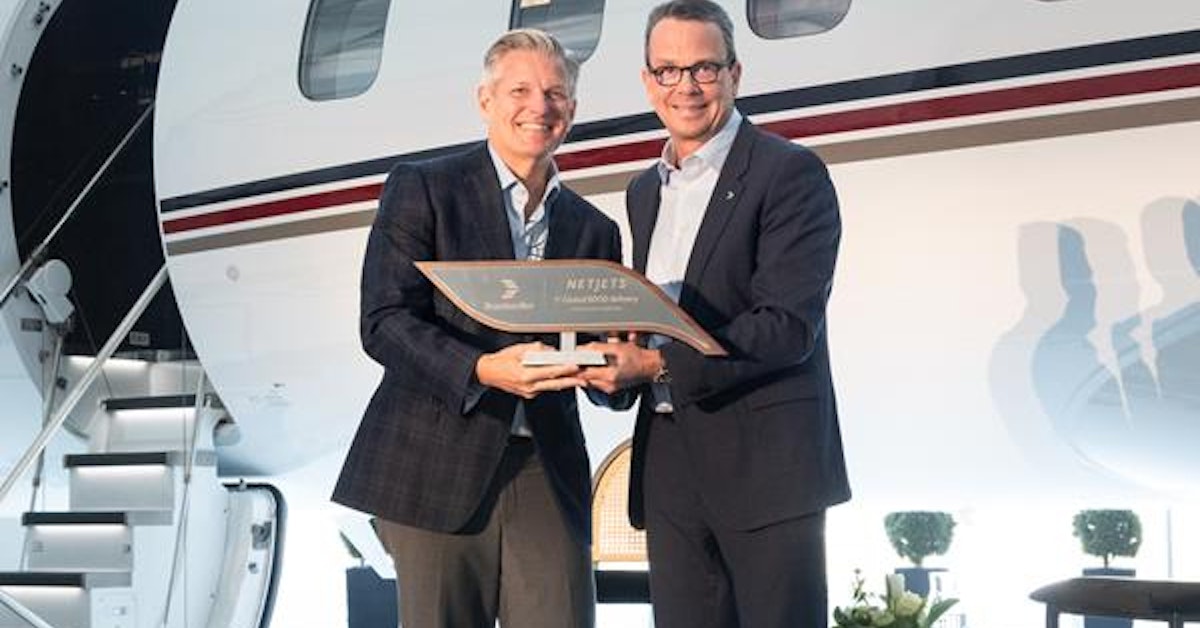
The first Global 8000 as part of a 2022 order has been delivered from Bombardier to NetJets in a Montreal handover ceremony.
Bombardier has delivered the first Global 8000 that will fly in the NetJets fleet.
The delivery dates from a November 2022 order.
The delivery took place at Bombardier’s Laurent Beaudoin Completion Centre in Montreal, Canada.
NetJets plans to scale its Global 8000 fleet to 24 aircraft.
That includes upgrading its entire in-service Global 7500 fleet to Global 8000 jets.
NetJets had 19 Global 7500s in its fleet as of March.
The 2022 announcement included a firm order for four Global 8000s.
At the time, it was valued at $812 million.
According to the announcement, further growth could come via a “series of options that could be exercised progressively over the coming years.”
NetJets President North America Patrick Gallagher said, “Our long-standing partnership with Bombardier has been built on a shared vision of excellence and innovation in business aviation.”
Gallagher added, “The range and features of the Global 8000 aircraft perfectly align with NetJets’ commitment to offering safety, service, and access at an extraordinary level and empowering owners to do more and miss less.”
Bombardier President & CEO Eric Martel said, “The Global 8000 is redefining the business aviation landscape with its unmatched performance, signature smooth ride, and innovative design, and we are thrilled to be providing our longtime, valued partner NetJets with its first Global 8000 aircraft.”
Cabin features include the OEM’s Pũr Air System and Soleil circadian lighting system.
The Global 8000 has four separate cabins and can fly nonstop for over 16 hours.
The current NetJets Global fleet included 88 aircraft as of the beginning of the month.
Before the delivery, NetJets had already seen a net growth of 19 aircraft in 2026.
It started the month with 845 aircraft in its fleet.
The unit of Berkshire Hathaway is the world’s largest private jet operator.
Facts Only
Bombardier delivered the first Global 8000 aircraft to NetJets in Montreal.
The delivery stems from a November 2022 order.
NetJets plans to scale its Global 8000 fleet to 24 aircraft.
The plan includes upgrading its existing Global 7500 fleet to Global 8000 jets.
NetJets had 19 Global 7500s in its fleet as of March.
The 2022 order included a firm purchase of four Global 8000s, valued at $812 million.
The order includes options for additional aircraft to be exercised over time.
The Global 8000 features Bombardier’s Pũr Air System and Soleil circadian lighting.
The aircraft has four separate cabins and a nonstop flight range exceeding 16 hours.
NetJets’ total fleet included 88 Global aircraft and 845 total aircraft as of early this month.
NetJets is a subsidiary of Berkshire Hathaway and the world’s largest private jet operator.
The handover ceremony occurred at Bombardier’s Laurent Beaudoin Completion Centre in Montreal.
Executive Summary
Bombardier has delivered the first Global 8000 aircraft to NetJets, marking a significant milestone in their long-standing partnership. The delivery, part of a November 2022 order, took place at Bombardier’s completion center in Montreal. NetJets plans to expand its Global 8000 fleet to 24 aircraft, including upgrading its existing Global 7500 jets. The initial order was valued at $812 million, with potential for further growth through exercisable options. The Global 8000 features advanced cabin technologies, including air purification and circadian lighting, and can fly nonstop for over 16 hours. NetJets, a Berkshire Hathaway subsidiary and the world’s largest private jet operator, currently has 88 Global aircraft in its fleet, with a total of 845 aircraft as of early this month. The delivery aligns with NetJets' strategy to enhance safety, service, and operational efficiency for its clients.
The collaboration underscores both companies' commitment to innovation in business aviation. Bombardier’s CEO highlighted the aircraft’s performance and design, while NetJets’ leadership emphasized its alignment with their operational goals. The deal reflects broader trends in private aviation, where operators are investing in next-generation aircraft to meet growing demand for long-range, high-performance jets.
Full Take
This delivery highlights the strategic alignment between Bombardier and NetJets, two industry leaders leveraging technological advancements to dominate the private aviation sector. The narrative emphasizes innovation, performance, and customer-centric upgrades, which are hallmarks of corporate messaging in high-value industries. However, the focus on "unmatched performance" and "extraordinary service" could subtly reinforce a paradigm of exclusivity, where luxury and efficiency are framed as inherent virtues rather than contextual benefits. The absence of discussion around environmental impact or operational costs—despite the aircraft’s long-range capabilities—raises questions about what trade-offs are being obscured.
The pattern here aligns with **ARC-0024 Ambiguity** (omitting inconvenient context) and **ARC-0043 Motte-and-Bailey** (promoting elite access as universal progress). The narrative assumes that scaling ultra-long-range jets is an unqualified good, without addressing whether this expansion serves broader societal needs or merely consolidates advantage for a niche market. Who truly benefits? The answer likely lies in the intersection of corporate profitability and high-net-worth convenience, not systemic accessibility.
Root cause: The paradigm of "bigger, faster, more exclusive" in private aviation mirrors broader trends in luxury markets, where technological prowess is conflated with moral superiority. The unstated assumption is that private jet travel’s growth is inevitable and desirable, ignoring externalities like carbon footprints or inequality.
Implications: For human agency, this reinforces a tiered system of mobility—where time and comfort are commodified for the few. The second-order consequence may be normalized acceptance of such disparities, as the narrative frames these advancements as "empowering owners" without interrogating who is excluded.
Bridge questions:
1. How does the expansion of ultra-long-range private jets intersect with global sustainability goals?
2. What alternative models of aviation could balance innovation with equitable access?
3. If NetJets’ growth is framed as "meeting demand," whose demand is being prioritized, and at what cost to others?
Counterstrike scan: A coordinated influence campaign would amplify the "innovation as virtue" framing while suppressing critiques of elitism or environmental harm. The actual content aligns with this playbook but lacks overt manipulation—it’s a standard corporate narrative, not a deceptive one. The gap between the story told and the story omitted is the real tell.