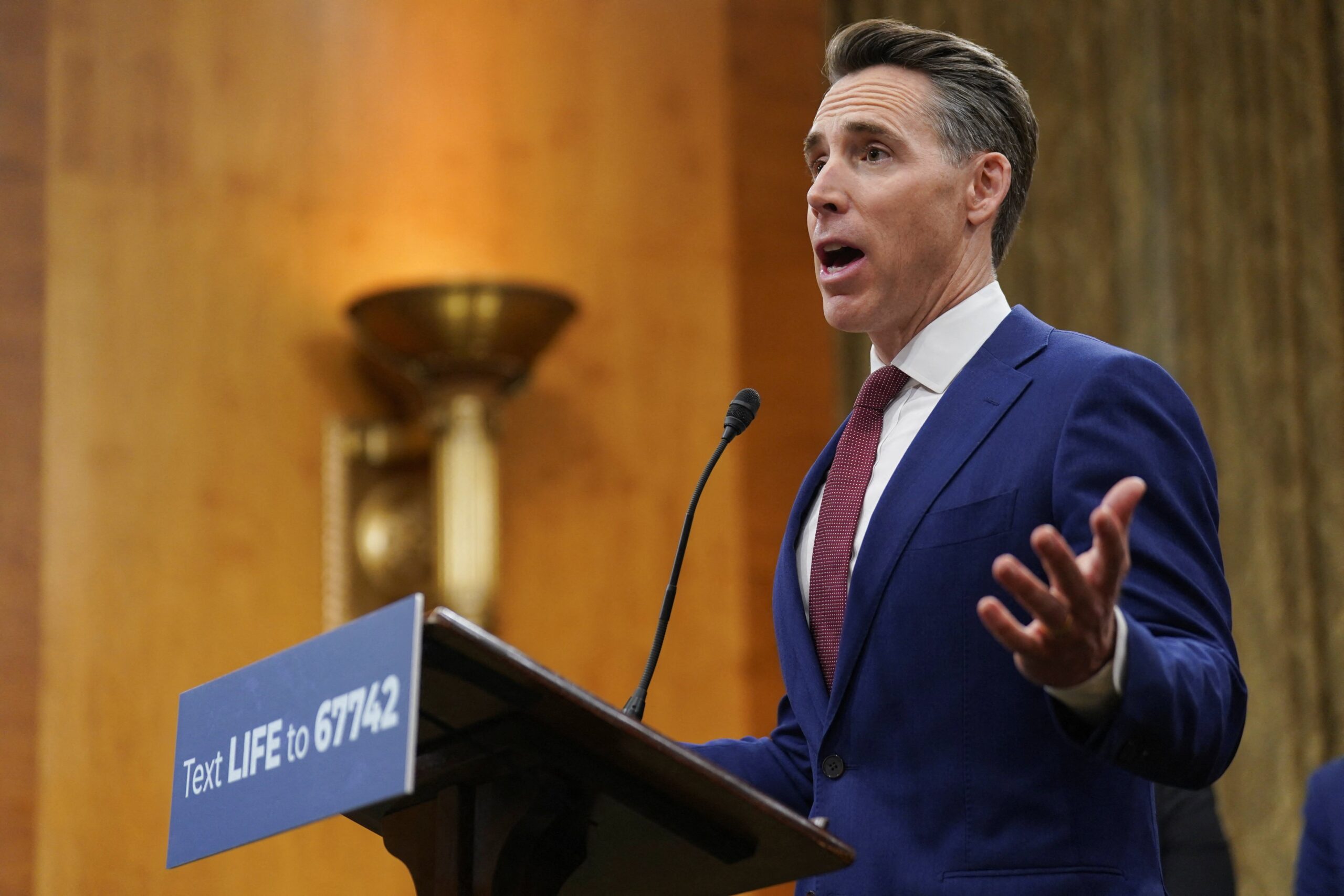
WASHINGTON (OSV News) — Senator Josh Hawley, R-Mo., announced March 11 he has introduced legislation in the Senate that would ban Mifepristone, a drug commonly, but not exclusively, used for first-trimester abortion.
The Safeguarding Women from Chemical Abortion Act, if enacted, would revoke the Food and Drug Administration’s approval of the drug.
However, the path forward for the legislation was not clear, as President Donald Trump indicated as a candidate for president in 2024, he would veto a national abortion ban if one reached his desk. Abortion restrictions have failed to gain traction in Congress since the Supreme Court’s 2022 Dobbs v. Jackson Women’s Health Organization decision, which overturned its previous precedent that held abortion as a constitutional right.
“We’ve known for years that Mifepristone is risky, but it’s really just in the last few years that we’ve learned this drug is inherently dangerous, and it’s inherently prone to abuse,” Hawley said in remarks at the Capitol March 11.
Proponents of the drug argue it is statistically safe for a woman to take, and attempts to restrict it are an attempt to ban abortion outright. In contrast, opponents argue there are significant risks to those who take it, particularly outside of medical settings, in addition to ending the life of an unborn child.
Hawley argued, “Only Congress can address this situation.”
“Only Congress can withdraw the FDA approval rendered way back in the Clinton administration for this drug that has proved to be inherently dangerous and inherently prone to abuse. Only Congress can act,” he argued.
FDA review status and timeline remain unclear
FDA officials pledged mifepristone would undergo a safety review. However, the status and timeline of the FDA’s review are unclear.
Meanwhile, the Trump administration has asked multiple judges to pause state lawsuits seeking to roll back Biden administration-era eased restrictions on Mifepristone, arguing those court cases would interfere with its review. In one such filing in Louisiana, the Justice Department said such reviews often take one year.
The FDA also recently approved a new generic form of the drug.
Mifepristone, the first of two drugs used in a medication-based abortion, was approved by the FDA in 2000, and gained the moniker “the abortion pill.” Medication abortions, sometimes called chemical abortions, account for the majority of abortions in the U.S., according to multiple studies.
Pro-life opponents of Mifepristone have pushed the Trump administration to roll back eased restrictions on the drug implemented by the Biden administration. Over a year into Trump’s second term, the Trump administration has thus far left that regulation in place.
The Catholic Church teaches that all human life is sacred from conception to natural death and, as such, opposes direct abortion. Church leaders have called for restricting mifepristone’s use in abortion, while noting that the drug’s more recent usage in medical protocols for miscarriage care, where an unborn child has passed away from natural causes, would be a morally legitimate scenario.
—
Kate Scanlon is a national reporter for OSV News covering Washington. Follow her on X.
Facts Only
* Senator Josh Hawley introduced the “Safeguarding Women from Chemical Abortion Act.”
* The act seeks to revoke the FDA’s approval of mifepristone.
* The FDA is reviewing mifepristone’s safety.
* President Donald Trump indicated he would veto a national abortion ban in 2024.
* The Supreme Court’s Dobbs v. Jackson Women’s Health Organization decision overturned Roe v. Wade.
* FDA officials pledged a safety review of mifepristone.
* The Justice Department estimates the FDA review could take one year.
* A new generic form of mifepristone was recently approved by the FDA.
* Medication abortions account for the majority of abortions in the U.S.
* The Catholic Church opposes direct abortion.
* The date of the announcement was March 11.
Executive Summary
Full Take
Patterns detected: ARC-0024 Ambiguity – The article presents a highly contested issue with significant uncertainties surrounding the FDA’s review timeline and potential outcomes. Hawley’s framing— “inherently dangerous, and inherently prone to abuse”— relies heavily on an unquantified assessment of risk, creating ambiguity about the actual level of danger associated with mifepristone use. The narrative is further complicated by the existing legal battles and competing interests of the Trump and Biden administrations, all operating within the broader context of a deeply polarized political landscape.
The introduction of the "Safeguarding Women from Chemical Abortion Act" represents a classic Motte-and-Bailey tactic. Hawley is effectively elevating a concern – the potential risks of mifepristone – into a demand for its complete removal, sidestepping the existing scientific consensus regarding its safety when used under proper medical supervision. The invocation of “abuse” is particularly evocative, tapping into anxieties about unregulated access and exacerbating the moral framing of abortion.
Furthermore, the article subtly reinforces a historical pattern: the cyclical politicization of reproductive health technologies. Mifepristone’s approval in 2000, its moniker “the abortion pill,” and subsequent challenges—as seen here—echo previous controversies surrounding other medications used in reproductive health, suggesting a pre-existing vulnerability to moral panic. This strategic framing obscures the underlying complexities of medical access, safety protocols, and patient autonomy. The inclusion of the Catholic Church’s perspective, while seemingly balanced, serves to reinforce a pre-existing, deeply held moral argument against abortion, further solidifying the frame.
The delayed timeline for the FDA review introduces a crucial element of strategic uncertainty, allowing each side to position itself as advocating for “safety” while simultaneously fueling anxieties. The potential for a one-year review, as suggested by the Justice Department, is a deliberate tactic to prolong the dispute and potentially influence public opinion.
Questions: How does the framing of "abuse" impact public understanding of mifepristone’s safety? What specific evidence would be needed to decisively challenge Hawley’s claims about inherent danger?
Sentinel — Likely Human
This article presents a factual overview of Senator Hawley’s proposed ban on Mifepristone, outlining the legislative action, key arguments from both proponents and opponents, and relevant context surrounding FDA approval and legal challenges. The reporting exhibits a balanced, neutral tone common in policy reporting, but with potential stylistic elements that warrant careful observation.