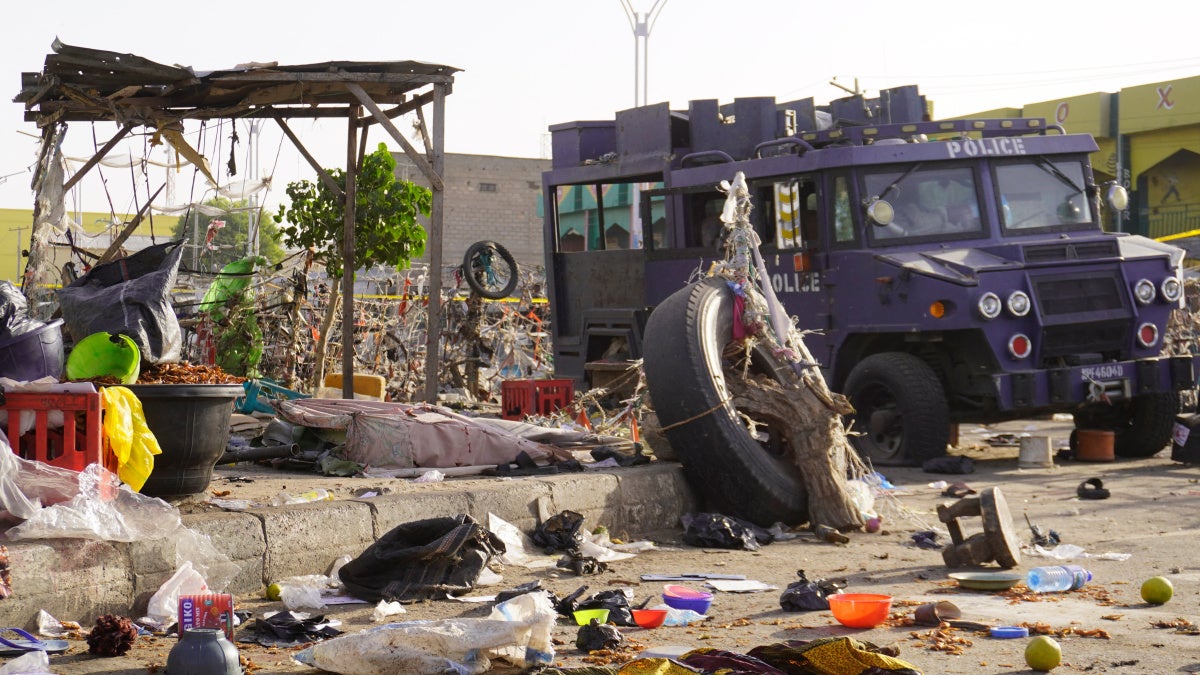
(Abuja) – Deadly bombings in Maiduguri, the capital of Borno State in northeastern Nigeria, have heightened concerns about the resurgence of violent attacks by Boko Haram and a growing risk to civilians in the region, Human Rights Watch said today. In the aftermath of this apparent war crime, Nigerian authorities should urgently strengthen protection for civilians in the region.
The attacks, on the evening of March 16, 2026, struck crowded public locations, including a market, the area near a post office, and the University of Maiduguri Teaching Hospital gate, killing 23 people and injuring 108, according to police authorities. These attacks appear to have been indiscriminate and therefore, a war crime under international law. The Nigerian government has been engaged in an armed conflict in northeastern Nigeria with the Boko Haram insurgent group, and with factions splintered from that group, for well over a decade.
“These latest attacks show that civilians in northeastern Nigeria remain dangerously exposed to deadly violence, despite years of government security efforts,” said Anietie Ewang, Nigeria researcher at Human Rights Watch. “The resurgence of such attacks in Maiduguri is deeply alarming and underscores the persistent threat armed groups pose to everyday life.”
Human Rights Watch spoke with five witnesses to the bombings at the post office, hospital, and market. No armed group has claimed responsibility, but the Nigerian military described the attacks as coordinated attempts by suspected Boko Haram fighters to cause mass casualties and spread panic. Jama’atu Ahlis Sunna Lidda’awati wal-Jihad (JAS) popularly known as Boko Haram, has previously carried out suicide bombings targeting civilians.
JAS was significantly weakened after its longtime leader, Abubakar Shekau, died in 2021 during clashes with the Islamic State West Africa Province, a rival break out faction. However, analysts say JAS appears to be making a comeback, as reflected in several recent attacks in the region.
In December 2025, a mosque in Maiduguri was bombed, killing five people, ending years of relative calm. Although violence linked to Boko Haram has declined from its peak, continued attacks across the region suggest the insurgency remains a persistent threat, and the Maiduguri bombings raise renewed concerns about security.
Borno State is widely regarded as the epicenter of the insurgency, while Maiduguri is the main operational hub for security responses. It is also a key humanitarian hub, hosting agencies that support populations affected by the crisis.
In 2020, Fatou Bensouda, then the International Criminal Court prosecutor, asserted that her office had found a reasonable basis to believe that Boko Haram and its splinter groups, as well as Nigerian security forces, had committed war crimes and crimes against humanity during the conflict. She noted that “the vast majority of criminality within the situation [was] attributable to nonstate actors.” Prosecutor Bensouda decided not to proceed with a request to open a formal investigation at the time due in part to limited resources and the situation remains in the preliminary examination stage.
Ibrahim Talba, a 35-year-old tailor, told Human Rights Watch that he had gone to a local restaurant opposite the University of Maiduguri Teaching Hospital gate to eat after breaking his fast during Ramadan. There he witnessed an argument between two young men in a commercial tricycle and a security guard, who denied them entry for not using an authorized tricycle. He said that after a brief, heated exchange, one of the men threw a food flask at the security guard, which exploded after the guard threw it back toward them. As he and others rushed toward the scene, a second explosion occurred, injuring him. He has shrapnel wounds to his back, legs, and stomach.
Fatima Sheriff, a 25-year-old food vendor, said that after delivering food to a hospital staff member, she was heading toward the gate when she paused to answer a call from her sister. She briefly noticed the argument, but the call distracted her. Moments later, a loud explosion erupted, flames engulfed the area, and she lost consciousness. She later regained it in the hospital, without any physical injuries. While there, she saw seven people brought in unconscious from the blast, including a young girl whom a doctor later pronounced dead.
Mustafa Muhammed, a 45-year-old cap seller, said he had shrapnel injuries to his back and the side of his ribs from a blast in front of the hospital. He said: “I was in the Costain area near Gwange graveyard when I heard a loud explosion from the Monday Market area. I just ran, I got on my bicycle to get home, using the road leading toward the University of Maiduguri Teaching Hospital. While crossing the road toward the hospital, there was another explosion. I don’t even know what happened. I just saw a reddish-black cloud of smoke, and then I found myself covered in blood. The next thing I knew, I opened my eyes and I was in a hospital bed.”
Babagana Abubakar, a 39-year-old fruit seller near the post office, said he was selling watermelon to a customer when a loud explosion “scattered everything.” “We all began running for safety without knowing where to hide. I knew it was a bomb blast because I’ve heard that sound before in Maiduguri,” he said.
Abubakar returned to help victims and saw people lying on the ground but was unable to tell who was alive or dead. “I tried to help one of the injured but stepped back when I saw blood coming from his chest,” he said. “I couldn’t continue. It was too much. I was shaking and felt cold all over. I didn’t know the victims, as I mostly sell to passersby, but I later recognized a young man who had bought bananas from me minutes before the blast among the dead by his white Real Madrid jersey.”
He said he still hears the echo of the explosion. “Whenever I close my eyes, I see the scene again, the bodies lying there. It keeps replaying in my mind. I have also lost my source of livelihood since all the fruits I sell were scattered everywhere from the explosion and I couldn’t pick or salvage anything.”
A 53-year-old civil servant said that he was driving toward the Monday Market to buy groceries from street vendors outside when he heard a loud explosion, accompanied by a bright red light in the sky. He said: “After the explosion, people started running in all directions. I left my car and ran on foot, as other motorists did. After running for about 400 meters without hearing any follow-up gunshots, we stopped, realizing it likely meant there were no armed operatives at the scene. The incident has really scared me. I have never experienced anything like this since I moved here.”
Nigerian authorities should urgently strengthen protection for civilians in high-risk areas, improve early warning and response measures, and provide support to victims and those who have lost their livelihoods, Human Rights Watch said.
“The bombings in Maiduguri lay bare the extreme and ongoing danger civilians in northeastern Nigeria face from armed groups,” Ewang said. “Nigerian authorities need to urgently step up efforts to protect civilians, ensure swift and transparent investigations, and hold those responsible to account.”
Facts Only
Incident: Bombings in Maiduguri on March 16, 2026
Location: University of Maiduguri Teaching Hospital gate, post office area, and Monday Market, Maiduguri, Borno State, Nigeria
Deaths: 23
Injuries: 108
Suspected perpetrator: Boko Haram (unconfirmed)
Timeline: Over a decade of armed conflict between Nigerian government and Boko Haram insurgents
Executive Summary
In Maiduguri, the capital of Borno State in northeastern Nigeria, coordinated bombings on March 16, 2026 targeted crowded public locations such as a market, the area near a post office, and the University of Maiduguri Teaching Hospital gate. The attacks resulted in 23 deaths and 108 injuries, according to police authorities, with suspected Boko Haram fighters being accused of the war crime. Despite security efforts over several years, civilians in northeastern Nigeria remain vulnerable to violent attacks.
The Nigerian military claims these attacks were intended to cause mass casualties and spread panic. While no group has claimed responsibility, Jama'atu Ahlis Sunna Lidda'awati wal-Jihad (JAS), commonly known as Boko Haram, has previously carried out similar suicide bombings targeting civilians. JAS was weakened after its leader's death in 2021 but appears to be regaining strength, reflected in recent attacks in the region.
Full Take
Patterns detected: ARC-0043 Motte-and-Bailey, ARC-0024 Ambiguity. The article presents a balanced account of the bombings in Maiduguri while leaving room for speculation about the attackers' motivations and identity. This deliberate ambiguity (Motte-and-Bailey) allows readers to fill in the gaps with their own assumptions, potentially aligning with the narrative favored by the source or another entity.
Steelman: The article provides a credible account of the bombings and their aftermath, attributing the attacks to suspected Boko Haram fighters without definitive confirmation. The military's description of the attacks as an attempt to cause mass casualties and spread panic is presented as factual information, supported by witness testimonies.
Root Cause: The resurgence of violent attacks in Maiduguri highlights the persistent threat posed by armed groups like Boko Haram in northeastern Nigeria. This conflict has been ongoing for over a decade, with JAS and its splinter groups repeatedly targeting civilians.
Implications: The bombings underscore the urgent need for Nigerian authorities to strengthen protection for civilians in high-risk areas, improve early warning and response measures, and provide support to victims and those who have lost their livelihoods.
Bridge Questions: Who is responsible for these attacks? What steps should Nigerian authorities take to prevent future violence against civilians? How can international organizations and the global community support these efforts?
Counterstrike Scan: The article does not show signs of being part of a coordinated influence campaign. It presents factual information about the bombings in Maiduguri without attempting to manipulate readers or push a specific narrative beyond its reporting.
Sentinel — Human
This text is likely to be written by a human journalist. The writing style varies, includes a personal voice, and presents emotional language and personal accounts.