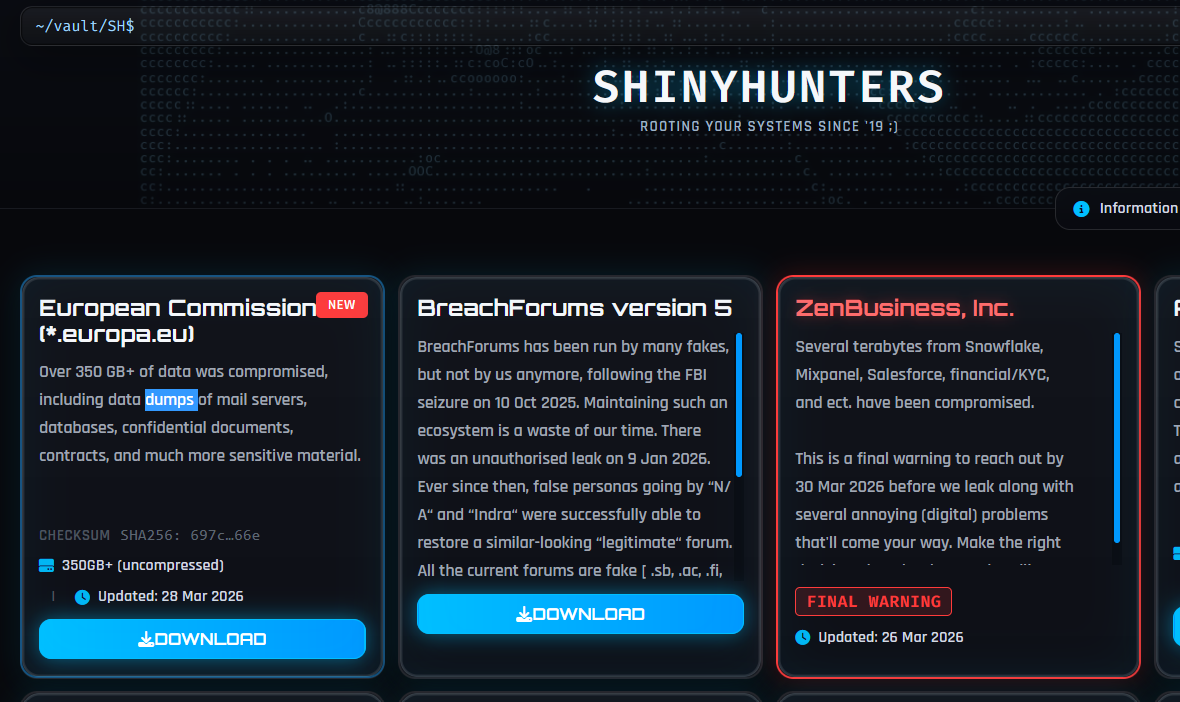
The European Commission has allegedly been breached by ShinyHunters, with reported data dumps including content from mail servers and internal communications systems.
The cybercrime group added the Commission to its Tor data leak site, claiming the theft of over 350 GB+ of data. Stolen data may include data dumps of mail servers, databases, confidential documents, contracts, and much more sensitive material.
On March 24, the European Commission detected a cyberattack affecting the cloud infrastructure hosting its Europa.eu websites. The incident was quickly contained, with mitigation measures applied and no disruption to website availability. Early findings suggest some data may have been accessed, and potentially affected EU entities are being notified.
“Early findings of our ongoing investigation suggest that data have been taken from those websites. The Commission is duly notifying the Union entities who might have been affected by the incident.” reads the press release published by the European Commission. “The Commission’s services are still investigating the full impact of the incident. “
The EU has launched an investigation into the security breach to determine its full impact. However, the Commission pointed out that its internal systems were not affected, limiting the overall impact of the attack.
The Commission said its internal systems were not affected and will continue monitoring the situation while strengthening protections. It will analyze the incident to improve cybersecurity, as the EU faces ongoing cyber and hybrid threats targeting critical services and institutions.
BleepingComputer first reported the incident, claiming that threat actors breached the European Commission’s AWS account, stealing hundreds of gigabytes of data, including databases, and providing screenshots as proof. The exact type of stolen data remains unclear. AWS said it did not suffer a security incident and that its services functioned as expected.
The attack vector is still unknown.
On 30 January, the European Commission detected another cyberattack on its mobile device management system. The organization pointed out that no mobile devices were compromised. The Commission contained and cleaned the system within nine hours.
Attackers may have accessed some staff data, including names and phone numbers, but so far they have not compromised any devices.
The ShinyHunters extortion group has recently targeted major companies, leaking data when ransom demands fail. Victims include Odido, Figure, Canada Goose, and SoundCloud. The group primarily uses social engineering, especially voice phishing, to steal credentials and access SaaS platforms like Salesforce, Okta, and Microsoft 365.
Follow me on Twitter: @securityaffairs and Facebook and Mastodon
(SecurityAffairs – hacking, European Commission)
Facts Only
The European Commission was allegedly breached by the cybercrime group ShinyHunters.
ShinyHunters claims to have stolen over 350 GB of data, including mail server content, databases, and confidential documents.
The stolen data was added to ShinyHunters' Tor data leak site.
On March 24, the European Commission detected a cyberattack affecting its cloud infrastructure hosting Europa.eu websites.
The incident was contained quickly, with no disruption to website availability.
Early findings suggest some data may have been accessed, and potentially affected EU entities are being notified.
The European Commission states its internal systems were not affected by the breach.
On January 30, the European Commission detected another cyberattack on its mobile device management system.
The January 30 attack was contained within nine hours, with no mobile devices compromised.
Some staff data, including names and phone numbers, may have been accessed in the January 30 attack.
ShinyHunters has recently targeted major companies, including Odido, Figure, Canada Goose, and SoundCloud.
The group primarily uses social engineering and voice phishing to steal credentials.
The attack vector for the European Commission breach remains unknown.
AWS, whose services were involved, stated it did not suffer a security incident.
Executive Summary
The European Commission has experienced multiple cybersecurity incidents in recent months, with the most significant involving a breach by the cybercrime group ShinyHunters. The group claims to have stolen over 350 GB of data, including mail server content, databases, and confidential documents, which it added to its Tor data leak site. The Commission detected a cyberattack on March 24 affecting its cloud infrastructure hosting Europa.eu websites, containing it quickly with no disruption to services. Early investigations suggest some data was accessed, and affected EU entities are being notified. The Commission asserts its internal systems were unaffected and is strengthening protections while analyzing the incident to improve cybersecurity.
Additionally, on January 30, the Commission detected another cyberattack on its mobile device management system, which was contained within nine hours. While no devices were compromised, some staff data, such as names and phone numbers, may have been accessed. ShinyHunters, known for targeting major companies like Odido, Figure, Canada Goose, and SoundCloud, typically uses social engineering and voice phishing to steal credentials. The attack vector for the Commission breach remains unknown, and AWS, whose services were involved, stated it did not suffer a security incident.
Full Take
The strongest version of this narrative highlights a concerning pattern of cyber threats targeting critical EU institutions, with ShinyHunters emerging as a persistent and sophisticated actor. The European Commission’s response—quick containment, transparency about potential data access, and ongoing investigations—demonstrates a measured approach to crisis management. However, the lack of clarity on the attack vector and the exact nature of the stolen data leaves room for speculation. The inclusion of AWS’s denial of a security incident adds a layer of complexity, suggesting the breach may have exploited misconfigurations or credential theft rather than a platform vulnerability.
Patterns detected: none. The reporting avoids emotional exploitation or distortion, focusing on verifiable events and official statements. The narrative does not engage in fear-mongering or forced binaries, instead presenting the facts with acknowledgment of uncertainty.
Root cause: This incident reflects the broader paradigm of escalating cyber threats against government and corporate entities, driven by the commodification of stolen data and the proliferation of social engineering tactics. The assumption that cloud infrastructure is inherently secure—without robust access controls—may be a critical vulnerability. Historically, this echoes the trend of state and non-state actors exploiting digital dependencies, with institutions often playing catch-up in cybersecurity resilience.
Implications: For human agency, the breach underscores the fragility of digital trust in public institutions. Citizens and employees bear the cost of potential data exposure, while the Commission faces reputational and operational risks. Second-order consequences may include heightened scrutiny of EU cybersecurity policies, increased investment in defensive measures, and a potential chilling effect on digital governance initiatives.
Bridge questions: How might the European Commission’s reliance on third-party cloud services (like AWS) shape its cybersecurity posture moving forward? What gaps in the current threat intelligence framework allowed ShinyHunters to target multiple high-profile entities with similar tactics? Would a shift from reactive to proactive cybersecurity strategies—such as red teaming or zero-trust architectures—mitigate future risks?
Counterstrike scan: If this were part of a coordinated influence campaign, the playbook might involve amplifying fears of institutional incompetence or foreign interference to erode public trust. However, the actual content aligns with standard cybersecurity reporting—factual, attributed, and devoid of manipulative framing. No structural alignment with a hypothetical attack narrative is detected.
Sentinel — Human
Although the text exhibits some signs of balance in framing and coherence, it also presents evidence of human writing such as varying sentence lengths and personal voice. The text's stylometric signals are likely not indicative of AI-generated content.