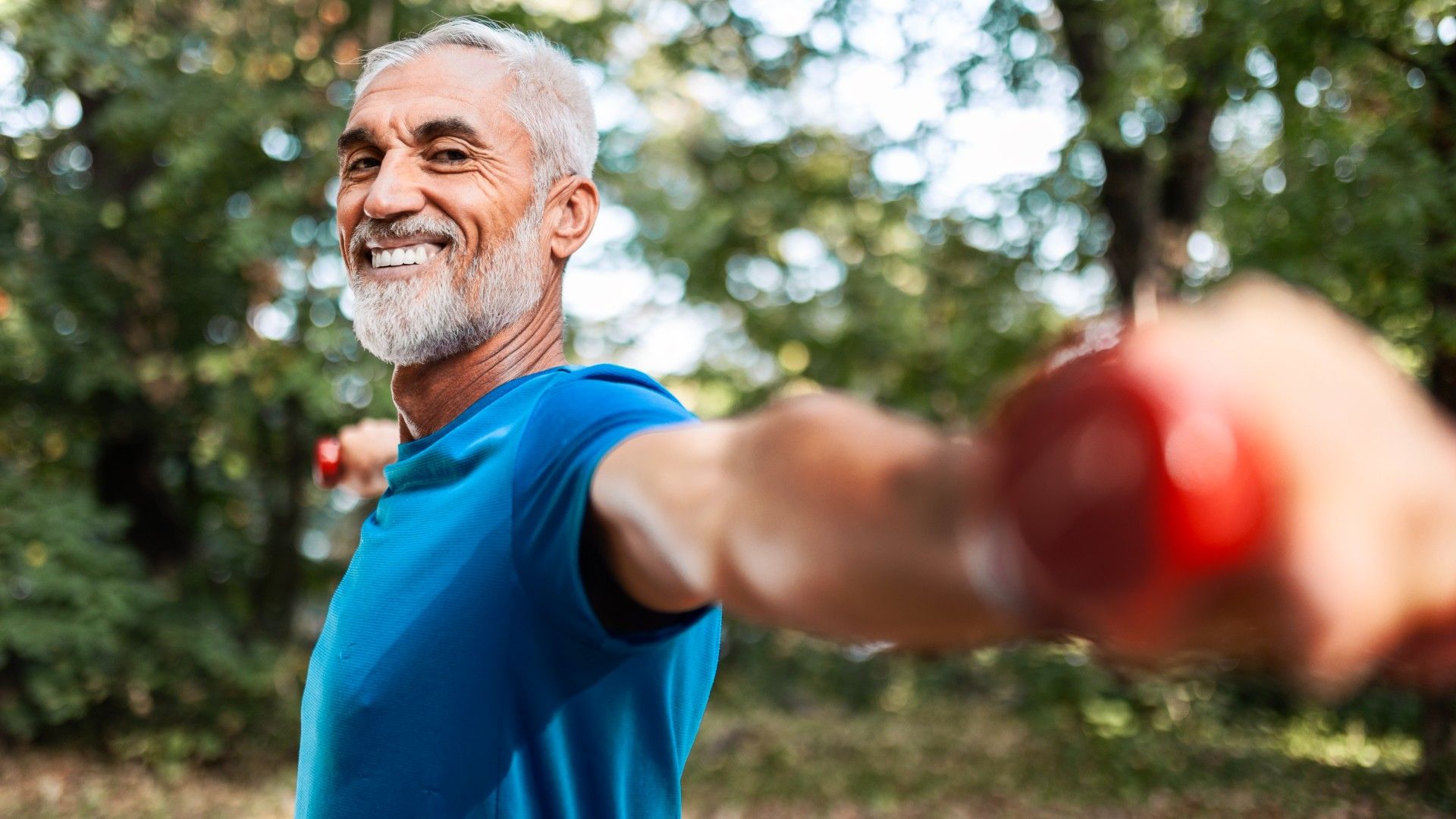
The best exercises for strength and mobility as you get older don't need to be fancy or gym-friendly; they need to be effective and performed consistently. And these three moves only require one of the best yoga mats.
I train clients of all ages, but I really enjoy working with people who are enjoying exercise in later life because, if I'm honest, that's where I get the most satisfaction watching strength, mobility and functional fitness transform.
Improving mobility is all about moving the joints through a range of movement (motion is lotion, after all); strengthening exercises help build strong muscle groups, bones and ligaments through resistance and loading.
I'm sharing three go-to exercises I believe you should add to your exercise routine, plus some of the benefits you can expect.
If you experience pain at any time, stop and rest. If you're working with an injury or health condition, or you're currently pregnant or postnatal, I recommend seeking advice before starting these exercises.
Watch: 3-move mobility routine
A post shared by Tom's Guide Fitness (@tomsguidefitness)
A photo posted by on
The routine: 3-4 sets, 8-10 reps per move
- Side leg raises: Lie on your side with your elbow resting on your mat stacked beneath your shoulder. Push up through your elbow and shoulder to protect the joints. Stack your legs and bend your knees. Keep a soft bend in the top knee as you lift the leg high into the air, squeezing your core and glutes. Pause, ensuring your hips and chest stay facing forward, then lower the leg again. Wrap a band above your knees or hold a dumbbell to your hip to progress the move. You can also add a pulse. Switch sides.
- Seated leg openers: Sit upright on your mat and extend both legs in front of you. Engage your core and imagine a piece of string coming out of the crown of your head pulling you up to lengthen your spine. Place your hands behind your head and squeeze your shoulder blades together. Lift your right leg to hover a few inches, then open your leg with as much control as possible as far as you can. Pause, then draw the leg back to center and lower it. Switch sides. Consider adding a band for more challenge or placing your hands on the mat for less.
- Cossack squats: Stand with your feet hip-width apart, then step your left foot out to the side as wide as you can, bend the knee and lower into a side lunge. Ensure you're bracing your core and staying upright with a straight back and your gaze ahead. Lower as far as you can, sending your butt back and down. Pause, then drive up powerfully through your left leg and step to the starting position. Switch sides. For a beginner-friendly option, start with your feet planted and legs already wide, allowing you to move from side to side without stepping. For a progression, add a weight.
What are the benefits?
Each of these exercises brings something slightly different to the table.
Get instant access to breaking news, the hottest reviews, great deals and helpful tips.
Side leg raises hit the outer glutes and open the hips and groin, also stretching down the inner thighs, known as the adductors. Hitting your glutes from different angles targets the muscles differently, and this movement pattern is crucial for abducting the hip away from the body using lateral motion.
Seated leg openers move the leg away from the body using a slightly different plane of motion, stretching the inner thighs and groin, opening the hips and building strength around the pelvis and in the glutes. The seated version also tests posture and alignment as you engage your core, place your hands behind your head and focus on staying upright while pulling your elbows back to open your chest.
Cossack squats build powerful muscles in the lower body, hitting your hips, glutes and legs while increasing mobility in your hips, knees and ankles. Try to stay upright and keep your core engaged by bracing your stomach. You can keep your toes facing forward or lift them to point into the air, which will externally rotate the hip and deepen the stretch in your hamstrings. This move is brilliant for building strength and mobility while improving balance and control.
Focus on full control and constant tension through all phases of the exercises. There's no rush, and there are only three moves to work through, so take your time.
You can adjust the reps and sets as necessary, and play with the weights or equipment you use. I like to add dumbbells and a band above my knees, but to begin with, I would move toward lighter weights and full range of movement every rep until you feel more familiar.
Any time your hands are behind your head, focus on opening your chest and knitting both shoulders together; this is brilliant for practicing an upright position, improving posture and helping you avoid slouching or curling your spine.
Give these a try, and let us know how you get on in the comments.
Follow Tom's Guide fitness on Instagram for more workouts, routines, tips, and tricks.
Follow Tom's Guide on Google News and add us as a preferred source to get our up-to-date news, analysis, and reviews in your feeds.
More from Tom's Guide
- I teach people how to be more mobile: 3 low-impact back and shoulder moves that build stability and strength after 40
- I’m a personal trainer who works with clients aged 65+ daily. Here are the 2 exercises I always recommend when it comes to building mobility and balance
- Sit all day? Try these 7 back exercises from a physical therapist right now
Sam Hopes is a level 3 qualified trainer, a level 2 Reiki practitioner and fitness editor at Tom's Guide. She is also currently undertaking her Yoga For Athletes training course.
Sam has written for various fitness brands and websites over the years and has experience across brands at Future, such as Live Science, Fit&Well, Coach, and T3.
Having coached at fitness studios like F45 and Virgin Active and taken on both 1:1 and group, Sam now primarily teaches outdoor bootcamps, bodyweight, and kettlebells.
She also coaches mobility and flexibility classes several times a week.
Sam has completed two mixed doubles Hyrox competitions in London and the Netherlands and finished her first doubles attempt in 1:11.
You must confirm your public display name before commenting
Please logout and then login again, you will then be prompted to enter your display name.
Facts Only
A fitness editor and certified trainer recommends three exercises for strength and mobility in older adults.
The exercises are side leg raises, seated leg openers, and Cossack squats.
Each exercise targets specific muscle groups: side leg raises work the outer glutes and hip abductors; seated leg openers engage the inner thighs, groin, and core; Cossack squats strengthen the lower body and improve hip, knee, and ankle mobility.
The routine consists of 3-4 sets of 8-10 reps per exercise.
Modifications include using resistance bands or dumbbells for progression and adjusting reps or equipment for individual needs.
The exercises require minimal equipment, primarily a yoga mat.
The author advises stopping if pain occurs and consulting a professional for injuries, health conditions, or pregnancy.
The article includes a video demonstration of the routine.
The author has experience coaching clients of all ages, with a focus on functional fitness for older adults.
Additional fitness content and workouts are promoted at the end of the article.
Executive Summary
The article presents three mobility and strength exercises designed for older adults, emphasizing consistency and effectiveness over complexity. The routine includes side leg raises, seated leg openers, and Cossack squats, each targeting different muscle groups and joint mobility. Side leg raises focus on the outer glutes and hip abductors, while seated leg openers engage the inner thighs, groin, and core. Cossack squats build lower body strength and improve hip, knee, and ankle mobility. The exercises require minimal equipment, such as a yoga mat, and can be modified with resistance bands or dumbbells for progression. The author, a certified trainer, highlights the importance of controlled movements and proper form to avoid injury. The routine is recommended for 3-4 sets of 8-10 reps per exercise, with adjustments for individual fitness levels. The article also advises consulting a professional if working with injuries or health conditions.
The exercises are framed as accessible and adaptable, suitable for individuals looking to maintain or improve strength and mobility as they age. The author draws on personal experience training clients of various ages, particularly emphasizing the satisfaction of seeing functional fitness improvements in older adults. The piece concludes by encouraging readers to try the routine and share their experiences, while also promoting additional fitness content from the publication.
Full Take
The article presents a straightforward and practical approach to mobility and strength training for older adults, emphasizing accessibility and consistency. The strongest version of this narrative is its focus on functional fitness, which aligns with broader trends in aging populations seeking to maintain independence and quality of life. The exercises are well-chosen for their adaptability and minimal equipment requirements, making them suitable for home workouts. However, the piece leans heavily on anecdotal evidence from the author’s experience rather than citing broader research or studies on the efficacy of these specific exercises for older adults. This could be seen as an appeal to authority, where the author’s credentials are used to lend credibility without additional empirical support.
The root cause of this narrative appears to be a growing recognition of the importance of mobility and strength training as people age, coupled with a market demand for simple, equipment-light routines. The article assumes that readers are motivated to improve their fitness but may lack access to gyms or complex equipment. While the exercises are practical, the lack of discussion about potential limitations or contraindications for certain conditions (beyond a general advisory) could be a missed opportunity to provide more nuanced guidance.
Implications for human agency are positive, as the routine empowers individuals to take control of their fitness with minimal barriers. However, the focus on older adults could inadvertently reinforce ageist stereotypes about physical decline, even as it seeks to counteract them. Second-order consequences might include increased demand for similar content, potentially leading to a proliferation of fitness advice that varies in quality and safety.
Bridge questions to consider: What research supports the long-term benefits of these specific exercises for older adults? How might this routine be adapted for individuals with chronic conditions or severe mobility limitations? What role does social support play in maintaining consistency with such routines?
Counterstrike scan: If this were part of a coordinated influence campaign, the playbook might involve promoting simple, marketable fitness solutions to an aging demographic, leveraging authority figures (e.g., certified trainers) to build trust. The actual content aligns with this pattern to some extent, as it presents a clear, actionable routine without delving into potential drawbacks or alternative approaches. However, the absence of overt manipulation or commercial intent suggests this is likely a genuine effort to provide useful fitness advice rather than a coordinated campaign.
Patterns detected: none
Sentinel — Human
The text exhibits strong human signals, characterized by a personal voice and detailed, nuanced instruction, combined with verifiable professional attribution, making synthetic generation unlikely.