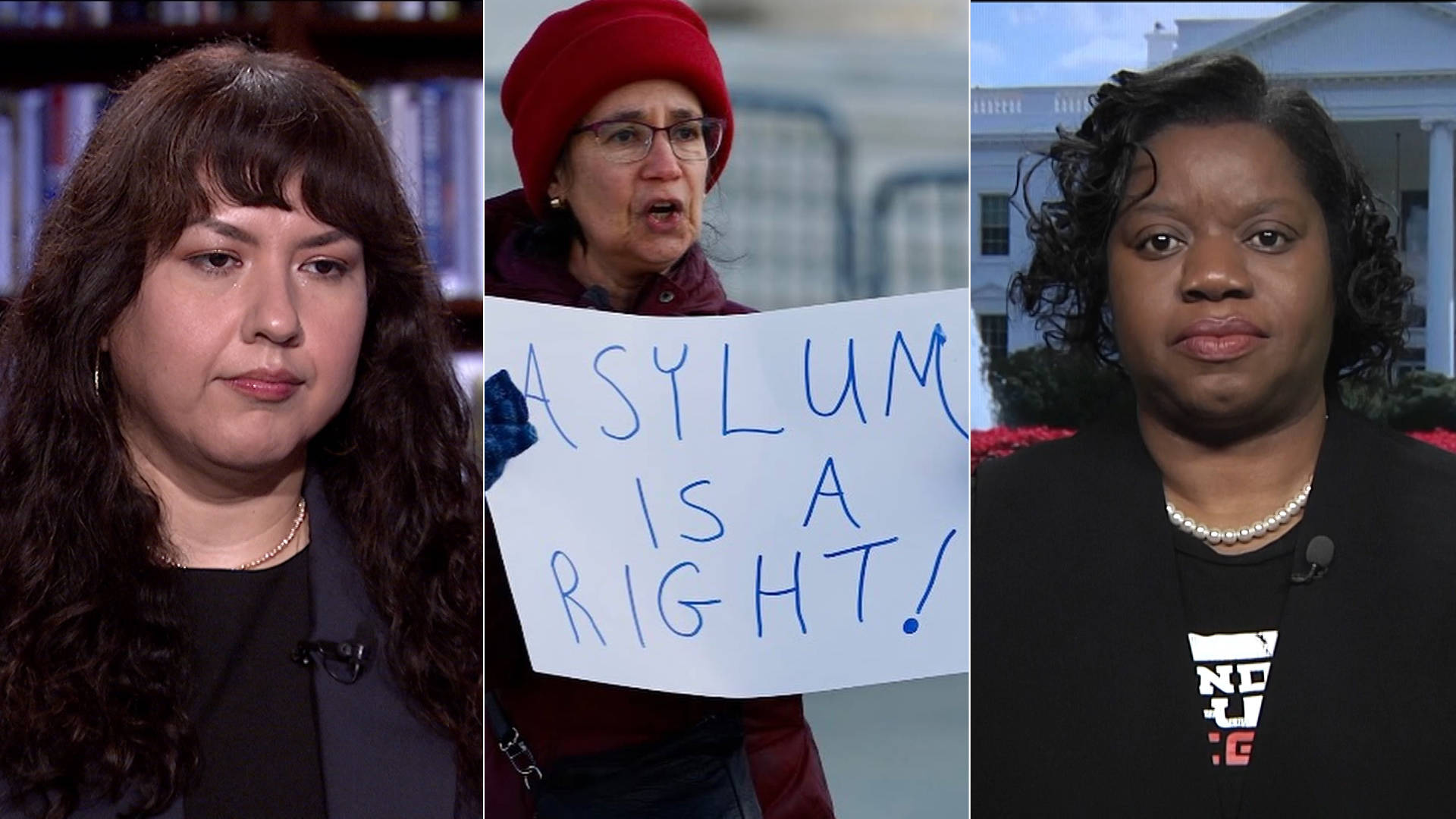
Guests
- Lupe Aguirredeputy director of U.S. Litigation, International Refugee Assistance Project (IRAP).
- Guerline Jozefco-founder and executive director of Haitian Bridge Alliance.
Thousands of Haitians and Syrians living in the United States are newly at risk of deportation after the Supreme Court ruled to allow the Trump administration to strip them of “temporary protected status,” or TPS. The program, designed for foreign citizens of countries the U.S. government believes are too unstable or dangerous to be returned to, often due to natural disasters or war, has been a major target of attack by the Trump administration and its anti-immigrant agenda.
“We are looking at the catastrophic deficit in the workforce in the United States if we allow this deportation machine and cruelty to take effect,” our guest, Haitian Bridge Alliance’s Guerline Jozef, says.
“This is just part of the Trump administration’s efforts to feed the detention and deportation machine and essentially halt immigration,” adds Lupe Aguirre of the International Refugee Assistance Project. “It’s about maintaining their campaign promises to root out people that they see as undesirable.”
Transcript
AMY GOODMAN: This is Democracy Now!, democracynow.org. I’m Amy Goodman, with Juan González, as we move into a second major decision on immigration the Supreme Court handed down yesterday, which, interestingly, is actually linked to devastating natural disasters like took place in Venezuela.
The Supreme Court ruled in another 6-to-3 decision that the Trump administration can strip away protected status from 350,000 Haitian immigrants and 6,100 Syrian immigrants who have been living and working lawfully in the United States under temporary protected status, known as TPS, the program designed for foreign citizens of countries the U.S. government believes are too unstable or dangerous to be returned to, often due to natural disasters or war. The loss of TPS will put hundreds of thousands of people at risk for deportation.
This is Guerline Jozef, co-founder of the Haitian Bridge Alliance, speaking yesterday.
GUERLINE JOZEF: Yes, today hurts. But we will continue to fight on behalf of the 1.3 million TPS holders from 17 countries. Today it is Haiti and Syria. Tomorrow is Venezuela, Nicaragua and others. So, together, we say no to injustice, and we must make sure that we as a country stand on the right side of history.
AMY GOODMAN: White House senior aide Stephen Miller, who is seen as the architect of the president’s deportation agenda, took questions from reporters after the ruling came down.
REPORTER: Does the administration consider Haiti a safe country?
STEPHEN MILLER: For Haitians? Absolutely.
REPORTER: For Haitians.
STEPHEN MILLER: Yes.
REPORTER: Despite the [inaudible]? Despite the —
STEPHEN MILLER: Yes. So, for — I mean, Haitians live in Haiti. It’s not our position that Haitians should leave Haiti. I mean, it would be — it’d be crazy for us to say that Haitians couldn’t live in Haiti. It’s their country. Of course Haitians should live in Haiti.
AMY GOODMAN: The case is Mullin v. Doe. The conservative majority ruled the Supreme Court lacked authority to review how the president or Department of Homeland Security used their authority on TPS. He also rejected the idea that racial prejudice was involved in the decision for Haitians.
In her dissent for the liberal minority, Justice Elena Kagan said it was, quote, “plain to see” that race played a role, writing, quote, “The evidence … includes statements by the President so repellent and racially inflected that the majority declines to put them in print.”
For more, we’re joined by two guests: Guerline Jozef, co-founder and executive director of Haitian Bridge Alliance, joining us from Washington, D.C., where she held the news conference yesterday, and with us in New York is Lupe Aguirre, deputy director of U.S. Litigation, International Refugee Assistance Project.
Guerline, let’s begin with you. Respond to the decision and what this means.
GUERLINE JOZEF: Thank you so much, Amy.
As I mentioned several times yesterday, the community was devastated, but we continue to make sure we push through. These decisions literally means that we have over 350,000 Haitians and 6,000 Syrians whose lives are in the balance, at risk of deportation, family separation, detention, cruel situations where we are continuing to see, knowing the conditions on the ground. And the narrative that the government is using against the community, we know very well that it is truly based on racial slur, that, again, we continue to see happening even after the SCOTUS decision yesterday. That’s why we continue to push in asking the Senate to uphold and vote in favor of extending TPS for three years for Haitians. That is currently on the floor of the Senate.
But the reality is that the decision yesterday is devastating. I cannot tell you how many people have been calling, not knowing what tomorrow will bring. “Are we going to be deported? What will happen to my children?” We have people who have been in the United States for over 10, 15, 20 years, that have been able to not only support themselves, give back to the United States, but also supporting those back at home for the past 10 and 15 years.
JUAN GONZÁLEZ: And, Guerline, in terms of the impact in the United States itself, there are estimates that as many as one-third of Haitian TPS holders work in the U.S. healthcare system. If all of these folks in the next few months or a year are suddenly declared no longer documented and can’t work, the impact that that might have on the U.S. healthcare system, that’s being completely ignored in this, isn’t it?
GUERLINE JOZEF: We have been talking to several hospitals, healthcare providers, and they tell us that they are afraid that the workforce will be eliminated. Currently, as you mentioned, one-third of the Haitian TPS holders are our healthcare givers. They are in the hospitals. They are in the home healthcare, in addition to understanding in places like Mississippi and Ohio, where they continue to not only invest in the communities where they have been able to live peacefully with their neighbors, going to church, but we have industries — the healthcare industry, the hospitality industry, the meat-packing industry, also the farmworkers also be a part of that. We are looking at the catastrophic deficit in the workforce in the United States if we allow this deportation machine and cruelty to take effect, based on what we are seeing right now.
AMY GOODMAN: I want to go to a Syrian TPS holder, member of the LGBTQ community, who submitted an anonymous audio recording to the International Refugee Assistance Program, IRAP, in response to the Supreme Court ruling.
SYRIAN TPS HOLDER: When I’ve heard the Supreme Court’s ruling this morning, I’ve been just, honestly, going around in circles since then, feeling anxious, scared and, honestly, confused about what might come ahead. With the reality of going back to Syria being closer than ever, I just don’t know. The Middle East is up in flames. Syria has just came out of a five-decade dictatorship, and it’s more unstable than ever. So, not only I’m facing the possibility of most likely facing all sorts of violence, from mental to physical and sexual, and I have to hide my identity once again, but I’m losing the things I have come to appreciate here in the U.S., things that I would tell everyone are things that you would consider normal, as simple as, quite literally, just living in peace with others, feeling supported by your own community. So I just tell that to everyone. Don’t only think about TPS holders, but, rather, the ripple effect that this will have amongst Americans and everyone here, on the economy, on the psyche of society here.
AMY GOODMAN: So, Lupe Aguirre, deputy director of the U.S. Litigation, International Refugee Assistance Program, IRAP, can you respond to this audio message?
LUPE AGUIRRE: Absolutely. First, I just want to comment on the strength and courage and resiliency of all the TPS holders from various countries. But what he said is absolutely right. There are ramifications beyond the TPS community, ramifications that will impact the U.S. society, our healthcare industries, our economies. We have one plaintiff who is a highly sought-after doctor that patients travel miles to see. But that didn’t matter to the Supreme Court.
The Supreme Court held, regardless of whether the government is following the scriptures of the TPS law, that we have no — the federal courts have no review power over that decision-making. And that’s absolutely the wrong and immoral decision. They chose ideology over our promise — our rule of law and our promise to provide refuge to people who are seeking safety.
JUAN GONZÁLEZ: And, Lupe, I wanted to ask you — the Trump administration is constantly saying that they are — they are directing their dragnets around immigration to the worst of the worst, the criminals. But in reality, what has been happening here is a total 180-degree turn on U.S. policy toward immigration in general, because we’re talking not just about the refugee system, the reductions there, the attacks on TPS, the increased fees, almost a doubling of the fees for people just to apply to become U.S. citizens, or visa fees. It’s an attempt to completely shut the country off from legal immigration, not just from undocumented immigration. I’m wondering your thoughts about that.
LUPE AGUIRRE: That’s absolutely correct. This is just part of the Trump administration’s efforts to feed the detention and deportation machine and essentially halt immigration, even when people follow the rules, apply, are vetted consistently, as they have been under the TPS laws. And so, it is not about — it’s about maintaining their campaign promises to root out people that they see as undesirable, even though they are valuable contributors to our society.
AMY GOODMAN: I want to thank you both very much. Of course, we’ll continue to follow the effects of this. Lupe Aguirre, deputy director, U.S. Litigation, International Refugee Assistance Project, or IRAP. And I also want to thank Guerline Jozef, co-founder and executive director of the Haitian Bridge Alliance.
Coming up, we will look at the Supreme Court blocking thousands of cancer patients from suing Bayer over the weed killer Roundup. Stay with us.
[break]
AMY GOODMAN: “Bad Monsanto” by the late folksinger Michael Hurley, performing in our Democracy Now! studio.
Media Options
Facts Only
Actor: Supreme Court, California appeals court, Bayer, World Health Organization's International Agency for Research on Cancer (IARC)
Event: Supreme Court allows lawsuits to proceed, California appeals court reverses earlier decision, Roundup linked to cancer by IARC, Bayer denies claims
Location: United States
Executive Summary
Full Take
Sentinel — Human
The text exhibits high human signals consistent with live journalistic transcription, characterized by varied sentence structure and embedded emotional testimony, suggesting human authorship rather than synthetic generation.