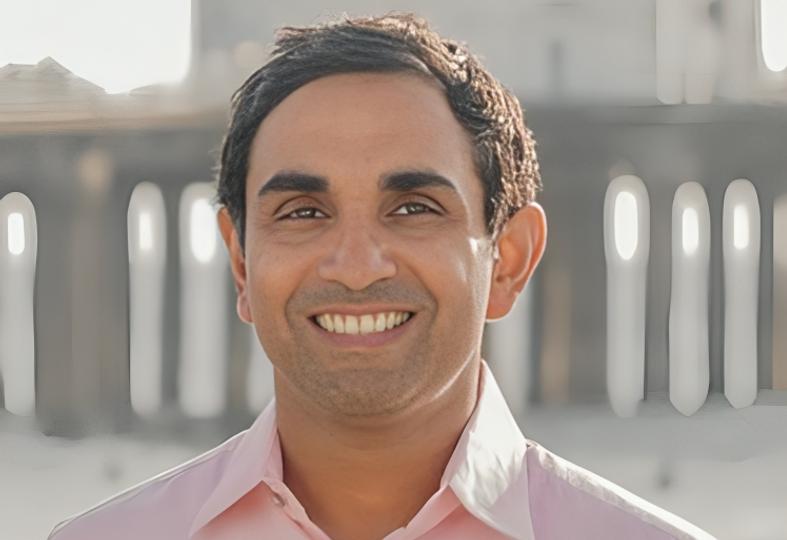
Crypto's future is bright in the context of AI's assault on software firms, says Kraken-backed investment firm
Crypto’s latest bear cycle is a mere blip when compared with the existential threat AI now poses to traditional software services, says Ravi Tanuku, CEO of KRAKacquisition Corp.
What to know:
- KRAK, a Nasdaq-listed special purpose acquisition company, is ready to explore potential deals with crypto-native firms valued between $2 billion and $10 billion.
- Crypto is a clear survivor amid the AI disruption hitting SaaS companies that traditionally formed a part of the IPO pipeline, CEO Ravi Tanuku said.
- The SPAC sponsored by Kraken with venture firms Natural Capital and Tribe Capital closed its $345 million IPO in January.
Don't be fooled by the prolonged crypto bear market, the industry remains a sound investment and less at risk from replacement by AI than traditional software as a service (SaaS) operations, according to Ravi Tanuku, CEO of KRAKacquisition Corp. (KRAKU), a blank check company backed by U.S. crypto exchange Kraken.
The company, a Nasdaq-listed special purpose acquisition company (SPAC) sponsored by Kraken with venture firms Natural Capital and Tribe Capital, closed its $345 million IPO in January, and is now ready to explore deals with crypto-native firms valued between $2 billion and $10 billion, Tanuku said in an interview.
This might sound ironic, given that Kraken's parent Payward only this month delayed its much-anticipated IPO as crypto markets collapsed: The CoinDesk 20 Index (CD20) is on track for a sixth straight monthly drop. Tanuku declined to comment on Kraken’s IPO plans, but said he sees things like stablecoins and payments as the next best story after AI, and crypto as a clear survivor amid the total disruption hitting SaaS companies, which traditionally formed part of the IPO pipeline.
Saas' very existence now seems to be under threat from rapid advancements in artificial intelligence and the potential for machines to write code — one of many areas of skilled labor that could be undone by AI.
“If you were a SaaS company and you wanted to go public and you didn't go public, you have a bigger problem now, which is whether or not you have an answer for AI,” Tanuku said in an interview. “That's not like crypto or bitcoin going from 70k to 80k. It’s a more existential, longer-term question that is much harder to shake.”
So if the money that's not being invested in AI isn't going to SaaS, does that mean crypto's next up? Not really, Tanuku said. But it does mean investors are looking for other places to deploy.
“What I would say is the digital-asset thematic is probably one of the stronger secular stories in the market after AI … AI is the best story. Nobody's going to deny that,” he said.
So what sort of crypto native opportunities is KRAK looking at, and does it include much in the way of AI crossover?
Tanuku said he’s looking at areas where crypto and AI naturally intersect. He mentioned the well-documented excitement over AI agentic commerce, and also raised the possibility of tokenization assisting in feeding AI’s growth.
“I'm curious if somebody doesn't start to float tokens to figure out how to finance some of this infrastructure, because the build-out is so expensive, there might be interesting ways to provide people yield and returns in a tokenized manner,” Tanuku said.
More For You
As stablecoins evolve into core financial infrastructure, North America leads. This report maps the regulation, market shifts, and players driving adoption.
Why it matters:
Stablecoins are entering their third phase of evolution - the institutionalization era - becoming increasingly embedded into core financial infrastructure. As institutions prioritize transparency and compliance, regulated issuers like USDC, RLUSD, and PYUSD are steadily gaining share with RLUSD surpassing $1B in market cap within its first year. North America, leading in regulatory frameworks and institutional distribution, is at the center of it all.
More For You
The integration provides institutions with a compliant way to hold TRX and will be expanded to include TRC-20 assets and native TRX staking.
What to know:
- Anchorage Digital, a U.S.-regulated crypto bank, will add support for the Tron blockchain, starting with institutional custody for TRX, the network's native token.
- The integration provides institutions with a compliant way to hold TRX and will be expanded to include TRC-20 assets and native TRX staking.
- The move brings Tron,...
Facts Only
KRAKacquisition Corp. (KRAKU) is a Nasdaq-listed SPAC sponsored by Kraken, Natural Capital, and Tribe Capital.
KRAK closed a $345 million IPO in January 2024.
The SPAC is targeting crypto-native firms valued between $2 billion and $10 billion for potential acquisitions.
Ravi Tanuku is the CEO of KRAKacquisition Corp.
Tanuku states that crypto, particularly stablecoins and payments, is a strong investment sector compared to SaaS companies.
Tanuku argues that SaaS companies face existential threats from AI advancements, including AI-generated code.
Kraken’s parent company, Payward, delayed its IPO in May 2024 amid a crypto market downturn.
The CoinDesk 20 Index (CD20) is on track for a sixth consecutive monthly decline.
Tanuku mentions potential intersections between crypto and AI, including tokenization for AI infrastructure financing.
Anchorage Digital, a U.S.-regulated crypto bank, will add institutional custody support for Tron’s TRX token.
The Tron integration will expand to include TRC-20 assets and native TRX staking.
Stablecoins like USDC, RLUSD, and PYUSD are gaining institutional adoption, with RLUSD surpassing $1 billion in market cap within its first year.
Executive Summary
KRAKacquisition Corp., a Nasdaq-listed SPAC backed by Kraken, Natural Capital, and Tribe Capital, has raised $345 million in its January IPO and is now targeting crypto-native firms valued between $2 billion and $10 billion for potential acquisitions. CEO Ravi Tanuku argues that crypto, particularly stablecoins and payments, remains a resilient investment sector compared to traditional SaaS companies, which face existential threats from AI-driven automation. While AI dominates investor attention, Tanuku positions crypto as a strong secondary thematic, noting potential intersections between tokenization and AI infrastructure financing. Meanwhile, Kraken’s parent company, Payward, recently delayed its IPO amid a prolonged crypto bear market, though Tanuku did not comment on this. The analysis also highlights institutional adoption of stablecoins and Tron’s integration into regulated custody services, signaling broader financial infrastructure trends.
The narrative contrasts crypto’s perceived stability with the disruption AI poses to SaaS, framing crypto as a survivor in a shifting technological landscape. However, the claim that crypto is less vulnerable to AI than SaaS rests on an assumption that crypto’s core functions—like payments and tokenization—are less automatable, a point that remains debated. The focus on high-value crypto acquisitions suggests confidence in the sector’s long-term viability, even as short-term market conditions remain volatile.
Full Take
**STEELMAN:** The strongest version of this narrative positions crypto as a resilient asset class amid AI-driven disruption, particularly in contrast to SaaS companies facing automation risks. The argument gains credibility by highlighting crypto’s utility in payments and tokenization—areas less directly threatened by AI—while acknowledging AI’s dominance in investor focus. The SPAC’s $345 million IPO and targeting of high-value crypto firms signal institutional confidence, even as short-term market conditions remain bearish. The inclusion of stablecoin adoption and Tron’s regulated custody integration further bolsters the case for crypto’s evolving role in financial infrastructure.
**PATTERN SCAN:** The narrative employs a subtle *ARC-0024 Ambiguity* by framing crypto as a "survivor" without specifying which aspects of crypto are immune to AI disruption. The comparison to SaaS relies on an implied binary—AI either replaces or doesn’t—without addressing how AI might reshape crypto itself (e.g., AI-driven trading, smart contract automation). Additionally, the emphasis on crypto’s resilience amid a bear market could be interpreted as *ARC-0043 Motte-and-Bailey*, where the "motte" (long-term potential) is defended while the "bailey" (short-term volatility) is downplayed.
**ROOT CAUSE:** The underlying paradigm assumes that crypto’s value lies in its decentralized, non-automatable functions (e.g., trustless payments, tokenized assets). This rests on the unstated assumption that AI’s primary threat is to labor-intensive sectors like SaaS, not to financial infrastructure. Historically, this echoes past tech cycles where incumbent industries (e.g., media, retail) were disrupted by digital innovation, with survivors being those that adapted to new paradigms.
**IMPLICATIONS:** For human agency, the narrative suggests that crypto offers a hedge against AI-driven job displacement in software, but it risks overestimating crypto’s insulation from AI’s broader economic effects. Investors may benefit from diversification into crypto, but the costs—regulatory uncertainty, market volatility—are unevenly distributed. Second-order consequences could include accelerated tokenization of AI infrastructure, blurring the lines between crypto and AI economies.
**BRIDGE QUESTIONS:**
If AI can automate code generation, could it also automate smart contract development, undermining crypto’s "survivor" status?
How might regulatory shifts (e.g., stablecoin oversight) alter crypto’s perceived resilience compared to SaaS?
What evidence would falsify the claim that crypto is less vulnerable to AI than SaaS?
**COUNTERSTRIKE SCAN:** A coordinated influence campaign pushing this narrative might exaggerate SaaS’s vulnerability while downplaying crypto’s own exposure to AI (e.g., AI-driven market manipulation, automated compliance). The actual content does not fully match this pattern, as it acknowledges AI’s dominance and crypto’s secondary role. However, the selective framing of crypto as a "clear survivor" without deeper scrutiny of AI’s potential impacts on crypto warrants caution.