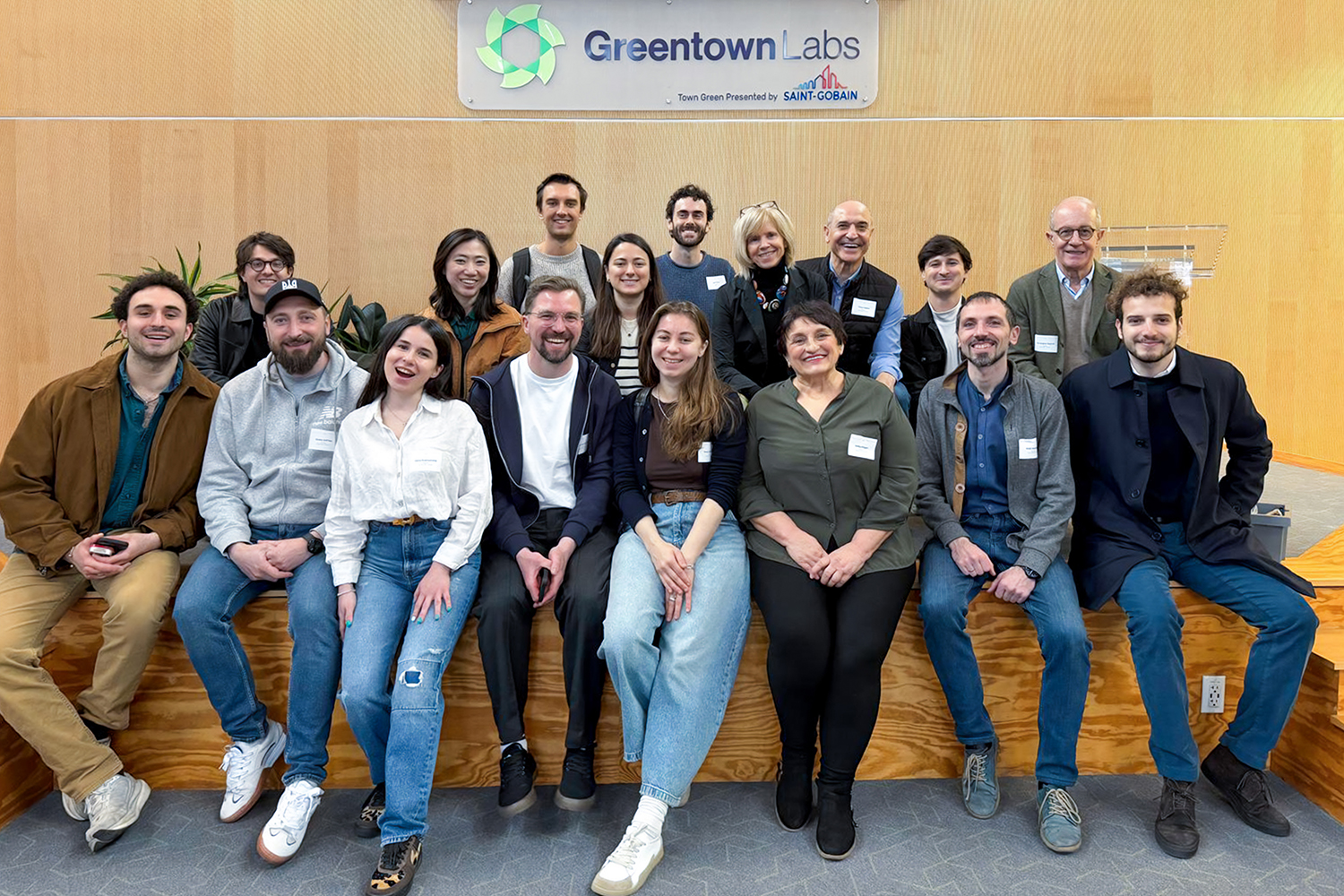
MIT graduate students are working with leaders from the Ukrainian city of Vinnytsia to explore strategies for economic development, infrastructure, and innovation during wartime conditions.
As part of the MIT Department of Urban Studies and Planning (DUSP) spring course 11.S941 (Innovating in Ukraine), DUSP hosted a delegation of five Ukrainian leaders from Vinnytsia, a city region of 400,000 people located approximately 280 kilometers from Kyiv in central Ukraine. The course, taught by professor of the practice Elisabeth Reynolds, is a practicum in which students work with a “client” for the semester on specific projects or issues the city would like to address and provide a final report or deliverable.
The city of Vinnytsia, which had two representatives on the trip, has focused on building out its “innovation ecosystem” across key parts of its economy. Amid the ongoing war with Russia, the country has accelerated its long-time expertise in information technology in both civilian and military contexts. Examples include the digitalization of government services, such that many services are accessible by cellphone through the e-governance app Diia, as well as the development of a rapidly evolving drone industry.
The 13 graduate students, who draw from the School of Architecture and Planning and the MIT Sloan School of Management, as well as Harvard University’s Kennedy School and Graduate School of Design, have worked with members of the city government and Vinnytsia National Technical University on a range of projects focused on the city’s future growth. The projects include developing an agro-food cluster to facilitate Ukraine’s integration into the European Union; transportation and logistics to support economic growth in the city and enhance its role as a regional hub; improving the city’s and country’s electronic waste management; and developing the city’s creative and entrepreneurial talent to retain and attract workers.
While in Cambridge for the week, the visitors and students toured a number of places and organizations that engage in innovation. A trip to Boston City Hall to meet with Kairos Shen, Boston’s chief city planner and a former professor of the practice at the MIT Center for Real Estate, highlighted the ways in which the built environment can facilitate activities and interactions to foster a more innovative city. Tours of the Cambridge Innovation Center in Kendall Square, Greentown Labs in Somerville, and MassChallenge in Boston provided examples of the myriad ways the region supports entrepreneurs through shared workspace, incubators, and network development.
“We are very interested in partnering with some of these organizations,” said Dmitry Sofyna, CEO and co-founder of WINSTARS.AI, an R&D center in Ukraine focused on AI applications. “We want to transform Ukraine from a major player in engineering and scientific outsourcing into a hub for creating large-scale tech companies in defense, medicine, and energy.” Vinnytsia is currently building Crystal Technology Park, one of the largest technology parks in Ukraine.
Usually during a practicum, students travel to the host location to spend a week during Independent Activities Period (IAP) or spring break learning about the city or region. In the case of the collaboration with Vinnytsia — an outgrowth of the MIT-Ukraine initiative and the Ukraine Community Recovery Academy, with which DUSP has been working for two years — the students are unable to travel to Ukraine due to the war. With the help of a generous alumnus, DUSP instead brought the Ukrainian delegation to Cambridge so that there could be in-person exchange between the students and the Vinnytsia partners.
“It’s been an amazing trip,” said Yanna Chaikovska, director of Vinnytsia’s Institute for Urban Development. “We are planning for the future because that is what we must do. Ukraine has faced many challenges in the past and always worked in small and big ways to move forward. MIT is helping us do this.”
Nick Durham, a joint DUSP/MIT Sloan master’s student, added: “I am continually inspired by the resilience of the Ukrainian people and how they are finding creative ways to build a better future. In many ways, Ukrainian innovation is serving as a model for reimagining industries and complex economic systems.”
The collaboration reflects a broader effort within DUSP to engage with cities facing complex economic and geopolitical challenges through applied, practice-based research. Hashim Sarkis, dean of the School of Architecture and Planning, spoke of this effort during a panel discussion with the Ukrainian visitors, noting that “with so much conflict in the world today, SA+P must create new ways to help cities rebuild, whether in Ukraine or elsewhere.”
Facts Only
* MIT graduate students worked with leaders from Vinnytsia, Ukraine.
* The course was part of the MIT DUSP spring course 11.S941 (Innovating in Ukraine).
* The course featured a delegation of five Ukrainian leaders from Vinnytsia.
* The students collaborated with city government members and Vinnytsia National Technical University.
* Projects focused on developing an agro-food cluster, transportation/logistics, electronic waste management, and talent development.
* Ukraine has accelerated expertise in information technology for civilian and military contexts.
* Examples of IT development include the e-governance app Diia and the drone industry.
* The collaboration was made possible by bringing the Ukrainian delegation to Cambridge.
* The students drew from the School of Architecture and Planning, MIT Sloan School of Management, Harvard University, and the Kennedy School.
* The students visited innovation centers in Boston, including the Cambridge Innovation Center and MassChallenge.
Executive Summary
Full Take
Sentinel — Human
The text displays the structural complexity and specific factual grounding typical of human-authored journalistic reporting rather than synthetic generation.