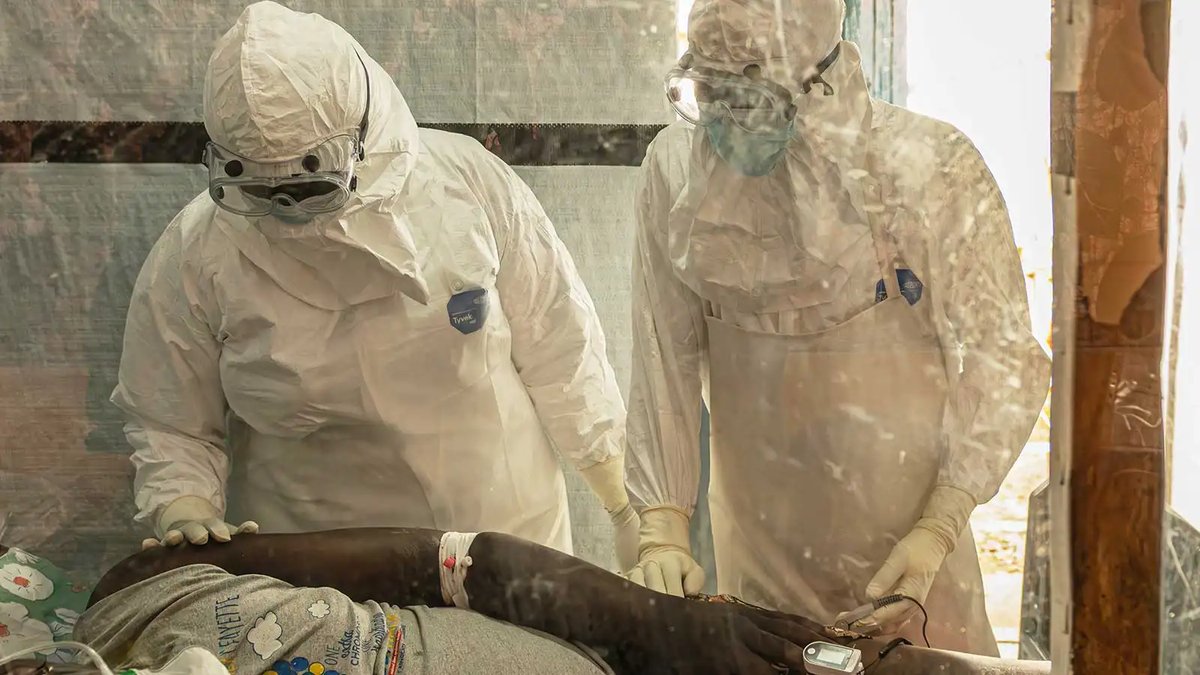
Researchers began a highly anticipated study of two possible Ebola treatments on Thursday in hopes of fighting the still-growing outbreak in eastern Congo, as the World Health Organization (WHO) announced the enrollment of the first participant.
The virus causing this outbreak, called Bundibugyo, is less common than others that cause Ebola disease and there are no specific treatments or vaccines for it. Already more than 1,400 people have been diagnosed and 438 have died, WHO Director-General Tedros Adhanom Ghebreyesus, PhD, said Thursday.
Standard supportive care, especially if started early, can help and the WHO says more than 200 people have recovered. But there's an urgent need for better options.
The trial "offers real hope that we can deliver concrete results for -- and with -- the communities at the heart of the outbreak," Ghebreyesus said in a statement.
Researchers will be testing if two drugs could improve survival. One is Gilead Sciences' remdesivir (Veklury), a broad-acting antiviral approved to treat COVID-19 but that has shown some hints in lab tests that it may help fight the currently spreading virus. The other is Mapp Biopharmaceutical's experimental MBP134, antibodies engineered to target Ebola viruses including Bundibugyo.
All patients enrolled in the trial would receive today's best standard care and be randomly assigned to also receive remdesivir, MBP134, both, or neither, said WHO research adviser Vasee Moorthy, MD, PhD. Survival will be tracked for 28 days after starting treatment.
It could take months and possibly as many as 1,000 study participants to tell if either drug works, Moorthy cautioned, explaining that scientists could tell more quickly, and with fewer patients, if one or the other turns out to be highly effective.
Currently, the study is being offered only in one Ebola treatment center in Congo's Ituri province. The region has been hit hard by violence, including toward healthcare workers trying to fight a virus spread by contact with sick patients' bodily fluids. Officials plan to expand to other locations once it is safe to do so.
Moorthy said enough of each drug had been donated by Gilead and the U.S. government, which has funded MBP134 research and owns those doses, for the trial. If either proves effective, the next step would be ensuring patients can continue to access the treatment outside the study.
The WHO-supported trial is a collaboration between Congo's national biomedical research institute INRB, Britain's Oxford University, Antwerp's Institute of Tropical Medicine, and other international health groups.
Sentinel — Human
The text reads as a structured news report, synthesizing specific facts and expert commentary regarding a global health trial, exhibiting characteristics typical of human-written journalism.