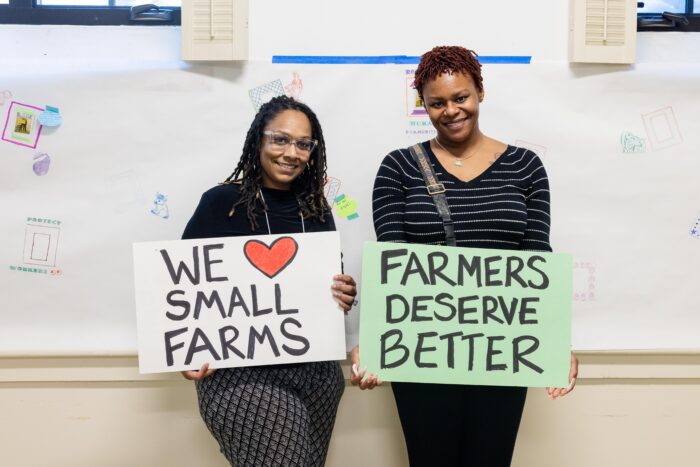
Despite the winter weather blanketing much of the nation and Washington, DC, an ongoing shutdown, and continued national debates on food and agriculture policy, NSAC’s advocacy work continues. The National Sustainable Agriculture Coalition (NSAC) held its annual Winter Meeting from February 9 to 12 in Washington, DC. Over 150 farmers and advocates from NSAC’s network gathered to strategize, build community, and bring the voice of sustainable agriculture to policymakers in DC. We gathered this year within the context of the ripple effects the Administration’s actions on immigration, international trade, and foreign policy have had across our entire country, including our food system.
Farmers’ Voices
Our time together included opportunities to plan our strategy for the year ahead. NSAC members talked about shared policy priorities in the political landscape and prepared for our Day of Action, when NSAC members and farmer advocates visit Congressional delegations. Many farmers are experiencing federal policy and programs that fail to meet their needs. This year, NSAC members were joined by nearly 50 farmers who came to share their experiences directly with policy makers in Washington, channeling their frustration into pragmatic, solutions-oriented advocacy, almost doubling farmer participation from recent years.
Policy work can be overwhelming to anyone who is new to it. However, despite that perception, policy aims to codify practices based on the real experiences of people who inform those policy decisions. At NSAC, this includes making sure that policy decisions are informed by the lived experiences of farmers who are working through their practices on building a better food and agriculture system. It is critical that farmers can equitably access opportunities to succeed, and that they have a voice in shaping what those opportunities look like. To that end, for the second year in a row, our Winter Meeting focused on providing opportunities for farmers to voice what has worked and what has not worked for them through storytelling and advocacy.
Coalition Work
An important aspect of coalition work is strategizing collectively over shared priorities. While our time together certainly does that, it is also an important opportunity to build a stronger community where we can hear everyone’s ideas and concerns. In the end, the ability to work together allows our work to be more impactful during our time together in Washington as well as in our collective action going forward. One way our impact can be measured is in the number of attendees at the meeting and their time spent on the Hill, meeting with members of Congress and their staff, and with decision-makers at USDA. Over 150 coalition members attended the Winter Meeting, likewise logging over 150 meetings with members of Congress, offering practical solutions and opportunities to benefit all farms. Additionally, NSAC members were able to meet with USDA officials across the department to talk about the benefits of the programs available for farmers, and areas where the programs could improve.
Beyond the numbers, creating opportunities for NSAC members and farmers to meet directly with their elected representatives can have a transformational, long term impact. These conversations strengthen our ability to communicate clearly and persuasively with members of Congress about the changes we would like to see in our food system. That impact can extend beyond numbers as it forms the basis of a representative democracy.
Our Voices Heard
A group of Buddhist monks walking for peace between Texas and Washington, DC, happened to be on Capitol Hill for an additional walk along the National Mall on the same day we held our traditional Day of Action. As
NSAC members and advocates visited Congress to have our collective voices heard, many were able to catch a glimpse of the pious trekkers between their walks to and from the Capitol grounds. The monks, however, were not the only travelers on Capitol Hill that day with a mission. Our day of advocacy has become a fixture of our winter meetings, and is also an opportunity to educate members of Congress about policy solutions that better serve farmers.
As Ed Dubrick of DuChick Ranch, LLC, and NSAC member, the Illinois Stewardship Alliance shared:
“We came directly to Capitol Hill to educate lawmakers on issues important to our farm and the farms of our neighbors. We shared personal stories that highlight the impact recent and current investments in conservation and local food systems have made in our community and why continued support for these programs is needed.”
Despite the Administration’s efforts to downplay the diversity of our nation, our food system is as diverse as the people who participate in it. Yet, not everyone has equal access to the opportunities that government programs offer or to the benefits many of those programs were designed to address.
Zach Ben, of Bidii Baby Foods in Navajo Territory, traveled to the Winter Meeting with NSAC member Farm to Table New Mexico. Although he has already had the opportunity to educate members of Congress on the challenges he and his community face as active participants in our food system, he further reflected on the experience:
“Coming from a disenfranchised culture, this is my opportunity to enfranchise our farm because I want to continue using Indigenous knowledge in my farming practices as a traditional baby foods producer.”
As part of our advocacy during our day of action, we also delivered a letter signed by over 500 farmers from across the nation to House and Senate Agriculture Committees leadership urging Congress to provide economic relief for farmers as the farm crisis continues to ravage rural communities, putting farmers at risk of losing their livelihood amid high production costs for fertilizers and equipment, while decreasing access to programs that help farmers implement conservation practices, as well as to domestic market initiatives. The letter calls for the development of more robust domestic markets and local supply chains, and for broad eligibility to maximize its impact. This letter is part of NSAC’s ongoing effort to work with Congress to address the severe challenges farmers are facing in the immediate and longer-term, and we hope its delivery will help Congressional leaders prioritize this in their committee work.
Perennial Advocate Award
Last year, we presented the NSAC Perennial Advocate Award for the first time, and this year, we took the opportunity to honor another champion of our movement. NSAC created the Perennial Advocate Award to honor someone who, through their lifetime, has proven to be a leader through years of dedication, participating in more than one farm bill campaign, providing insight and input in many coalition campaigns, and contributing significantly to policy development through research, grassroots work, advocacy, and thought partnership. The Perennial Advocate Award goes to someone who exemplifies NSAC’s values of integrity, stewardship, collaboration, and justice.
This year, NSAC was proud to honor Margaret Krome. Margaret served as Policy Program Director at Michael Fields Agricultural Institute before she retired last year. In introducing the award, NSAC Coalition Director Sarah Hackney spoke of Krome’s work as grassroots-led policy advocacy, and reminded the audience of Krome’s constant grounding question in policy advocacy work, “Have you talked to a farmer?”
In receiving the award, Krome expressed gratitude and reframed her role in the sustainable agriculture movement, humbly stating, “I don’t believe in stars, but I believe in constellations.” Her anecdotes of being able to convince lawmakers of the benefits and utility of foundational programs to the movement, like the Sustainable Agriculture Research and Education Program (SARE), exemplified in her own words, the tenets of a representative democracy.
As our time together wrapped up, we left as we do every year: exhausted and inspired for the road ahead. Unlike other years, we wrapped up our winter meeting with the news of an upcoming farm bill markup. We left our meeting with the sense that, as our work continues, our time together had been worth it, helping us continue to lay the groundwork for farm policy that invests in healthy communities, levels the playing field for small and mid-sized farmers, equips farmers with the tools and resources they need to build resilient and viable operations, and foster the next generation of farmers and ranchers. While the draft farm bill falls short of these goals, we will carry the momentum from our Day of Action forward and continue pushing for food and farm policy that works across the food system, from the natural resources our farmers steward to the producers and farm workers, and across the supply chain.
The NSAC staff is grateful for all of our members, partners, vendors and donors who help make this work possible, and of course for the farmers on the front lines! Thank you to photographer Ruth Annan for capturing so many special moments from this winter’s Lobby Day!
Leave a Reply
Facts Only
The National Sustainable Agriculture Coalition (NSAC) held its annual Winter Meeting in Washington, DC, from February 9 to 12.
Over 150 farmers and advocates attended the meeting.
The event included a Day of Action where nearly 50 farmers met with Congressional delegations.
NSAC members also met with USDA officials to discuss farm programs.
A letter signed by over 500 farmers was delivered to House and Senate Agriculture Committees, urging economic relief for farmers.
Margaret Krome received the NSAC Perennial Advocate Award for her contributions to sustainable agriculture policy.
Farmers shared personal experiences with policymakers to highlight challenges in the food system.
The meeting addressed issues such as high production costs, conservation programs, and local food systems.
NSAC members emphasized the need for equitable access to farming opportunities.
The event concluded with discussions about the upcoming farm bill markup.
The meeting took place amid national debates on food policy, immigration, and trade.
Participants included farmers from diverse backgrounds, such as Zach Ben of Bidii Baby Foods in Navajo Territory.
Executive Summary
The National Sustainable Agriculture Coalition (NSAC) held its annual Winter Meeting in Washington, DC, from February 9 to 12, gathering over 150 farmers and advocates to strategize and engage with policymakers. The event included a Day of Action, where nearly 50 farmers met with Congressional delegations to advocate for policies addressing challenges in sustainable agriculture, such as economic relief, conservation programs, and local food systems. NSAC members also met with USDA officials to discuss program improvements. The meeting highlighted the importance of farmer voices in policy decisions, with participants emphasizing the need for equitable access to opportunities and resources. A letter signed by over 500 farmers was delivered to House and Senate Agriculture Committees, urging economic relief amid rising production costs and limited program access. The event also honored Margaret Krome with the Perennial Advocate Award for her lifelong contributions to sustainable agriculture policy. The meeting concluded with a sense of momentum, despite concerns that the upcoming farm bill draft falls short of key goals.
The gathering occurred against a backdrop of national debates on food and agriculture policy, immigration, and trade, with participants emphasizing the diversity of the food system and the need for inclusive policy solutions. Farmers shared personal stories to illustrate the impact of federal programs and the challenges they face, such as high production costs and limited access to conservation initiatives. The event underscored the role of coalition-building and direct advocacy in shaping food and farm policy, with NSAC members aiming to foster resilient farming operations and support the next generation of farmers.
Full Take
The NSAC Winter Meeting presents a compelling narrative of grassroots advocacy and policy engagement, emphasizing the critical role of farmer voices in shaping food and agriculture systems. The strongest version of this narrative highlights the tangible efforts of farmers and advocates to influence policy, from direct meetings with lawmakers to the delivery of a letter signed by over 500 farmers. The focus on equitable access, economic relief, and sustainable practices aligns with broader movements for systemic change in agriculture. However, the narrative also subtly frames the current policy landscape as inadequate, with the upcoming farm bill draft falling short of key goals—a claim that, while supported by participant testimonials, could benefit from broader contextual analysis of political constraints.
Patterns detected: none. The content does not exhibit manipulation patterns such as emotional exploitation or distortion. Instead, it presents a straightforward account of advocacy efforts, grounded in verifiable actions and participant statements.
The root cause of this narrative lies in the tension between grassroots agricultural needs and institutional policy frameworks. The assumption that farmer-led advocacy can bridge this gap is central, but the article does not explore potential counterarguments, such as the structural barriers within Congress or the influence of agribusiness lobbies. Historically, this echoes the broader struggle of small-scale farmers to gain policy traction in a system often dominated by larger agricultural interests.
The implications for human agency are significant: the narrative empowers farmers as active participants in policy, but it also underscores the fragility of their position amid economic and political pressures. The second-order consequences could include increased polarization if policy changes fail to materialize, or conversely, a strengthened coalition if advocacy efforts yield tangible results.
Bridge questions: How might the NSAC’s advocacy efforts be received by lawmakers with competing agricultural priorities? What structural barriers, beyond the farm bill, might limit the impact of these policy proposals? Would the inclusion of agribusiness perspectives strengthen or weaken the coalition’s goals?
Counterstrike scan: If this narrative were part of a coordinated influence campaign, the playbook might involve amplifying farmer testimonials to create a sense of urgency while downplaying opposing viewpoints. However, the actual content does not match this pattern, as it presents a balanced account of advocacy efforts without overt manipulation.
Sentinel — Human
The article exhibits strong human authorship signals, including emotional nuance, specific attribution, and narrative digressions, with minimal stylometric or coherence red flags.