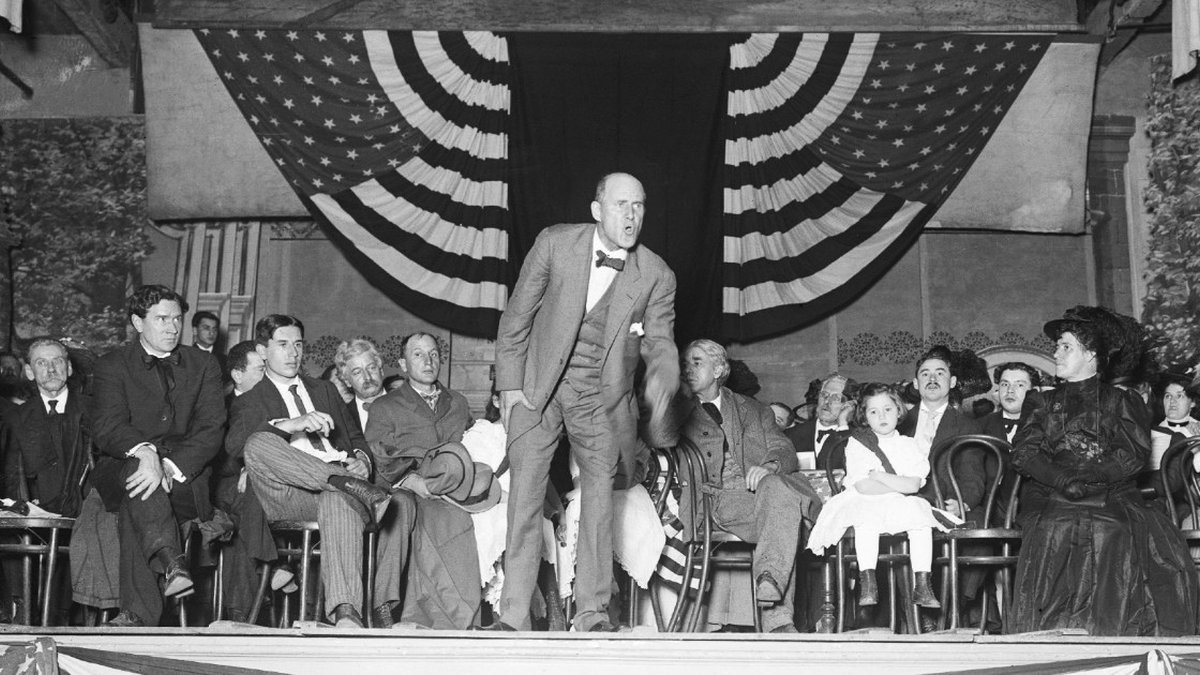
What to Eugene Debs Was the Fourth of July?
Few figures on the left have been as committed to realizing the democratic promise of American politics as Eugene Debs.
It has been regarded as a patriotic duty for Americans, on the 4th of July, to apostrophize Liberty and to select from the vocabularies of all languages eulogistic words to describe its value and its glory, and when words failed to express those essential attributes of liberty which made life itself an inferior blessing, bonfires have blazed, cannons have belched their thunder, banners have waved, drums have throbbed, and bugle blasts have called the people to assemble and rejoice together over God’s inscrutable decree in bestowing upon Americans blessings denied to all other peoples, kindreds, and tongues since time began. Nor do I doubt that on this anniversary such exhibitions will be repeated, but it will be a hollow mockery. The stage will be gorgeous with scenery for the play of liberty, but liberty will be absent—only its ghost will appear, only its “canonized bones” will be present.
—Eugene V. Debs, “Liberty’s Anniversary,” July 4, 1895
This July 4 there will no doubt be a plenitude of fireworks displays, air shows, military parades, rockets’ red glare, and bombs bursting in air to mark the nation’s 250th anniversary. Donald Trump decreed as much within days of his 2025 inauguration, via an executive order that promised “to provide a grand celebration worthy of the momentous occasion of the 250th anniversary of American Independence on July 4, 2026,” and “to take other actions to honor the history of our great Nation.” Ever the showman, Trump will produce a scripted, televised, and livestreamed extravaganza of Americanism, featuring a UFC fight that epitomizes his concept of politics and culminating in what he has called “the most spectacular birthday party” for the country. He will wrap himself in the Declaration of Independence as part of a broader effort to frame anyone who criticizes him as a dangerous menace to the American way of life.
Central to this agenda is a determined effort to erase the American left, both figuratively and literally. The figurative erasure was inaugurated with an executive order on “Ending Radical Indoctrination in K-12 Schooling,” which mandated the termination of “radical, anti-American ideologies” and the promotion of educational policies designed “to instill a patriotic admiration for our incredible Nation and the values for which we stand.” This edict was followed by a second one, “Restoring Truth and Sanity to American History,” and a wholesale assault on universities across the country.
The effort to literally erase the left began with Trump’s summer 2025 deployment of federalized National Guard troops and U.S. Marines to Los Angeles to suppress protests of ICE detentions, following similar deployments in Chicago, Memphis, and Washington, D.C. That September, Trump issued a memo on “Countering Domestic Terrorism and Organized Political Violence,” and then held a convocation of hundreds of the highest-ranking officers in the U.S. armed forces, who were informed that they might soon be fighting a “war from within” against the violent hordes who had taken over cities “run by the radical left Democrats.” Finally, in December, the administration began Operation Metro Surge, sending roughly 3,000 Department of Homeland Security agents to Minnesota’s Twin Cities in a mass deportation campaign that led to thousands of arrests and the killing of two protesters, Renee Good and Alex Pretti.
These measures represent the fulfillment of promises proudly announced by Trump during his campaign. In a 2023 Veterans Day speech described by the Washington Post as “echoing dictators,” Trump declared: “We pledge to you that we will root out the communists, Marxists, fascists, and the radical left thugs that live like vermin within the confines of our country that lie and steal and cheat on elections. . . . They’ll do anything, whether legally or illegally, to destroy America and to destroy the American Dream.”
As Dissent readers know, it is in fact Trump and his allies who are resolutely destroying American democracy. Far from being a threat to democracy, the American left has historically played an indispensable role in the democratization of American politics and society, from the abolitionist, women’s rights, and labor movements of the nineteenth century to twentieth-century Progressive and New Deal reformers—many inspired by socialist ideas—and the postwar civil rights, women’s, and peace movements.
Nobody on the left epitomizes the deep and sincere commitment to realizing the democratic promise of American politics more than Eugene Debs, the legendary turn-of-the-twentieth-century Socialist Party leader who was twice imprisoned for his political advocacy, ran five times for president, and consistently battled reactionary invocations of American nationalism. Debs, who lived his entire life in Terre Haute, Indiana, was about as culturally mainstream a Midwesterner as can be imagined, as is made clear in Nick Salvatore’s classic biography, Eugene V. Debs: Citizen and Socialist and the 2019 PBS documentary The Revolutionist: Eugene V. Debs, which draws heavily on Salvatore’s work. And yet Debs’s experiences—as a locomotive fireman and railroad worker, an industrial union organizer and strike leader, and eventually as the preeminent leader of the Socialist Party of America—brought him face to face with the hypocrisy, injustice, and political corruption of Gilded Age America, and instructed him on the dignity of the struggle to make America greater by making it freer and more just.
Debs was a withering critic of July 4 hoopla. He articulated this in the epigraph to this essay, written from a Woodstock jail in 1895, and even more powerfully in a speech delivered in Chicago on July 4, 1901. “I am not of those who worship the flag,” Debs said.
I am a patriot, but in the sense that I love all countries. I love the sentiment of William L. Garrison: “All the world is my country and all mankind are my countrymen.” Thomas Jefferson once said: “Where liberty is, is my country.” That is good. Thomas Paine said: “Where liberty is honored, that is my country.” That is better. Where liberty is not, Socialism has a mission, and, therefore, the mission of Socialism is as wide as the world.
Debs made clear he is an internationalist, yet he invoked three Americans who took their bearings from the American Revolution. “I like the 4th of July,” he concluded, because “it breathes a spirit of revolution.” Indeed, as Salvatore’s pathbreaking biography made clear, Debs consistently saw himself as an heir to a distinctly American tradition of civic republicanism and dissenting radicalism, and frequently cited a wide range of American historical figures that included Thomas Jefferson, Patrick Henry, Samuel Adams, Thomas Paine, Elijah Lovejoy, Elizabeth Cady Stanton, Lucretia Mott, William Lloyd Garrison, Wendell Phillips, Gerrit Smith, John Brown, Thaddeus Stevens, Susan B. Anthony, and Abraham Lincoln.
This commitment to the spirit of 1776 is central to two of Debs’s most important speeches: “Liberty,” given upon his release from prison in 1895 for his role in the Pullman Strike, and his address to the jury at the close of his 1918 trial for violating the Espionage Act of 1917, which resulted in his conviction. In these speeches Debs speaks as what historian Ernest Freeberg has called “democracy’s prisoner”—a man figuratively and literally on trial for his political convictions. He powerfully condemns the American political system for its violation of his rights and for its hostility to the demands of workers. And yet in each of these speeches Debs also speaks as an American, committed to realizing the egalitarian promise of the American Revolution carried forward by generations of dissenters, whom he proudly claims as his forbears.
At a time when a rhetoric of American greatness was being deployed to break strikes, disrupt and disperse public demonstrations, and harass and prosecute dissenters, Debs refused to be silenced—but he also refused to cede American liberty to his reactionary opponents.
Liberty, Lost and Regained
On November 22, 1895, after spending six months in prison, Debs addressed a large crowd of supporters at Battery D in Chicago. As president of the American Railway Union (ARU), Debs had been one of the leaders of the Pullman Strike of 1894, which brought interstate rail transport to a standstill. U.S. Attorney General Richard Olney, working in tandem with Pullman managers and allies, obtained a court injunction against the union and deployed federal troops to break the strike, over the public objections of Illinois Governor John Peter Altgeld (whom Debs later memorialized in a 1902 obituary). The union offices were ransacked; upward of a dozen people were killed and over fifty wounded during the violent escalation; and a number of union leaders, most famously Debs himself, were arrested, convicted of violating the injunction, and sentenced to prison terms for their role in organizing the boycott, a move upheld by the Supreme Court.
“Liberty” is a rhetorically complex speech. It evokes the spirit of liberty heralded by the Declaration of Independence and the promise of an egalitarian form of collective economic freedom yet to be realized by American workers. As Salvatore argues, the speech marked an important moment in Debs’s evolution from a labor activist with radical republican leanings to the country’s leading socialist.
Debs’s speech denounces the collusion of the Pullman Company and its allies with the federal judiciary, the White House, and the troops under the president’s command. “I stand in your presence stripped of my constitutional rights as a freeman and shorn of the most sacred prerogatives of American citizenship, and what is true of myself is true of every other citizen who has the temerity to protest against corporation rule or question the absolute sway of the money power,” he said. “It is not law nor the administration of law of which I complain. It is the flagrant violation of the constitution, the total abrogation of law and the usurpation of judicial and despotic power, by virtue of which my colleagues and myself were committed to jail, against which I enter my solemn protest.”
Debs framed the suppression of the Pullman Strike as an attack on working-class Americans, successfully prosecuted by a government in league with “money power” and “plutocracy.” While condemning the violation of his constitutional liberties, he also defended the ARU as a necessary and legitimate organization of workers, and the strike as a legitimate means of pursuing justice. The union “threw down no gauntlet to courts or armies—it simply resisted the invasion of the rights of workingmen by corporations . . . and defied the power of corporations.”
The speech’s central reference point is the Declaration of Independence. The first half of the speech centers on the theme of “personal liberty; or giving it its full height, depth, and breadth, American liberty, something that Americans have been accustomed to eulogize since the foundation of the Republic.” Paying tribute to the republic’s founding, Debs proceeded to wax poetic, for eight long paragraphs, about the enduring resonance of the 1776 proclamation, the indivisibility of liberty, and the “more than satanic crime of stealing the jewel of liberty from the crown of manhood and reducing of the victim of the burglary to slavery or to prison.”
It is for this crime that Debs morally indicts the railroad magnates and their federal government allies. And he insists that it is the labor movement that embodies “the spirit of ’76”: “To the unified hosts of American workingmen fate has committed the charge of rescuing American liberties from the grasp of the vandal horde that have placed them in peril, by seizing the ballot and wielding it to regain the priceless heritage and to preserve and transmit it without scar or blemish to the generations yet to come.”
The ballot, Debs notes approvingly, quoting an abolitionist poem, “has been called ‘a weapon that executes a free man’s will as lighting does the will of God.’” Debs rhapsodizes in almost religious tones about the power of democratic elections:
There is nothing in our government it cannot remove or amend. It can make and unmake presidents and congresses and courts. It can abolish unjust laws and consign to eternal odium and oblivion unjust judges, strip from them their robes and gowns and send them forth unclean as lepers to bear the burden of merited obloquy as Cain with the mark of a murderer. It can sweep away trusts, syndicates, corporations, monopolies, and every other abnormal development of the money power designed to abridge the liberties of workingmen and enslave them by the degradation incident to poverty and enforced idleness, as cyclones scatter the leaves of the forest. The ballot can do all this and more. It can give our civilization its crowning glory—the cooperative commonwealth.
A brilliant orator, Debs was also a strategist. Far from being naive about the limits of the electoral process and the enormous obstacles facing radical social movements and political parties, Debs fully appreciated the importance of organizing, movement building, political education, and direct action. But he also appreciated the power of the dissenting American political tradition, and he understood that civil liberties and regular democratic elections represented genuine if precarious political progress, which could further social and economic justice.
“Liberty” ends with the hope that “American lovers of liberty are setting in operation forces to rescue their constitutional liberties from the grasp of monopoly and its mercenary hirelings.” That hope was not in vain—even if the Pullman Strike was suppressed, and Debs’s imprisonment was the harbinger of arduous struggles ahead, both for him and for the movement he helped to found.
The Canton Speech and the Espionage Conviction
By the time the United States entered the First World War on April 6, 1917, Debs had become a well-known and outspoken radical and a co-founder of the Socialist Party of America. He had run for office four times as the party’s presidential candidate, receiving over 900,000 votes, or 6 percent of the total, in 1912. A strong critic of the war since its start in 1914, and an enthusiastic supporter of the Russian Revolution—both the February 1917 overthrow of the Russian Czar and the Bolsheviks’ October seizure of power—Debs was one of many fierce critics of U.S. entry into the war, as Michael Kazin explores in War Against War.
On June 16, 1918, Debs famously delivered a staunch antiwar speech at a Socialist Party state convention in Canton, Ohio. As a result, he was arrested, prosecuted, and ultimately convicted of violating the 1917 Espionage Act by interfering with the draft. As commentators have noted, Debs well understood his legal vulnerability when he spoke at Canton, and he was careful not to explicitly advocate draft resistance. At the same time, the speech offered a relentless attack on the hypocrisies of the war, the authoritarian tendencies it unleashed, and the treatment of workers as the cannon fodder of inter-imperialist rivalry. Debs denounces “the gentry who are today wrapped up in the American flag, who shout their claim from the housetops that they are the only patriots, and who have their magnifying glasses in hand, scanning the country for evidence of disloyalty,” insisting that “in every age it has been the tyrant, the oppressor and the exploiter who has wrapped himself in the cloak of patriotism, or religion, or both to deceive and overawe the people.”
The speech was radical in its condemnation of the war and its promise of socialist revolution. And it contained none of the references to the American revolutionary heritage—Jefferson, Paine, Garrison—that had marked the 1895 “Liberty” speech and so much of Debs’s rhetoric in the ensuing years. Yet in Debs’s address to the jury in his 1918 trial, quoted in Scott Nearing’s 1919 pamphlet “The Debs Decision,” these themes boldly reappear. Proudly defending his sympathy for the Bolshevik Revolution, Debs pivots to the fact that America itself was born in revolution. He reminds the jury that “there was a time when George Washington, who is now revered as the father of his country, was denounced as a disloyalist, when Sam Adams, who is known to us as the father of the American Revolution, was condemned as an incendiary, and Patrick Henry, who delivered that inspired and inspiring oration that aroused the colonists, was condemned as a traitor.” He then shifted to the “mighty agitation” associated with the abolitionist movement, declaring himself to proudly stand in a tradition of dissent much more serious about liberty than those hypocritical “patriots” who carry the flag while they trample freedom afoot.
Debs noted the irony of an American government that was prosecuting socialists in the name of “democracy”: “Isn’t it strange that we Socialists stand almost alone today in defending the Constitution of the United States?” And he closed by refusing to recant a single word of his Canton speech. “What you may choose to do to me will be of small consequence after all,” he told the jury. “I am not on trial here. There is an infinitely greater issue that is being tried today in this court, though you may not be conscious of it. American institutions are on trial here before a court of American citizens. The future will tell.”
Debsian Patriotism
The future did tell. Debs was convicted and sentenced to prison for ten years; his conviction was upheld by the Supreme Court in a unanimous decision written by Justice Oliver Wendell Holmes Jr.; and he served over two years in a federal penitentiary before his sentence was commuted by President Warren G. Harding. More important, the Socialist Party and the socialist left more generally were decimated by the Wilson administration’s wartime crackdown and the Red Scare to which it gave rise. In American Midnight, Adam Hochschild considers the potentially widespread effects of this suppression of the Socialist Party: “Had it not been so hobbled, even with a minority of voters it might have been able to push the mainstream parties into creating the sort of stronger social safety net and national health insurance systems that people take for granted in Canada and Western Europe today.”
At the same time, Debs remained unbowed in his strenuous advocacy of both democratic civil liberties and a genuinely democratic socialism. And through his efforts, he helped lay the foundation for a socialist tradition that eventually gave rise to this very magazine in 1954, and that more recently has experienced a resurgence in the electoral successes of Bernie Sanders, Alexandria Ocasio-Cortez, Zohran Mamdani, Katie Wilson, and the hundreds of socialists, most members of the Democratic Socialists of America, who hold state and local office across the country.
This history is complicated, and it is not my purpose here to assess the many ways that Debs has figured and still figures in debates about left political strategy. My only point is that at a time when a triumphalist history of the United States is being promoted with a vengeance, we can clearly see how Debs’s greatness resided in his courageous activism in the face of real repression, vindicating the very ideals that the ideologues of the MAGA movement regularly trample.
Debs appreciated the rhetorical power of flag-waving, but he adamantly resisted the use of patriotic symbols to police dissent and repress the labor movement, and he suffered for his refusal to bend the knee to the rhetoric of “America, right or wrong.” At the same time, while Debs refused to pledge allegiance to the flag upon demand, he did not reject “the republic for which it stands,” or at least for which it has sometimes stood and might yet stand. He said as much in the opening line of his “Liberty” speech: in spite of the hypocrisy and the repression, “manifestly the ‘spirit of ’76’ still survives” wherever and whenever “lovers of liberty” and “despisers of despotism” act collectively to advance the cause of freedom.
Debs actually walked the walk of liberty in a way that few others in American history have done. And by refusing to cede the spirit of the Declaration to the economic and political elites of his day, he played a crucial role in advancing workers’ rights, the right to dissent and protest even in time of war, and the possibility of ongoing contestation that is at the heart of any meaningful form of democracy. Debs, in short, was one of the great democratizers of twentieth-century America.
To insist on this is not to sugarcoat Debs or to present him as someone easily incorporated into a reassuring liberal narrative of steady progress. Debs was a labor radical. He was a rabble-rouser who challenged the economic and political prerogatives of capital and disrupted the conventional politics of his day in the way he combined direct action, mass protest, and electoral politics. And what he stood for—socialism—was outside the American mainstream then, and remains so now, despite the impressive victories noted above. And yet what he stood for is an essential part of the ongoing history of the United States. His agitation, his repression, and the partial incorporation of his demands are all central to the contentious story of American democracy.
This July 4, Trump and his supporters will seek to conscript “the spirit of ’76” in the name of their bitter, authoritarian, gold-plated vision. And yet Debs reminds us that the tradition of radical dissent in the United States has always been contested. Those who have done the most to honor its legacy are those who have refused to keep silent in the face of injustice, and who have insisted that redeeming the promise of the Declaration of Independence’s noble words is an ongoing struggle.
Jeffrey C. Isaac is James H. Rudy Professor of Political Science at Indiana University, Bloomington. A longtime member of Dissent’s editorial board, he has written many books and articles, and he comments regularly on current affairs at Common Dreams and on his two blogs, Democracy in Dark Times and Defending Democracy’s Declaration. He dedicates this essay to the memory of Nick Salvatore, a great historian, and Raymond Franklin, his old Queens College economics professor and mentor and inspiration in everything related to socialism. He would also like to thank his friends Bob Ivie, Bob Orsi, and Jeff Goldfarb for their comments.