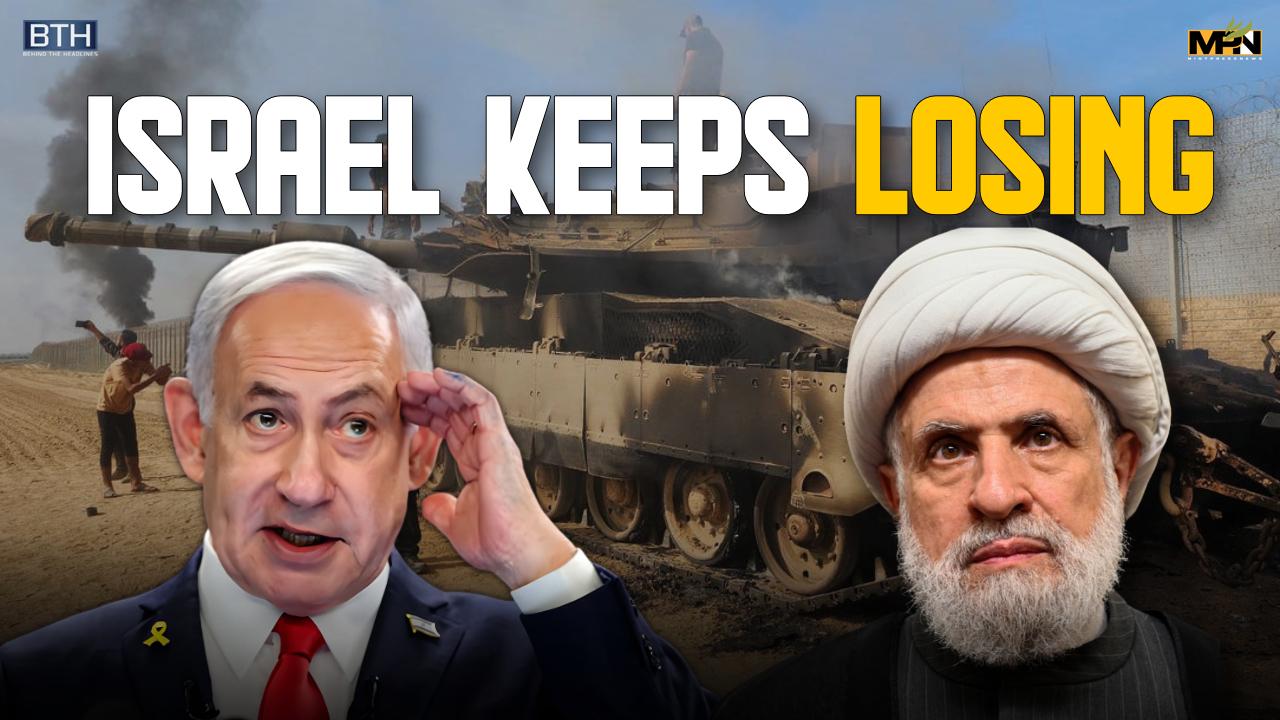
On this week’s MintCast podcast, MintPress director Mnar Adley is joined by Robert Inlakesh, a staff writer at MintPress and political analyst specializing in Middle East geopolitics — they discuss Hezbolla’s military wins against Israel. As Israel intensifies its military campaign in Lebanon, the gap between its strategic ambitions and battlefield realities is becoming increasingly apparent. While Israeli officials speak openly of creating a long-term “buffer zone” in southern Lebanon—effectively reviving a decades-long occupation—the operation is facing fierce resistance from Hezbollah forces on the ground.
Israeli airstrikes have pounded civilian areas across the country, following a familiar pattern seen in Gaza: widespread destruction of infrastructure and residential neighborhoods under the justification of targeting militant positions.
Critics argue that this approach is designed not only to weaken Hezbollah but to depopulate large parts of southern Lebanon, fundamentally altering the region’s demographics.
Yet despite the intensity of the bombardment, Hezbollah has not collapsed. On the contrary, the group continues to demonstrate significant military capability. Reports indicate that just in the last three weeks, 50 Israeli tanks have been destroyed, and Hezbollah units remain active across multiple fronts. Far from being diminished, the organization is widely believed to retain a force numbering in the tens of thousands—potentially exceeding the size of the Lebanese army itself.
This resilience has complicated Israel’s ground invasion plans. What was expected to be a rapid advance into southern Lebanon is now shaping up to be a prolonged and costly confrontation. Hezbollah’s entrenched positions, combined with its experience from previous conflicts, have turned the battlefield into a war of attrition.
The broader regional context has only added to the complexity. The removal of the Syrian government in late 2024 disrupted long-standing supply lines and alliances that once supported Hezbollah. However, rather than collapsing, the group appears to have adapted, maintaining operational capacity even as regional dynamics shift.
Meanwhile, political tensions inside Lebanon are rising. The country’s leadership—widely seen as aligned with U.S. interests—is under increasing pressure to confront Hezbollah internally. Washington has pushed for the group’s disarmament, raising fears that Lebanon could be drawn into internal conflict at the very moment it faces external invasion. The possibility of a renewed civil war is no longer unthinkable.
Israel, for its part, faces mounting questions about sustainability. Over the past year, it has engaged in military actions across multiple countries, stretching its resources and testing its economic limits. While U.S. support continues to provide critical backing, the long-term viability of sustaining simultaneous conflicts remains uncertain.
At the heart of the crisis is a fundamental miscalculation that has defined much of the region’s recent history: the belief that overwhelming force can quickly neutralize deeply rooted resistance movements. In Lebanon, as in other theaters, that assumption is being tested once again.
As the war grinds on, one reality is becoming clear—what was intended as a decisive campaign risks evolving into another protracted conflict with no easy exit.
Facts Only
Actors: Israel, Hezbollah, Lebanon, U.S.
Events: Military campaign, airstrikes, civilian casualties, infrastructure damage, tank destruction, ground invasion, political tensions.
Dates: Not specified in the article.
Locations: Lebanon, potentially other countries (implied but not explicitly stated).
Executive Summary
Full Take
This analysis will employ a SKEPTICAL MODE due to the news reporting nature of the source material.
Steelman: The article presents a balanced narrative of Israel's military campaign in Lebanon against Hezbollah, highlighting the resistance faced by Hezbollah and the complications this has caused for Israel's ground invasion plans. It also acknowledges rising political tensions within Lebanon and questions about the long-term sustainability of Israel's military actions.
Pattern Scan: None detected. The source material presents a balanced narrative without significant evidence of manipulation patterns.
Root Cause: The conflict can be seen as a result of ongoing geopolitical tensions in the Middle East, with both Israel and Hezbollah seeking strategic advantages.
Implications: The implications are far-reaching, affecting not only the involved parties but also regional stability and the civilian populations caught in the crossfire.
Bridge Questions: What are the long-term goals of each party involved? How can diplomatic solutions be pursued to de-escalate tensions? What role can international community play in mediating conflicts in the region?
Sentinel — Human
The text shows signs of being human-written, with varied sentence structure, digressions in the narrative, and individual perspective and analysis.