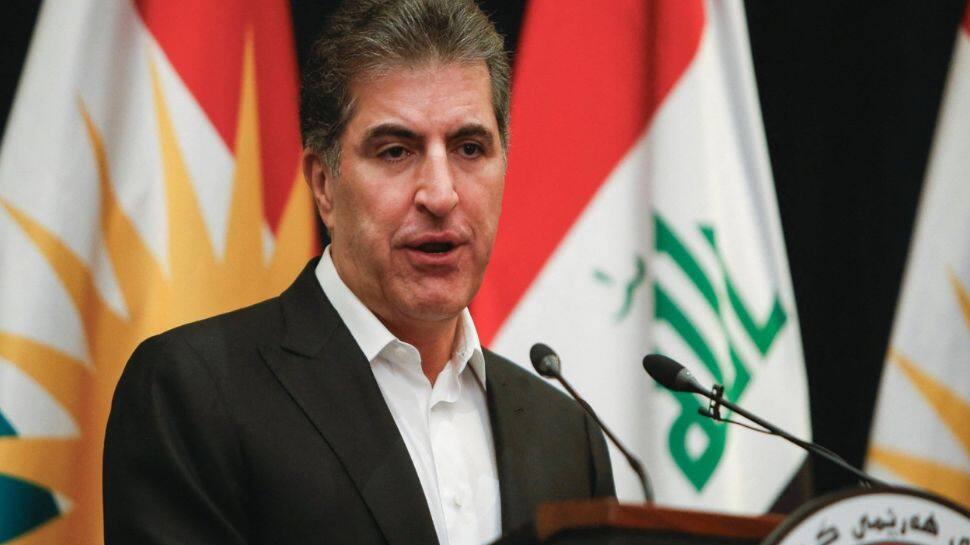
Iran's Islamic Revolutionary Guard Corps (IRGC) has strongly condemned the targeting of the president of Iraq's Kurdistan, calling it "a clear act of terrorism", alleging the drone strikes to be conducted by the US and Israel by using the term "aggressor enemies."
Trending Photos
A drone strike on Iraqi Kurdistan Region President Nechirvan Barzani's residence on Saturday sparked a blame game between the US and Iran. The US claimed Iran-backed militias carried out the attack, while Iran counterclaimed it was a US-Israeli assassination attempt.
Iran's Islamic Revolutionary Guard Corps (IRGC) has strongly condemned the targeting of the president of Iraq's Kurdistan, calling it "a clear act of terrorism", alleging the drone strikes to be conducted by the US and Israel by using the term "aggressor enemies", according to Iranian State Media Press TV.
In an official statement as quoted by Press TV, the IRGC described the reported drone attack on the residence of Nechirvan Barzani as " a clear example of a terrorist act by aggressor enemies."
The IRGC further claimed that the incident reflects a broader pattern of "cowardly assassinations" aimed at undermining peace, stability, and regional cooperation between the Kurdistan Region and neighbouring countries, according to Press TV.
The IRGC also asserted its readiness to defend regional partners, emphasising the need for a "collective defence shield" and enhanced security cooperation among countries to counter the "aggressors", Press TV reported.
The strike on Duhok is no longer just a local security breach; it is a geopolitical Rorschach test. To the West, it is proof of Iran's "malign influence." To Tehran, it is a "false flag" designed to justify Western aggression.
The US said that the attack was conducted by "Iran's terrorist militia proxies in Iraq", according to the official press statment by Thomas "Tommy" Pigott, Principal Deputy Spokesperson.
The official statement said, " The United States unequivocally and forcefully condemns the despicable terrorist attacks by Iran's terrorist militia proxies in Iraq on the private residence of Iraqi Kurdistan Region President Nechirvan Barzani. These actions by Iran and its proxies are a direct assault on Iraq's sovereignty, stability, and unity. We categorically reject the indiscriminate and cowardly terrorist acts that Iran and its terrorist proxies have unleashed in the Iraqi Kurdistan Region and throughout Iraq."
Earlier on Saturday, Iraq's Kurdistan Regional Government confirmed the drone strike targeting the residence of the President of the Kurdistan Region of Iraq, Nechirvan Barzani, in Duhok amid the conflict in the region.
According to a statement issued by Kurdistan Region Prime Minister Masrour Barzani, the attack was strongly condemned, describing it as a "cowardly drone attack" and calling for urgent action against those responsible.
"I condemn and denounce in the strongest terms the cowardly drone attack on the residence of Nechirvan Barzani, President of the Kurdistan Region, in Duhok. Once again, we call on the federal government to act on its responsibilities, bring these outlaw criminals to justice, and curb the continued terrorist attacks carried out by these groups," the statement read.
The Prime Minister further urged the international community to support the Kurdistan Region in protecting its citizens and safeguarding its interests, while asserting that authorities reserve the right to respond decisively to such threats.
"We reserve every right to confront these terrorists, and we will take whatever steps are necessary to protect the Kurdistan Region," the statement added.
Stay informed on all the latest news, real-time breaking news updates, and follow all the important headlines in india news andworld News on Zee News.
Live Tv
Facts Only
A drone strike targeted the residence of Nechirvan Barzani, President of Iraq's Kurdistan Region, in Duhok on Saturday.
The Kurdistan Regional Government confirmed the attack and condemned it as a "cowardly drone attack."
The US accused Iran-backed militias of conducting the strike, calling it a terrorist act.
Iran's Islamic Revolutionary Guard Corps (IRGC) blamed the US and Israel for the attack, describing it as a "clear act of terrorism."
The IRGC stated the incident reflects a pattern of "cowardly assassinations" aimed at destabilizing regional cooperation.
The US condemned the attack as a direct assault on Iraq's sovereignty, stability, and unity.
Kurdistan Region Prime Minister Masrour Barzani called for the federal government to bring those responsible to justice.
The Kurdistan Regional Government reserved the right to respond decisively to such threats.
The strike has become a point of contention in broader geopolitical narratives, with the US framing it as evidence of Iran's malign influence.
Iran framed the attack as a "false flag" operation to justify Western aggression.
Executive Summary
Full Take
The strongest version of this narrative is that the drone strike on Nechirvan Barzani's residence is a microcosm of broader regional tensions, where both the US and Iran are vying for influence in Iraq and the Kurdistan Region. Each side has a plausible case: the US points to Iran's history of proxy warfare, while Iran accuses the US of destabilizing the region through covert operations. The IRGC's framing of the attack as part of a pattern of "cowardly assassinations" aligns with its broader narrative of Western aggression, while the US's condemnation of Iran-backed militias fits its strategy of isolating Iran diplomatically.
Patterns detected: ARC-0024 Ambiguity (both sides use vague language to assign blame without definitive evidence), ARC-0043 Motte-and-Bailey (each side retreats to broader narratives of aggression when challenged).
The root cause of this narrative is the long-standing geopolitical rivalry between the US and Iran, with Iraq and the Kurdistan Region serving as a battleground for influence. The unstated assumption is that the other side is inherently destabilizing, which justifies preemptive or retaliatory actions. This echoes historical patterns of proxy conflicts, where local actors become pawns in larger power struggles.
The implications for human agency and dignity are significant. Civilians in the Kurdistan Region bear the costs of this escalation, facing increased insecurity and potential retaliation. The second-order consequences include further erosion of trust between regional actors and the international community, making diplomatic solutions harder to achieve.
Bridge questions: What evidence would change your assessment of who is responsible for the attack? How might local Kurdish perspectives differ from the narratives presented by the US and Iran? What role do regional alliances play in shaping the responses to such incidents?
Counterstrike scan: If this were part of a coordinated influence campaign, the playbook would involve amplifying blame narratives to justify military or political actions, while suppressing local voices and evidence. The actual content does not fully match this pattern, as it includes multiple perspectives and acknowledges the complexity of the situation. However, the lack of definitive evidence and the reliance on geopolitical framing suggest a need for deeper scrutiny.