Did you know that Truthout is a nonprofit and independently funded by readers like you? If you value what we do, please support our work with a donation.
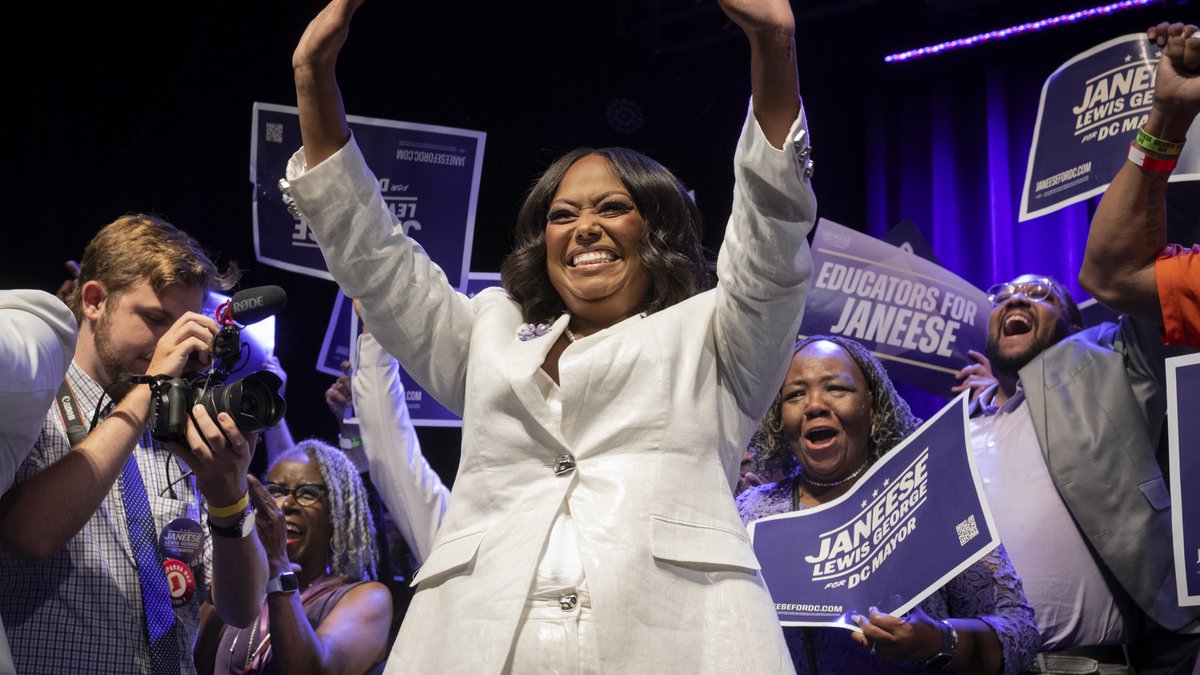
On August 11, 2025, President Trump initiated a federal takeover of Washington, D.C. Nearly 11 months later, Washingtonians organized around one of the most progressive candidates in the District’s mayoral history, a democratic socialist named Janeese Lewis George.
Since August 2025, every corner of the District of Columbia has swarmed with thousands of National Guard troops, from major metro stations to residential neighborhoods. In September, thousands of residents gathered at Malcolm X Park and marched from Ward 1 all the way to the White House for the “We Are All DC” march. The event was attended by thousands and was the single largest demonstration against Trump’s takeover of D.C.
Countless bright red signs were scattered all over the marching masses, printed with the same words that the crowds were chanting: “Free DC.” This also happens to be the name of the organization that co-hosted the march, alongside labor unions and community groups. Free DC is a fiscally sponsored special project of Community Change, and according to Washingtonians, one of the biggest reasons that Lewis George won big in the Democratic primary.
“We are the only country in the world where the citizens of the capital city do not have full political protections, full legal protections,” said Alex Dodds, campaign director and co-founder of Free DC. “And we know from other countries where dictatorships have taken root, that dictators and authoritarian leaders will always seek to control the capital city, because it’s a really easy way for them to silence dissent.”
While this group was founded just a few years ago, the Free DC movement has roots in the 1960s, when Marion Berry, who would later be elected as the second mayor of Washington, D.C., mobilized students and communities to participate in acts of civil disobedience to protest the lack of representation for D.C. residents. In 1974, Washington got its very first elected mayor after Congress passed the Home Rule Act. The legislation gave power to D.C. residents in the form of day-to-day governance but still withheld representation from Washingtonians at the federal level. This lack of real representation is the power imbalance that was central to this year’s mayoral primary, according to organizers.
Lewis George was one of just two candidates that Free DC chose to endorse this cycle, alongside Robert White, who won his race for delegate to the U.S. House of Representatives. According to Dodds, the endorsement process involved an in-depth questionnaire, a forum, and a community voting process. After everything was tallied, Lewis George was head and shoulders above the other candidates being considered.
“Janeese’s campaign was really focused on building the power of the people together to do things very aligned with a Free D.C. … no one is coming to save us but us. And so we have to do this together,” Dodds told Truthout.
Lewis George’s platform included universal affordable child care, an issue of particular importance to Washingtonians as D.C. has the highest average child care costs in the country. Transportation was also a focus of her campaign, as she promised to make buses free for residents enrolled in SNAP food assistance programs and invest in bike lanes and the metro system. Lewis George also focused heavily on affordability, listing her intention to expand rent stabilization programs, fund affordable housing, and invest in down payment assistance programs to increase homeownership across D.C.
Lewis George’s candidacy as a democratic socialist came at a time when D.C. residents could see the effects of Trump’s takeover on every street across the city. Under the president’s orders, Washington, D.C., has become ground zero for Immigration and Customs Enforcement (ICE) raids and detentions. Just days before the election, Trump even threatened a deeper federal takeover if Lewis George is elected mayor. In response, Lewis George doubled down on her defense of her hometown.
“We are not going to get ICE off our streets by fearing this president. We are not going to protect our rights or Home Rule by obeying in advance,” Lewis George wrote in a statement. “Threatening Home Rule because you do not like how residents vote is an attack on democracy itself. The people of D.C. elect the mayor of D.C., and they want someone who will stand up to Donald Trump.”
Lewis George’s supporters say this response was one of many reasons why so many D.C. residents swung toward her platform.
“Donald Trump doesn’t get to decide who represents Washington, D.C.,” Delvone Michael told Truthout. “The voters do.”
Michael, who is a senior political strategist at the Working Families Party, another group that endorsed Lewis George, added: “I think they saw strength in her response to him. And just like any bully you stand up to, the bully will fold.”
Voters largely saw through these attacks, understanding that threats to home rule would be coming down the line no matter who won the primary; the biggest concern for many was how a leader handled those threats.
“The reality is, President Trump will do exactly what he wants to do. It doesn’t matter who is elected mayor of Washington, D.C.,” Preston Mitchum — a Black queer attorney, activist, and supporter of Lewis George — told Truthout. “I think people use that against Janeese in particular because she is a progressive Black woman who is not a status quo candidate. She is unapologetically a democratic socialist and someone who sees D.C. for exactly what it is, a city that should be a state.”
Lewis George is a D.C. council member, a third-generation Washingtonian, and a former prosecutor. On paper, her experience is not unlike that of the other leading candidate in the mayoral race, Kenyan McDuffie. McDuffie is a fourth-generation Washingtonian and, like Lewis George, is also a D.C. council member and a former prosecutor. McDuffie, however, was regularly aligned with current Mayor Muriel Bowser.
“Kenyan ran a very uninspiring campaign about what couldn’t be done,” said Michael. “We’re in a change moment, and right now the status quo is not going to be enough.”
While both candidates are former prosecutors, an issue that defines their differences is how they hoped to address public safety. One of the most heated issues this cycle was youth curfew zones and “teen takeovers.” The current mayoral administration has used emergency youth curfew zones, specific areas of the city where young people are not permitted after a certain hour, to address the mass gathering of teenagers. After a viral “teen takeover” at a Chipotle in D.C.’s Navy Yard neighborhood, McDuffie attacked Lewis George for her votes against curfew zones, labeling her soft on crime. Critics of the curfew strategy have labeled it as inherently racist, saying it targets Black young people for simply existing in public.
Lewis George has instead recommended expanded programming and job pathways for young people in the District. On another issue related to policing, while both candidates spoke in favor of defunding the police in 2020, they have also both voted to increase funding for the Metropolitan Police Department while serving on the Council of the District of Columbia. While McDuffie pledged to immediately add additional officers to the force, Lewis George ran on promises to invest in alternatives to policing while increasing police accountability.
According to voters and organizers, Free DC was the hinge that pushed Lewis George across the finish line. The vast majority of D.C. residents want statehood; that is no secret. But the Free DC movement aims to do more than accomplish statehood — it is a response to authoritarianism and federal occupation.
“Lewis George has commitments to stand up against Trump as opposed to Bowser and McDuffie’s stance of appeasement and compliance in advance,” said Kurtis Hagans, chair of the Metro D.C. Democratic Socialists of America (DSA). “We have laws on the books about the sanctuary status of the District. And we’ve been lied to by the current mayor, Mayor Bowser, about the cooperation of our police forces and our local government with ICE … Janeese Lewis George has said that she will make sure that that cooperation truly stops.”
Bowser’s administration has been criticized for its quickness to comply with the White House’s demands. In March 2025, Mayor Bowser folded to Trump’s pressure and painted over Black Lives Matter Plaza, a memorial to the racial justice protests of 2020 following the murder of George Floyd. In August 2025, Mayor Bowser praised the president for the federal takeover and its effects on crime in D.C., although recent data indicates the National Guard has had little to no effect on crime across the District.
According to a 2025 poll conducted by We Are Labor, the majority of D.C. voters rated Bowser’s performance as mayor unfavorably, 59 percent wanted a new candidate for mayor, and 72 percent disagreed with the mayor’s cooperation with Trump. Voters were looking for the change that Lewis George represented, and the defiance that she led with.
Lewis George was not the only progressive who won in D.C. this cycle. Aparna Raj, a democratic socialist and tenant organizer, won her race to represent Ward 1 on the D.C. Council. Robert White, a current council member, overwhelmingly beat a more moderate opponent in the primary for delegate to the U.S. House. D.C. shadow representative Oye Owolewa, also a democratic socialist, won the at-large council seat in a crowded field (D.C. representatives to Congress are known as “shadow representatives” because they are not granted voting power).
Organizers say these results prove that D.C. wants more people-powered movements and fewer machines that run on the status quo.
“The United States is descending at groundbreaking speed towards fascism and authoritarianism…,” said Dodds. “What works in moments like that is not lawyers. It is not legislation; it is not policy. It is not wealthy people coming in to save you. It is people power. It is mass movements.”
Free DC has been at the center of these mass movements since the takeover. Its members have done canvassing, engaged in election protection work, held community events, and organized protests attended by thousands. Lewis George’s embrace of the movement against occupation was the magic that delivered her a victory by nearly 20 points.
“Talking more about jobs and centering labor unions built the broadest coalition that I have ever seen D.C. create in the time I have been here,” said Mitchum. “It wasn’t just about the name of Free DC; it’s what Free DC and Janeese represented.”
Press freedom is under attack
As Trump cracks down on political speech, independent media is increasingly necessary.
Truthout produces reporting you won’t see in the mainstream: journalism from the frontlines of global conflict, interviews with grassroots movement leaders, high-quality legal analysis and more.
Our work is possible thanks to reader support. Help Truthout catalyze change and social justice — make a tax-deductible monthly or one-time donation today.
Sentinel — Human
LIKELY_HUMAN (confidence: 0.15)