Skip to content
Chimera readability score 60 out of 100, Graduate reading level.

Israeli-Palestinian conflict
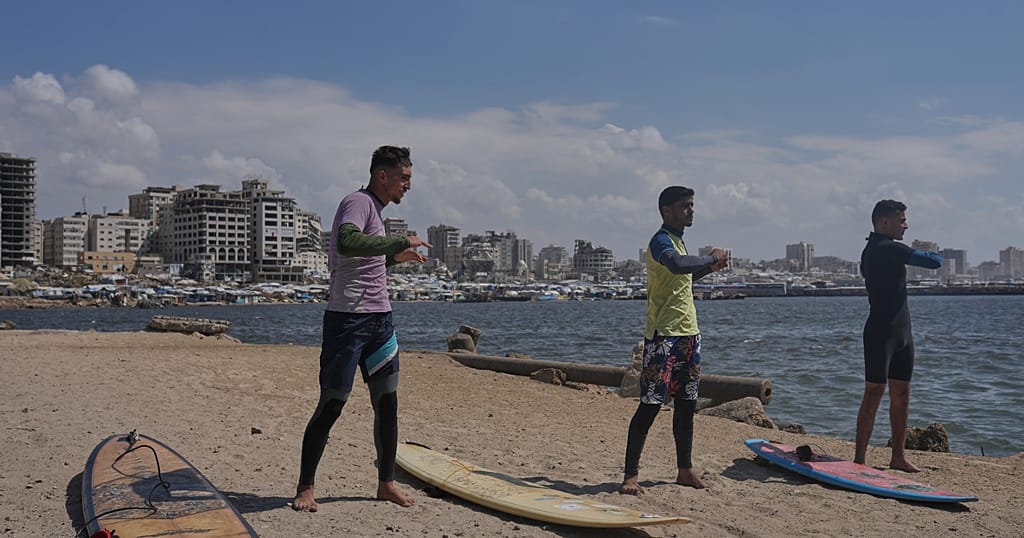
Despite the severe shortages and devastation in Gaza, a handful of surfers in Gaza City continue to hold onto the sport they love.
Tahseen Abu Assi, one of the few remaining surfers in the strip, said only “three or four surfers” are still practicing because of the lack of equipment and the impossibility of replacing damaged boards.
“Most of them left this sport because there are no boards and there’s no equipment for these boards. The board gets damaged and there’s nothing to replace it, or parts, to repair these boards,” he said.
According to Abu Assi, no new surfboards have entered Gaza since 2007. During repeated displacements caused by the war, he said he protected his surfboard above all else.
“I was displaced with it four to five times,” he said, “I used to evacuate with it, before I evacuated with my family, because it’s the only one I have.”
Israel’s military offensive in Gaza has killed more than 72,600 Palestinians, according to Gaza’s Health Ministry, caused widespread destruction and displaced most of the territory’s residents.
The ministry, part of the Hamas-led government, maintains detailed casualty records that are seen as generally reliable by U.N. agencies and independent experts. It does not give a breakdown of civilians and militants.
Israel launched the offensive after Hamas-led militants killed some 1,200 people, mostly civilians, and took another 251 hostage in their attack on Oct. 7, 2023.
While the heaviest fighting has mostly subsided since a fragile ceasefire took effect on Oct. 10, deadly Israeli strikes have repeatedly disrupted the truce. Hamas and Israel have accused each other of violating the ceasefire. Palestinians in Gaza are still contending with myriad daily struggles.
“There is fear of course, but we can’t leave this sport,” he said. “During the war, in the middle of the war, in the middle of the bombing and the planes above us, we used to go down and practice this sport.”
01:00
West Bank and part of Gaza vote in first municipal elections since war
02:07
Condemnation and outrage: Israelis and world react to Israeli death penalty law
01:32
UAE aid ships reach Egypt as Gaza crossings reopen amid ongoing violence
Go to video
Members of a newly formed Palestinian technocrat to be involved in running Gaza
01:00
Gaza air strike by Israel kills Hamas commander and four others
01:23
Israel becomes first country to recognize Somaliland

Facts Only

* Tahseen Abu Assi is one of the remaining surfers in Gaza City.
* Only three or four surfers are still practicing due to lack of equipment and inability to replace damaged boards.
* No new surfboards have entered Gaza since 2007.
* Abu Assi used his surfboard for evacuation four to five times during displacement.
* The Israeli military offensive in Gaza resulted in more than 72,600 Palestinian deaths, according to Gaza’s Health Ministry.
* The Israeli offensive followed an attack on October 7, 2023, by Hamas-led militants.
* Hamas-led militants killed some 1,200 people and took 251 hostages in the October 7, 2023, attack.
* A fragile ceasefire took effect on October 10, 2023.
* Deadly Israeli strikes have repeatedly disrupted the ceasefire between Hamas and Israel.

Executive Summary

Despite the ongoing conflict in Gaza, a small group of surfers in Gaza City continue to practice their sport due to severe shortages of equipment and damaged boards. One remaining surfer, Tahseen Abu Assi, reported that only three or four surfers are currently practicing because there is no equipment to replace damaged boards or parts. Abu Assi stated that no new surfboards have entered Gaza since 2007 and that he protected his surfboard during repeated displacements caused by the war. The Israeli military offensive in Gaza resulted in more than 72,600 Palestinian deaths, according to Gaza’s Health Ministry, which maintains casualty records. The conflict followed an attack on October 7, 2023, where Hamas-led militants killed some 1,200 people and took 251 hostages. While a fragile ceasefire took effect on October 10, deadly Israeli strikes have repeatedly disrupted the truce, leading to ongoing daily struggles for the Palestinian population in Gaza.

Full Take

The narrative juxtaposes the immense scale of violence and mass casualty reporting with a highly specific, localized human story concerning the maintenance of a leisure activity. This framing creates a cognitive tension: the focus shifts between macro-level geopolitical violence and micro-level struggle for basic resources, specifically the ability to maintain physical or cultural practices. The use of the 72,600 casualty figure, while presented as reliable by U.N. agencies and independent experts, functions as a powerful anchor for the tragedy, establishing the conflict's severity. The personal account of the surfers serves as an intimate, visceral counterpoint, emphasizing that amidst systemic destruction and displacement, individual agency and the preservation of personal identity persist. The contrast highlights the chasm between state-level conflict and lived experience. A key pattern involves the emotional exploitation of the reader by linking extreme political violence directly to the scarcity of basic resources, which can simplify complex geopolitical realities into a stark dichotomy of survival versus dignity. This pattern utilizes fear appeals to generate moral urgency while often obscuring the systemic, historical, and structural causes of the displacement and material deprivation. The implications are that the fight for agency extends beyond military or political control to the simple right to possess the means for daily life and cultural continuity. The missing perspectives involve analyzing how the documented casualty figures are utilized and weighted by different governing bodies, and the structural role of displacement in shaping the immediate, day-to-day priorities of the population.

Sentinel — Human

Confidence

The article exhibits strong human characteristics, blending specific, emotional personal testimony with factual geopolitical reporting, suggesting it originated from human journalistic reporting.

Signals Detected
low severity: Natural variation in sentence length and tone; includes an idiosyncratic, anecdotal voice.
low severity: The text successfully blends highly specific, emotional human testimony with high-level, verifiable geopolitical statistics, demonstrating a cohesive journalistic narrative.
low severity: Citations (Gaza Health Ministry, U.N. agencies) are specific; the inclusion of specific dates and casualty figures grounds the claims, minimizing the risk of simple template matching.
low severity: The anecdotal quote about the surfers appears personal and emotionally resonant, lacking the overly smooth, formulaic phrasing typical of LLM generation.
Human Indicators
The specific, emotionally focused anecdote about the surfers provides a unique perspective that is difficult to generate without a specific human context.
The flow between personal narrative and objective statistical reporting is handled naturally, suggesting human editorial intervention.