Politics
Governance, legitimacy, partnerships and global influence are set to shape Africa’s political outlook in 2026, according to a new flagship report released after a two-day high-level forum in Brussels.
The APO report, titled “Report on the State of African Governance: Forces of the Future”, examines political trends, governance challenges and stability prospects across the continent, presenting a forward-looking but fragile picture.
“We think there are positive trends in African governance, and we think we should expose it. We should talk about it,” said Viwanou Gnassounou, Chairman of APO’s Advisory Board. “When we do our reports, we point our fingers at those aspects on the continent where we think we can do much, much better. Definitely elections.
“Yes, there have been fair elections on the day of voting. But if you look at the whole process, there is a way of kicking out some of the candidates relatively legally, which does not make it a truly fair election,” he added. “If you want real legitimacy, and if you want your people to feel you represent them, make sure you don’t create frustration or a sense that you are not addressing their issues.”
The report notes that 15 elections are scheduled across Africa this year, posing a key test of whether countries can move toward more credible, peaceful and inclusive electoral processes.
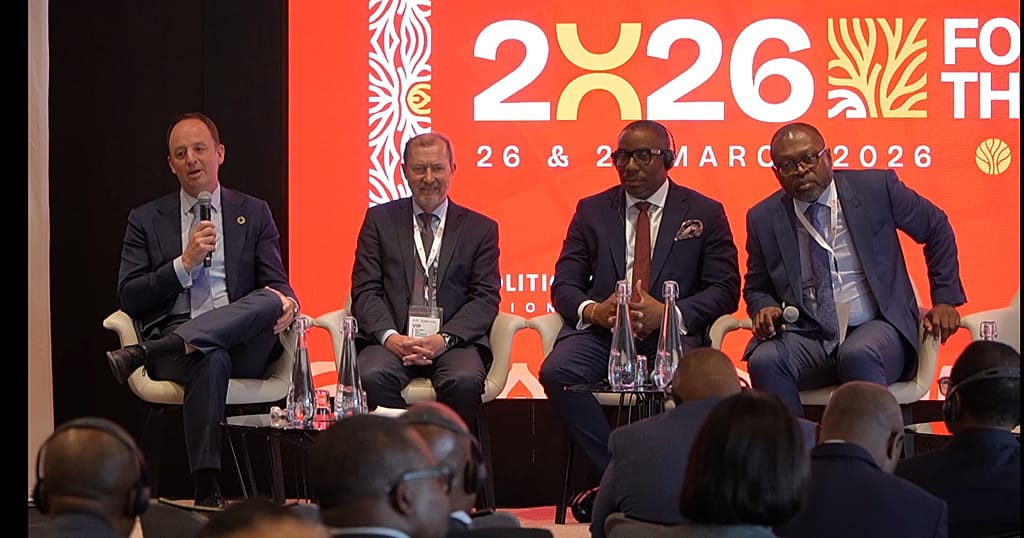
At the forum’s Grand Dialogue, leaders and policymakers described a fragmented international environment in which geopolitical tensions are reshaping alliances and priorities. They stressed, however, that the current moment also offers opportunities for reform and progress.
Zambian Foreign Minister Mulambo Haimbe said the continent must “have skin in the game” by embracing reform. “For us to move away from business as usual and speak on governance issues and the management of affairs in our respective countries in a way that opens up to the ideas we are putting forward, we must speak with one voice,” he said. “It doesn’t help for me in Zambia to say one thing and in Benin there is a different language being spoken. We have to speak with one voice, with one accord. And of course, we also have to understand that partnerships are crucial.”
Guinea’s Minister of Planning and International Cooperation, Ismael Nabe, said that while reports are important, the country’s recent experience shows how discipline, good governance and the rule of law can drive change. “The last three or four years have been great years for us based on discipline and good governance and rule of law,” he said. Guinea has developed a 15-year economic blueprint built on five main pillars and a set of enabling measures, he added.
On Africa’s position in global affairs, the report finds the continent is more consequential to international decision-making than at any time since independence. However, it cautions that being consequential is not the same as being influential, and urges governments and institutions to make choices firmly aligned with Africa’s own interests.
The report depicts a continent under pressure but also in transition. While governance challenges are intensifying, the demand for reform is also growing, particularly among younger populations who are increasingly vocal, driving change and reshaping political debates across Africa.
Reporting by Jerry Fisayo-Bambi for Africanews.
01:02
Madagascar’s president orders polygraph for aspiring ministers
00:59
Congo’s Sassou Nguesso wins 5th term with 94.8%, provisional results
00:48
Cameroon's National Assembly gets new leader after 34 Years
01:13
Senegal's Ousmane Sonko mobilizes Pastef ahead of 2027 elections
01:07
Madagascar leader appoints financial intelligence chief as new prime minister
00:02
Libya PM Dbeibah reshuffles government in bid to boost services
Facts Only
The APO Group released a report titled “Report on the State of African Governance: Forces of the Future” after a two-day forum in Brussels.
The report examines political trends, governance challenges, and stability prospects in Africa.
Viwanou Gnassounou, Chairman of APO’s Advisory Board, stated that while some elections are fair on voting day, broader processes often exclude candidates legally, undermining legitimacy.
Fifteen elections are scheduled across Africa in 2026.
Zambian Foreign Minister Mulambo Haimbe emphasized the need for African countries to speak with one voice on governance and reform.
Guinea’s Minister of Planning and International Cooperation, Ismael Nabe, highlighted Guinea’s progress due to discipline, good governance, and rule of law.
Guinea has developed a 15-year economic blueprint based on five main pillars.
The report notes Africa’s increased role in global decision-making but cautions that being consequential does not equate to influence.
Younger populations in Africa are driving demand for reform and reshaping political debates.
The forum included discussions on geopolitical tensions and opportunities for reform.
Additional news briefs mention political developments in Madagascar, Congo, Cameroon, Senegal, and Libya.
Executive Summary
Full Take
The strongest version of this narrative highlights Africa’s dual trajectory: progress in governance and electoral processes alongside persistent challenges like legal exclusions and legitimacy gaps. The report and forum discussions rightly acknowledge the continent’s growing global relevance while cautioning against conflating visibility with actual influence. Leaders like Zambia’s Haimbe and Guinea’s Nabe provide concrete examples of reform efforts, grounding the analysis in actionable insights. However, the narrative risks oversimplifying complex governance issues by framing them primarily through electoral legitimacy and youth activism, potentially overlooking structural barriers like economic inequality or external geopolitical pressures.
Pattern scan: The report’s emphasis on youth-driven reform could subtly invoke ARC-0024 Ambiguity, as "demand for reform" is a broad term that may obscure differing priorities among young populations. Additionally, the call for African unity in governance (e.g., "speak with one voice") might echo ARC-0043 Motte-and-Bailey, where the motte (unity as a principle) is defensible, but the bailey (uniform policy adoption) is more contentious. No overt manipulation is detected, but the framing leans toward optimistic reformism, which could downplay systemic inertia.
Root cause: The narrative assumes that electoral fairness and youth engagement are sufficient drivers of governance improvement, potentially underestimating the role of institutional capacity and external actors. Historically, African political transitions have often been shaped by both internal dynamics and global power struggles, a tension the report acknowledges but doesn’t fully explore.
Implications: If African governments prioritize legitimacy and partnerships, the continent could leverage its growing global role more effectively. However, without addressing deeper structural issues—like economic dependency or elite capture—the risk of superficial reform remains. Younger populations may gain political voice, but their influence could be co-opted or suppressed if institutions don’t evolve.
Bridge questions: How might external powers (e.g., China, EU, U.S.) shape Africa’s governance reforms in ways that serve their own interests? What role do economic inequalities play in undermining electoral legitimacy, even when processes appear fair? Could the emphasis on youth activism inadvertently marginalize other demographic or regional perspectives?
Counterstrike scan: A coordinated influence campaign might amplify the "youth-driven reform" narrative to create a false binary between "progressive" young leaders and "corrupt" elites, ignoring nuanced governance challenges. The actual content doesn’t match this pattern, as it presents multiple perspectives and acknowledges complexities. The report’s balanced tone suggests genuine analysis rather than manipulation.
Patterns detected: ARC-0024 Ambiguity, ARC-0043 Motte-and-Bailey
Sentinel — Human
The article appears likely to be human-written, with evidence of personal voices and idiosyncratic emphasis in the quotes. The stylometric signals show variation in sentence length and lexical diversity, while coherence indicators suggest passionate quotes from interviewees.