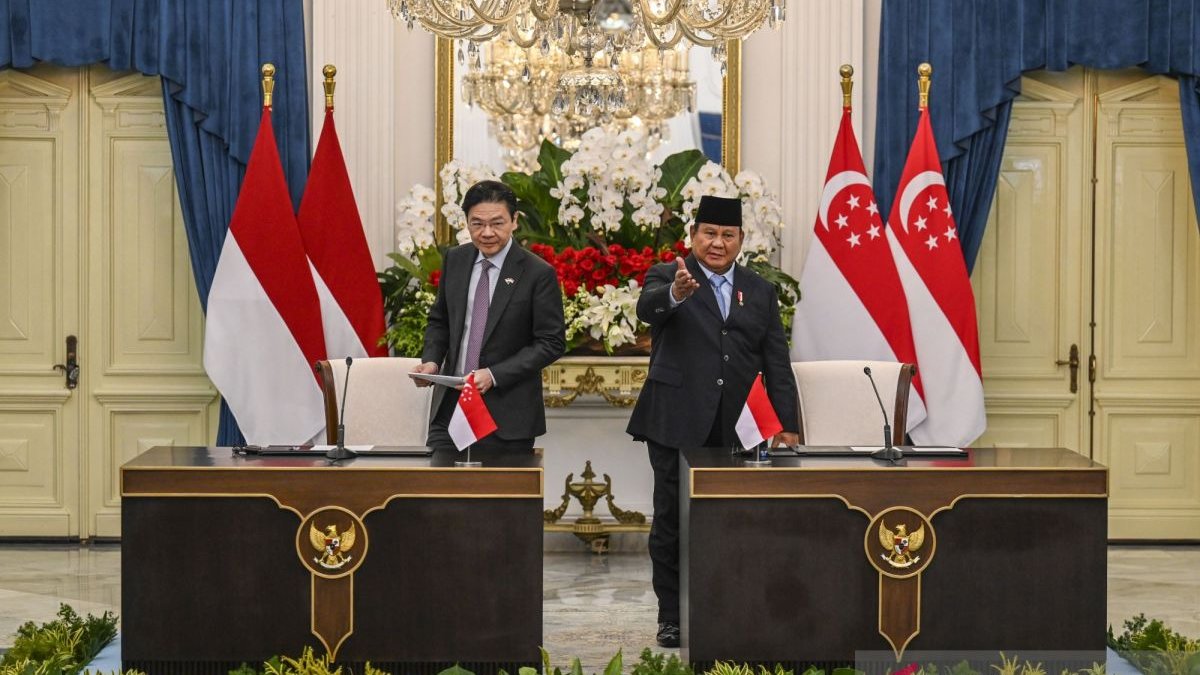
..Singapore—as Indonesia's strategic trading partner and investor over the past decades—views the Prabowo administration as stable..Jakarta (ANTARA) - As Indonesian President Prabowo Subianto and Singapore's Prime Minister Lawrence Wong concluded their annual Leaders' Retreat at Jakarta’s Merdeka Palace on Monday (July 6), the two countries inked a total of 26 agreements.
The total surpassed the 19 agreements signed last year—a jump that signals stronger ties between the two neighbors.
President Prabowo noted that the Leaders' Retreat demonstrated the maturity, trust, and strategic value of the Indonesia-Singapore relationship. The three-hour meeting underscored the growing level of mutual trust between the two nations.
Of the 26 agreements announced, 18 are government-to-government (G2G) pacts, while the remaining eight are business-to-business (B2B) deals.
The agreements cover a broad range of sectors, including trade, investment, energy, green initiatives, digital transformation, and human capital development.
Prabowo emphasized that economic cooperation remains the bedrock of the bilateral relationship between Indonesia and Singapore, with increased collaboration visible across nearly all sectors.
The growing role of Danantara Investment Management Agency (BPI Danantara) was also spotlighted as the body appointed to implement cross-border electricity trade. The move positions Danantara as a key vehicle for Indonesia's economic diplomacy.
The cross-border electricity trade roadmap, signed by Danantara CEO Rosan Roeslani alongside Singaporean partners, was followed by a series of business-to-business memoranda of understanding (MoUs) between Danantara and three Singaporean entities: Keppel, Singapore Energy Interconnections, and Sembcorp.
Beyond energy, the two countries also agreed on food supply chain resilience and carbon credit collaboration under Article 6 of the Paris Agreement. The climate change issue—whose impacts have become increasingly apparent recently—has formally entered the architecture of the two nations' bilateral cooperation, moving beyond policy discussions into practical cooperation.
The Malacca Strait amid Middle East tensions
Beyond economic matters, security dimensions featured more prominently compared to last year's retreat, following persistent global geopolitical uncertainty.
Prabowo and Wong agreed to keep the Malacca Strait and Singapore Strait open in accordance with the United Nations Convention on the Law of the Sea (UNCLOS) 1982, while maintaining coordination with Malaysia and Thailand to secure the waterways against maritime accidents, pollution, and piracy.
This agreement comes amid an increasingly volatile global landscape. Wong explicitly noted that the two leaders discussed developments in the Middle East and their subsequent impact on Singapore, particularly regarding the Malacca Strait, given that both neighboring coastal states share a strategic interest in safeguarding the vital shipping lane.
The discussion reflects a broader recognition, as geopolitical tensions in other regions are now being explicitly framed as having a domino effect on shipping lanes that serve as the economic lifeblood for both Indonesia and Singapore.
On the defense cooperation front, the two nations updated the implementation of their Defense Cooperation Agreement (DCA) and discussed expanding joint military training areas for the Indonesian National Armed Forces (TNI) and the Singapore Armed Forces (SAF) across three locations: Baturaja (South Sumatra), Siabu (Riau), and West Kalimantan. The defense ministers of both countries signed the updated defense cooperation documents in the presence of the two leaders.
Turning to broader issues, Prabowo reaffirmed ASEAN's stance on resolving disputes peacefully through dialogue and diplomacy across all regions.
What set this year's retreat apart from a mere annual ceremony was the rhetoric chosen by both leaders. Prabowo used phrases like "heart-to-heart" and "openly," emphasizing both parties' agreement to resolve any misunderstandings "as friends."
The statements helped ease tensions that recently flared up on social media when the Indonesian stock market tumbled, pushing the rupiah beyond the psychological threshold of 18,000 per US dollar.
Amid the economic panic, hashtags like "Sell Indonesia" flooded social media platforms, which were met with a counter-surge of "Sell Singapore" hashtags.
Prabowo also recalled that Wong was the first partner country leader to visit Indonesia since he took office as president—highlighting the importance of Indonesia-Singapore ties.
Strengthening people-to-people ties was also highlighted as a foundation no less critical than G2G or B2B achievements. This includes the Garuda High School student exchange program with Singapore, support for increased direct flights following the launch of the new Singapore-Pontianak route, and collaboration between youth organizations.
President Prabowo also noted that 2027 will mark the 60th anniversary of diplomatic relations between Indonesia and Singapore, making this retreat an important milestone ahead of that anniversary.
The deals' significance for Indonesia
The jump from 19 agreements to 26 in one year may signal that Singapore—as Indonesia's strategic trading partner and investor over the past decades—views the Prabowo administration as stable and predictable enough to further deepen its cooperative exposure. This includes sensitive domains such as cross-border electricity trading and access to military training grounds in Sumatra and Kalimantan.
The appointment of Danantara to execute cross-border energy cooperation is also worth noting for the future, positioning the state investment agency as a new hub for Indonesia’s economic diplomacy.
The effectiveness of this expanded role will become clearer over the coming years. Whether these agreements translate into successful implementation remains to be seen.
Meanwhile, on the maritime security front, the reaffirmed commitment to keeping the Malacca Strait open amid tensions in the Middle East and global supply chain uncertainties leaves this strategic shipping lane increasingly susceptible to geopolitical pressure.
For Indonesia, this also presents an opportunity to reinforce its position as a credible guardian of global shipping lanes that remains consistent with international law of the sea—a source of diplomatic capital that can be leveraged in broader forums, including ASEAN.
Related news: Prabowo says Indonesia and Singapore must stay strong partners
Related news: Singapore PM Wong optimistic about future ties with Indonesia
Editor: M Razi Rahman
Copyright © ANTARA 2026
Sentinel — Human
The text reads like professionally compiled news reporting, skillfully weaving specific bilateral agreements with broader geopolitical and economic context, exhibiting characteristics typical of human journalistic synthesis.