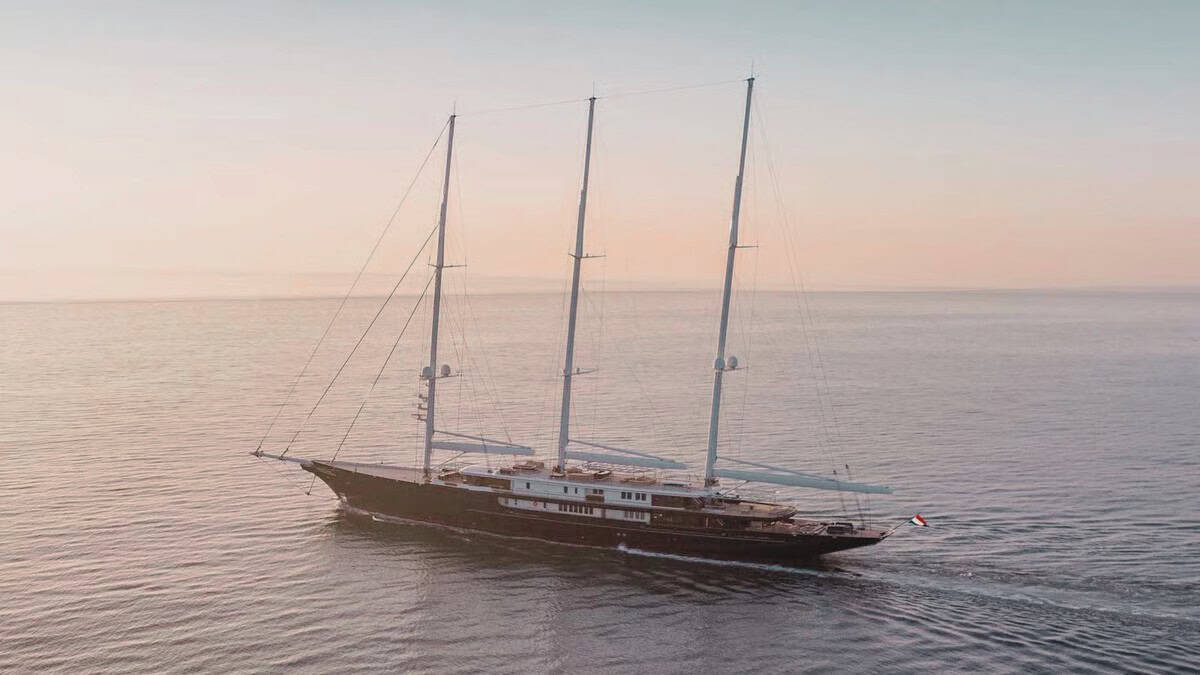
One of the world’s most recognizable private yachts has made an appearance off Costa Rica’s Pacific coast. Koru, the giant sailing yacht tied to Amazon founder Jeff Bezos, was reported in Guanacaste waters this week, drawing attention from locals, tourists, and yacht watchers tracking its route near the Gulf of Papagayo. Costa Rican coverage placed the yacht in the area and vessel-tracking data later showed Golfo de Papagayo listed as its last port before it resumed navigation.
The sighting quickly became a point of curiosity in one of our country’s best-known luxury tourism areas. Papagayo is already associated with high-end resorts, private villas, and marina traffic, but Koru’s arrival gave the coastline an extra burst of international attention. Social media posts from visitors in the area helped fuel the interest, with some sharing photos of the enormous vessel from shore and nearby marinas.
Koru is no ordinary yacht. Built by Dutch shipyard Oceanco and delivered in 2023, it measures about 125 meters, or roughly 410 feet, and is described by its builder as the largest sailing yacht in the world. The three-masted schooner has a dark blue hull, broad open deck space, a swimming pool, and three jacuzzis, combining old-world sailing lines with ultra-luxury scale. Oceanco says the yacht’s exterior design was handled by Dykstra Naval Architects, while the interior was created by Tino Zervudachi and Associates.
Industry records show Koru can host up to 18 guests with a crew of about 40, placing it among the most prominent private vessels afloat. Since entering service, it has been photographed in a string of headline-making destinations, from the Caribbean to the Mediterranean, reinforcing its status as one of the most closely watched yachts in the world.
Traveling with Koru is Abeona, a 75-meter support vessel delivered in 2023 by Damen Yachting. Abeona functions as the operational partner to the main yacht, carrying extra equipment, tenders, and support capacity that allows longer voyages with fewer port needs. Yacht industry reports describe it as featuring a helipad and hangar, with room for up to 45 people including crew, guests, and specialist staff.
For us here in Costa Rica, the sighting is mostly a curiosity rather than a major event, but it fits our country’s growing profile as a destination that attracts luxury travel alongside its more familiar eco-tourism image. Guanacaste has long marketed itself around beaches, sport fishing, and upscale hospitality, and a visit from one of the world’s best-known superyachts only adds to that reputation.
Facts Only
Jeff Bezos' superyacht *Koru* was reported in Guanacaste, Costa Rica, near the Gulf of Papagayo.
*Koru* is a 125-meter (410-foot) sailing yacht built by Oceanco and delivered in 2023.
It is described as the largest sailing yacht in the world, with a dark blue hull and three masts.
The yacht features a swimming pool, three jacuzzis, and can host 18 guests with a crew of 40.
Exterior design was by Dykstra Naval Architects; interior by Tino Zervudachi and Associates.
*Koru* is accompanied by *Abeona*, a 75-meter support vessel built by Damen Yachting in 2023.
*Abeona* includes a helipad, hangar, and capacity for 45 people, including crew and specialists.
The yacht has previously been photographed in the Caribbean and Mediterranean.
Guanacaste is a known luxury tourism area in Costa Rica, featuring high-end resorts and marinas.
The sighting was shared on social media by visitors and locals.
Vessel-tracking data confirmed Golfo de Papagayo as *Koru*'s last port before resuming navigation.
Executive Summary
Full Take
The sighting of *Koru* off Costa Rica’s Pacific coast is a textbook example of how elite consumption becomes a spectacle, reinforcing narratives of exclusivity and aspiration. The strongest version of this narrative is straightforward: a billionaire’s yacht, a symbol of unparalleled luxury, visits a region already positioned as a playground for the wealthy. The coverage leans into the awe of scale—*Koru*’s size, its support vessel *Abeona*, the sheer logistical footprint of such a voyage—while framing it as a curiosity rather than a critique. This is a classic case of **ARC-0024 Ambiguity**, where the focus on spectacle obscures deeper questions about inequality, environmental impact, or the local economic dynamics of hosting such vessels.
The paradigm here is the normalization of extreme wealth as a neutral or even positive force, assuming that the presence of such yachts inherently benefits the destination. Yet the unstated assumptions are telling: that luxury tourism is an unmitigated good, that the environmental cost of operating a 125-meter yacht is irrelevant, and that the local economy’s reliance on high-end visitors is sustainable. Historically, this echoes the pattern of colonial-era elite retreats, where wealthy outsiders extract aesthetic and recreational value from a place while contributing little to its long-term resilience.
For human agency, the implications are mixed. On one hand, Costa Rica’s ability to attract such visitors may bolster its tourism sector. On the other, it risks deepening dependency on a volatile, exclusionary market. Who benefits? Marina operators, luxury resorts, and service providers catering to the ultra-rich. Who bears the costs? Local communities facing rising living costs, environmental strain, and the erosion of public access to coastal areas. Second-order consequences could include increased pressure on infrastructure, cultural displacement, or even resentment toward the ultra-wealthy’s visible consumption.
Bridge questions: What would it look like if Costa Rica prioritized equitable tourism over elite spectacle? How might the environmental footprint of such yachts be weighed against their economic contributions? What voices are missing from this narrative—local fishermen, environmental activists, or workers in the tourism industry?
Counterstrike scan: If this were part of a coordinated influence campaign, the playbook would emphasize the glamour of *Koru* while downplaying critiques of wealth inequality or environmental harm, framing it as a harmless curiosity. The actual content aligns with this pattern but stops short of overt manipulation—it’s more a reflection of media’s default reverence for wealth than a deliberate disinformation effort. The lack of critical framing is notable but not necessarily sinister.
Patterns detected: **ARC-0024 Ambiguity**