Tenzin Nyidon
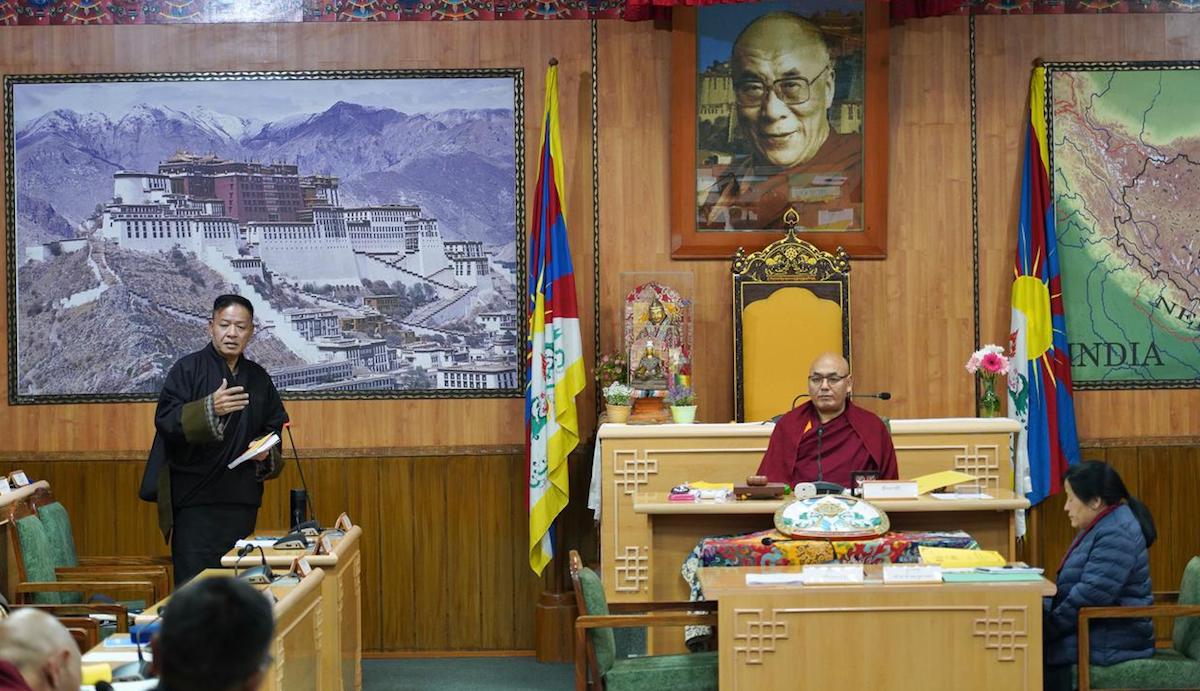
DHARAMSHALA, March 17: The President of the Central Tibetan Administration (CTA), Penpa Tsering, who also holds the portfolio of Finance Minister, delivered detailed clarifications on the second day of the ongoing budget session on Tuesday. His responses addressed a wide range of questions, concerns, and observations raised by more than 20 Members of Parliament (MPs) during Monday’s deliberations on the proposed budget for the upcoming fiscal year.
During the first day of the session, MPs expressed concerns over several key issues, including the suspension and partial restoration of U.S. funding, particularly the reinstatement of approximately $7–8 million as well as the notable disparity between allocations for social welfare (66.19%) and political activities (23.38%). Some MPs argued that greater financial emphasis should be placed on political efforts to strengthen the Tibetan cause, rather than prioritising social development projects such as infrastructure in exile settlements.
Additional concerns were raised regarding the wording in the United States’ 2026 budget Appropriation Act, which references recognition of the CTA and the Tibetan government-in-exile, as well as broader questions surrounding the administration’s long-term financial sustainability.
Responding to these concerns, President Penpa Tsering explained that significant efforts had been made to restore U.S. funding following earlier cuts. Of the $12 million approved under U.S. assistance, $7 million has been successfully reinstated and allocated to key CTA departments, including Education, Home, and Health. However, he noted that $5.2 million remains unrestored, affecting critical initiatives such as the CTA’s Capacity Building programme, allocated $3 million over five years, and the Digital Library project under the Department of Religion and Culture, which has an allocation of $2 million.
Addressing concerns over budget allocation, the CTA President clarified that while 23.38% of the proposed budget is earmarked for political purposes and 66.19% for social welfare, the administration’s spending strategy reflects long-term planning. Over the past four fiscal years, the Cabinet has invested heavily in public infrastructure, including settlement development projects. Once completed, these initiatives are expected to enhance self-reliance across various sectors, including governance, education, and healthcare.
He further emphasised that the administration does not treat political and social welfare sectors as mutually exclusive. The social welfare category encompasses key departments, including Finance, Home, Education, and Health, which collectively contribute to strengthening the Tibetan cause over time. Reassuring the House, he stated that the CTA remains financially stable and is not currently facing any major fiscal challenges.
Reflecting on broader expenditure trends, the President noted that during the tenure of the 16th Cabinet, the administration recorded its highest levels of actual expenditure from the consolidated fund, covering both recurring costs and investments in political and social welfare initiatives. He stressed that such spending was necessary to meet the demands of the time, sustain the Tibetan struggle, and address the basic needs of the Tibetan people. He also remarked that achieving a just resolution for Tibet cannot rely solely on political efforts.
On the question of nomenclature, raised by some MPs in light of language in recent U.S. legislation, President Penpa Tsering stated that renaming the CTA as the Tibetan government-in-exile is neither necessary nor advisable. He explained that the current designation ensures compliance with the legal framework of the host country and helps safeguard the administration’s long-term stability.
Addressing concerns about financial dependency, the CTA President revealed that approximately 29% of the administration’s total expenditure is supported by U.S. assistance, while over 90% of its annual budget relies on external funding. He acknowledged the need to diversify funding sources and confirmed that efforts are underway to secure support from other donor countries and organisations.
In particular, he highlighted ongoing initiatives to engage “middle power” nations as potential sources of financial assistance. He also noted that the Cabinet has undertaken efforts to enhance transparency by presenting a comprehensive report on the CTA’s financial status and expenditures over the past two decades.
However, he cautioned that due to pressure from the Chinese government and risks associated with external interference, it is not always feasible to publicly disclose detailed information regarding funding sources. He indicated that such matters could be discussed privately with Members of Parliament if necessary.
Facts Only
Penpa Tsering, President of the Central Tibetan Administration (CTA) and Finance Minister, addressed the budget session in Dharamsala on March 17.
Over 20 Members of Parliament raised concerns about the proposed budget for the upcoming fiscal year.
U.S. funding for the CTA was partially restored, with $7–8 million reinstated out of $12 million approved.
The proposed budget allocates 66.19% to social welfare and 23.38% to political activities.
MPs debated whether political efforts should receive more funding than social development projects.
The U.S. 2026 Appropriation Act references the CTA and the Tibetan government-in-exile.
$5.2 million of U.S. funding remains unrestored, affecting programs like the Capacity Building initiative and the Digital Library project.
The CTA has invested heavily in public infrastructure over the past four fiscal years.
Penpa Tsering stated that social welfare and political sectors are not mutually exclusive.
The CTA does not plan to rename itself as the Tibetan government-in-exile due to legal and stability concerns.
Approximately 29% of the CTA’s expenditure is supported by U.S. assistance, with over 90% of its budget relying on external funding.
Efforts are underway to secure funding from other donor countries and organizations.
Executive Summary
Full Take
The strongest version of this narrative presents the CTA as a pragmatic institution navigating complex financial and political realities. Penpa Tsering’s responses frame the budget allocations as a strategic balance between immediate social needs and long-term political goals, emphasizing self-reliance and stability. The partial restoration of U.S. funding is portrayed as a diplomatic success, while the reliance on external funding is acknowledged as a vulnerability requiring diversification. The refusal to adopt the "government-in-exile" label is justified as a legal necessity, not a concession.
Patterns detected: none. The narrative avoids emotional exploitation, distortion, or bad faith tactics. It presents a measured defense of the CTA’s priorities, though the emphasis on long-term planning could be seen as a motte-and-bailey if critics argue that immediate political action is being deprioritized. The root cause paradigm is one of institutional survival—balancing donor expectations, Chinese pressure, and the needs of the Tibetan community. The implications for human agency are significant: the CTA’s financial dependence limits its autonomy, while its infrastructure investments aim to reduce that dependency over time. The second-order consequences include potential donor fatigue or shifting geopolitical priorities that could further strain funding.
Bridge questions: How might the CTA’s financial strategy evolve if U.S. funding were fully restored or further reduced? What alternative funding models could reduce reliance on external sources without compromising political goals? How do Tibetan communities in exile perceive the trade-offs between social welfare and political activism?
Counterstrike scan: A coordinated influence campaign would likely amplify divisions between social and political spending, framing the CTA as either neglecting the Tibetan cause or mismanaging funds. The actual content does not match this pattern, as it presents a nuanced defense of the budget without demonizing critics or oversimplifying the challenges.
Sentinel — Human
The article shows strong signs of human authorship, with natural stylistic variations, specific attributions, and digressions inconsistent with AI generation.