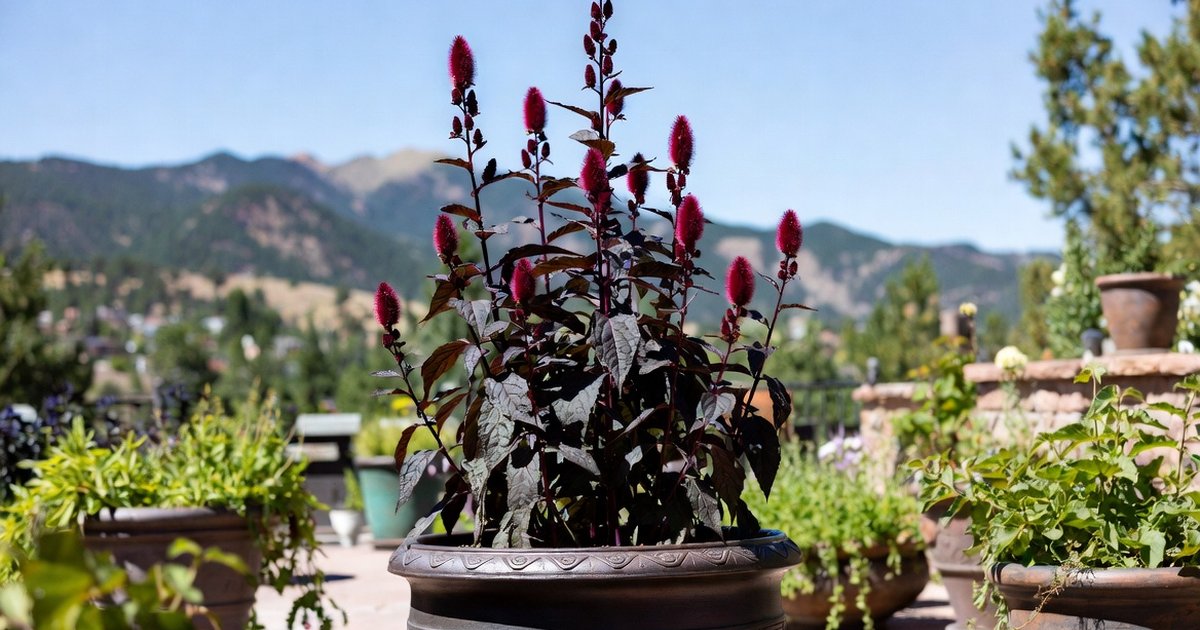
Ornamental Millet (primarily Pennisetum glaucum, also known as Pearl Millet), especially popular cultivars like ‘Purple Majesty’, ‘Purple Baron’, or ‘Jester’, is a bold, dramatic annual grass valued for its tall, upright stature and striking foliage and seed heads
It serves as an excellent “thriller” (centerpiece) in large containers, providing height, texture, and movement. The deep burgundy-purple leaves and bottlebrush-like flower spikes contrast beautifully with your other plants (trailing Sweet Potato Vine, Creeping Jenny, Alyssum, Lobelia, bright Marigolds, and Lantana).
Growing Conditions in Fort Collins
Ornamental millet is a warm-season tropical grass that loves Colorado’s hot, sunny summers.
- Hardiness: Grown as a tender annual in Zone 5b. It will not survive winter and is killed by frost.
- Planting time: Late May to early June, after all danger of frost and when soil has warmed (night temps above 55°F). It grows quickly once warm weather arrives.
- Sun: Full sun (6–8+ hours) for best color and strong growth. It thrives in intense Colorado sunlight.
- Soil: Well-draining, average to fertile soil. Performs well in large containers with quality potting mix.
- Water: Moderate to consistent moisture, especially in containers. It tolerates some drought once established but looks best with regular watering during hot, dry spells. Avoid constant soggy soil.
Care Tips
- Growth habit: Upright, 3–5 feet tall (depending on variety) with a 1–3 foot spread. ‘Purple Majesty’ is a standout with rich purple foliage and dramatic dark seed heads.
- Bloom/Interest time: Foliage color intensifies as the season progresses; purple flower spikes appear mid-to-late summer and last into fall. Great for cut flowers too.
- Maintenance: Low. Stake if needed in very windy spots. No deadheading required. Cut back or remove after frost.
- Fertilizer: Moderate feeder. Apply a balanced or slow-release fertilizer at planting and again mid-season.
- Pests/Diseases: Very tough and deer-resistant. Few issues in dry Colorado conditions.
Fort Collins Pro Tip: Use Ornamental Millet as the tall centerpiece in your large pots, surrounded by trailing plants (Sweet Potato Vine, Creeping Jenny, Alyssum, Lobelia) and mid-height fillers (Marigolds, Lantana). It creates a stunning, tropical-looking container that stands out on patios with the mountain backdrop.
Would you like details on specific cultivars or ideas for full container recipes combining all the plants you’ve asked about?
Facts Only
* Pennisetum glaucum is the scientific name for Ornamental Millet, also known as Pearl Millet.
* Popular cultivars include ‘Purple Majesty,’ ‘Purple Baron,’ and ‘Jester.’
* The plant is grown as a tender annual in Zone 5b.
* Planting time is late May to early June, following the end of frost and warm soil temperatures (above 55°F).
* Optimal growth requires full sun, providing 6–8+ hours of light.
* The plant thrives in intense Colorado sunlight.
* Soil requirements are well-draining, average to fertile.
* Water requirements are moderate and consistent; it tolerates some drought but looks best with regular watering.
* Growth habit is upright, typically 3–5 feet tall with a 1–3 foot spread.
* Maintenance is low, requiring moderate feeder use and occasional staking in windy spots.
* The plant is very tough and deer-resistant.
Executive Summary
Full Take
The narrative positions Ornamental Millet not merely as a plant, but as a functional aesthetic tool designed to leverage specific climate and aesthetic associations. The framing heavily emphasizes the plant’s ability to act as a dramatic centerpiece ("thriller") within a specific regional context (Fort Collins, Colorado), associating it with the "tropical-looking" style. This approach establishes a clear, aspirational outcome: stunning container gardens achieved through the strategic combination of height, texture, and color contrast.
The focus on specific watering and planting schedules grounds the aesthetic fantasy in practical, localized knowledge, suggesting that achieving this desired visual outcome is tied to understanding the immediate environmental constraints of the region. This creates an implicit authority by linking practical care directly to the realization of a desired, high-impact visual effect.
The use of the "Fort Collins Pro Tip" serves as a clear pattern of authority, demonstrating a specific, optimized arrangement that validates the plant’s role within a curated landscape. This implies that the power of the plant is realized only when deployed within a specific, highly structured visual context, suggesting that true value lies less in the biological properties of the millet and more in its performance within a pre-defined design framework.
Patterns detected: ARC-0043 Motte-and-Bailey, ARC-0024 Ambiguity, ARC-0031 Contextual Framing
Sentinel — Human
The text functions effectively as a practical, localized gardening guide, exhibiting a natural, experience-based flow rather than the predictable, homogenous rhythm of machine generation.