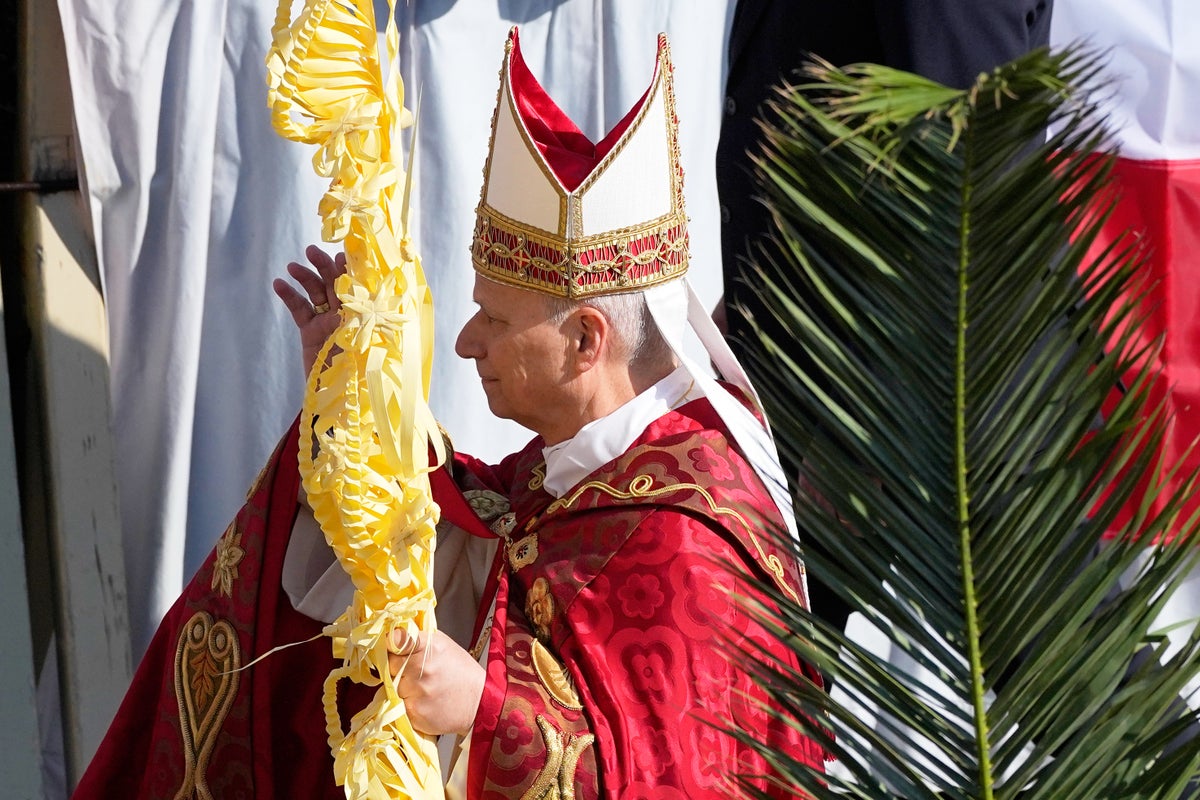
Pope Leo XIV is celebrating Palm Sunday before tens of thousands of people in St. Peter’s Square
Pope Leo XIV celebrated Palm Sunday before tens of thousands of people in St. Peter's Square, as he opened his first Holy Week as pontiff that for many people recalled the final, suffering days of Pope Francis’ life.
The celebration began with a procession of cardinals, bishops, priests and laypeople walking into the square carrying olive branches and palm fronds, some intricately braided. They stopped at the central obelisk, where Leo delivered an opening prayer, and then processed toward the altar to begin the Mass.
Palm Sunday marks Jesus’ triumphant entrance into Jerusalem in the time leading up to his crucifixion, which Christians observe on Good Friday, and resurrection on Easter Sunday.
When Holy Week opened last year, Francis was still recovering at the Vatican after a five-week hospital stay for double pneumonia. He had delegated the liturgical celebrations to others, but rallied on Easter Sunday to greet the faithful from the loggia of St. Peter’s Square. Most poignantly, he then made what became his final popemobile loop around the piazza.
Francis died the following morning, Easter Monday, after suffering a stroke. His nurse, Massimiliano Strappetti, later told Vatican Media that Francis had told him: “Thank you for bringing me back to the square” for the final salute.
Leo is due to preside over this week’s liturgical appointments and is returning to tradition with the Holy Thursday feet-wash ceremony that commemorates Jesus’ Last Supper with his disciples.
During his 12-year pontificate, Francis famously celebrated the Holy Thursday ritual by travelling to Rome-area prisons and refugee centers to wash the feet of people most on society’s margins. His aim was to drive home the ritual’s message of service and humility, and he would frequently muse during his Holy Thursday homilies “Why them and not me?”
Francis’ gesture had been praised as a tangible evidence of his belief that the church must go to the peripheries to find those most in need of God’s love and mercy. But some critics bristled at the annual outings, especially since Francis would also wash the feet of Muslims and people of other faiths.
Leo, history’s first U.S.-born pope, is returning the Holy Thursday foot-wash tradition to the basilica of St. John Lateran, where popes performed it for decades. The Vatican hasn’t yet said who will participate, though Popes Benedict XVI and John Paul II normally washed the feet of 12 priests.
On Friday, Leo is due to preside over the Good Friday procession at Rome’s Colosseum commemorating Christ’s Passion and crucifixion. Saturday brings the late night Easter Vigil, during which Leo will baptize new Catholics, followed a few hours later by Easter Sunday when Christians commemorate the resurrection of Jesus.
Leo will celebrate Easter Sunday Mass in St. Peter’s Square and then deliver his Easter blessing from the loggia of the basilica.
___
Associated Press religion coverage receives support through the AP’s collaboration with The Conversation US, with funding from Lilly Endowment Inc. The AP is solely responsible for this content.
Bookmark popover
Removed from bookmarks
Facts Only
Pope Leo XIV celebrated Palm Sunday in St. Peter’s Square, opening his first Holy Week as pope.
Tens of thousands of people attended the event, which included a procession with olive branches and palm fronds.
The procession stopped at the central obelisk for an opening prayer before continuing to the altar for Mass.
Palm Sunday commemorates Jesus’ entrance into Jerusalem before his crucifixion and resurrection.
Last year, Pope Francis was recovering from double pneumonia during Holy Week and delegated liturgical duties.
Francis made his final public appearance on Easter Sunday 2023, greeting the faithful from St. Peter’s loggia.
Francis died the following day, Easter Monday, after suffering a stroke.
Leo will preside over Holy Week liturgical events, including the Holy Thursday foot-washing ceremony.
Francis previously held the foot-washing ritual in prisons and refugee centers, washing the feet of marginalized individuals, including Muslims.
Leo is returning the ceremony to St. John Lateran Basilica, where past popes traditionally washed the feet of priests.
The Vatican has not announced who will participate in this year’s foot-washing ceremony.
Leo will also lead the Good Friday procession at the Colosseum, the Easter Vigil, and Easter Sunday Mass.
Executive Summary
Pope Leo XIV opened Holy Week with Palm Sunday celebrations in St. Peter’s Square, marking his first Holy Week as pontiff. The event drew tens of thousands of attendees and included a procession with olive branches and palm fronds, followed by Mass. The occasion also evoked memories of Pope Francis’ final days, as last year’s Holy Week coincided with his recovery from pneumonia and his final public appearance before his death on Easter Monday. Leo is reverting to traditional practices, such as holding the Holy Thursday foot-washing ceremony at St. John Lateran Basilica, a departure from Francis’ approach of visiting prisons and refugee centers to wash the feet of marginalized individuals, including non-Christians. The Vatican has not yet specified who will participate in this year’s ceremony. Leo’s schedule includes presiding over Good Friday’s Colosseum procession, the Easter Vigil, and Easter Sunday Mass, where he will deliver the traditional blessing from St. Peter’s loggia.
The shift in liturgical practices under Leo contrasts with Francis’ emphasis on outreach to societal peripheries, reflecting differing interpretations of papal service and tradition. While Francis’ actions were praised for their inclusivity and humility, they also faced criticism from some who questioned the theological implications of washing the feet of non-Christians. Leo’s return to precedent aligns with the practices of his predecessors, Benedict XVI and John Paul II, who typically washed the feet of priests. The transition between the two pontiffs highlights broader debates within the Church about tradition, modernity, and the role of the papacy in contemporary society.
Full Take
The strongest version of this narrative highlights a symbolic transition in papal leadership, contrasting Pope Leo XIV’s return to tradition with Pope Francis’ progressive outreach. The article effectively frames this shift as a moment of continuity and change within the Catholic Church, acknowledging both the emotional resonance of Francis’ final days and the liturgical choices of his successor. It presents a balanced view, noting praise for Francis’ inclusivity and criticism from traditionalists, while avoiding overt bias.
Pattern scan: The piece leans into emotional framing by juxtaposing Leo’s first Holy Week with Francis’ poignant final days, which could subtly influence reader perceptions of the new pope’s tenure. However, it avoids overt manipulation, presenting facts and context without exaggeration or distortion. The inclusion of differing perspectives on Francis’ foot-washing ritual demonstrates journalistic balance, though the absence of direct criticism of Leo’s traditional approach might reflect an implicit preference for continuity.
Root cause: The narrative reflects broader tensions within the Church between tradition and modernization. Francis’ papacy emphasized decentralization and outreach to marginalized groups, while Leo’s early actions suggest a re-centering of institutional practices. This paradigm echoes historical cycles of reform and consolidation in religious institutions, where leadership changes often signal shifts in priorities.
Implications: For human agency, the return to tradition may reassure conservative Catholics but could alienate those who valued Francis’ inclusive gestures. The costs and benefits are unevenly distributed—clergy and traditionalists may feel validated, while marginalized communities might perceive a retreat from engagement. Second-order consequences could include debates over the Church’s role in interfaith dialogue and social justice.
Bridge questions: How might Leo’s traditional approach reshape the Church’s relationship with marginalized communities? What theological or pastoral justifications could underlie his liturgical choices? Would a hybrid model—balancing tradition with outreach—be feasible, or are these approaches inherently in tension?
Counterstrike scan: A coordinated influence campaign might exploit the emotional contrast between Francis’ death and Leo’s ascent to frame the new pope as either a restorative figure or a reactionary one, depending on the audience. The actual content does not match this pattern, as it presents both continuity and change without pushing a singular agenda. The article’s focus on liturgical details rather than ideological framing suggests a neutral stance.
Patterns detected: none