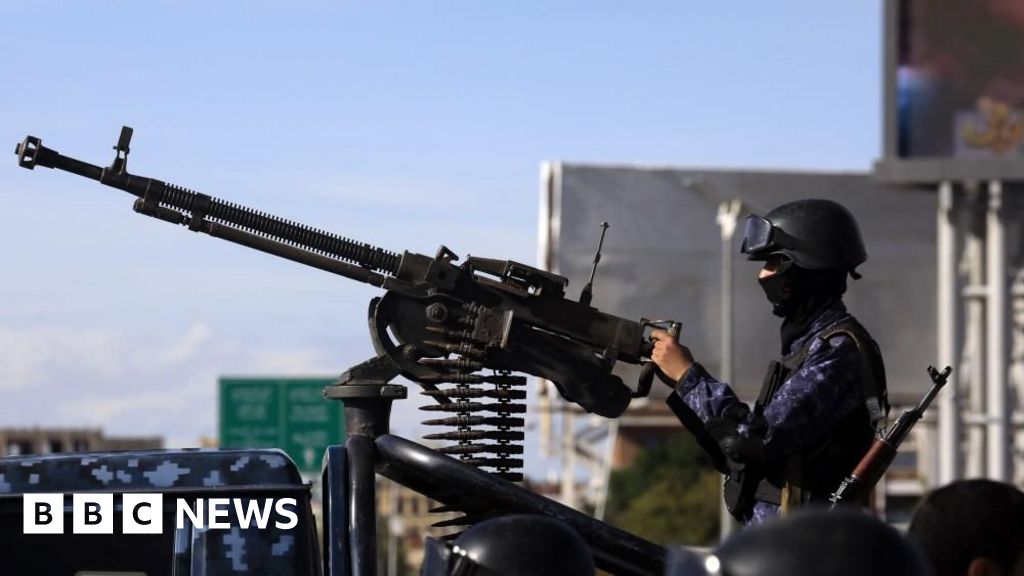
The Iran-backed Houthis in Yemen say they have launched a barrage of missiles against Israel - the first since the start of the US-Israel war with Iran.
The group said in a statement that it had targeted "sensitive Israeli military sites" and vowed to continue such attacks. Israel said it had shot down two missiles coming from Yemen.
The entry of the powerful Iranian proxy into the conflict raises fears of further disruption to the world economy as the armed group has capacity to attack shipping in the Red Sea.
Houthis consider themselves to be part of a so-called "axis of resistance" that also includes other groups financed by Iran, such as the Hezbollah in Lebanon and Hamas in the Gaza Strip.
Yemen has been devastated by a civil war that began 12 years ago, when the Houthis seized control of the country's north-west from the internationally recognised government and a Saudi-led coalition supported by the US intervened in an effort to restore its rule.
Crucially, they control the Yemen's Red Sea coastline.
The involvement of the group in the conflict that began with US and Israeli strikes on Iran on 28 February had been largely expected.
Prior to launching Saturday's attack, their military spokesman issued a statement saying their hands were "on the trigger for direct military intervention" if any countries joined the US-Israeli strikes or the Red Sea was used for military operations against Iran.
A few hours later, they confirmed they had launched "a salvo of ballistic missiles" and attacks would continue "until the aggression against all resistance fronts ceases" - an apparent reference to Israel's escalation of operations against the Hezbollah.
Later on Saturday, the Houthis said a second wave of missiles and drones had been launched against Israel.
US and Israeli attacks against Iran have continued unabated, even as US President Donald Trump says he has postponed a threatened attack on Iran's power plants if it does not reopen the strategic Strait of Hormuz to shipping by 6 April.
About 20% of the world's oil and liquefied natural gas typically passes through the waterway.
Its closure has caused the price of oil to skyrocket and has raised concerns that a prolonged blockage could raise energy prices - and even lead to a severe contraction in the economies of many countries.
Trump says Iran is desperate to reach a deal to end the war and is involved in talks with the US to do so - which Tehran denies.
There is a large distance between Israel and Yemen, and Israel has been successful in intercepting Houthi missiles in the past.
But the armed group has previously attacked vessels in the Bab al-Mandab Strait, which ships use to access the Red Sea and, ultimately, the Suez Canal from the Indian Ocean.
From November 2023 to early 2025, the Houthis launched almost 200 attacks on ships in the Red Sea, damaging over 30 vessels and hijacking at least one.
The attacks forced even major shipping companies to stop using the Red Sea - through which almost 15% of global seaborne trade usually passes - and take a much longer route around southern Africa instead.
The US and UK carried out air strikes on Houthi targets in Yemen in January 2024 and in March 2025 following the attacks.
The effective closure of the Strait of Hormuz by Iran has forced Saudi Arabia to divert oil through a pipeline to its Red Sea coast, with shipments bound for the Asian market then sailing south past Yemen - making Bal al-Mandab the main channel for these shipments.
Facts Only
The Iran-backed Houthis in Yemen launched missiles against Israel, their first attack since the start of the US-Israel war with Iran.
The Houthis stated they targeted "sensitive Israeli military sites" and pledged to continue attacks.
Israel reported intercepting two missiles fired from Yemen.
The Houthis control Yemen's Red Sea coastline and have previously attacked shipping in the Bab al-Mandab Strait.
From November 2023 to early 2025, the Houthis conducted nearly 200 attacks on Red Sea vessels, damaging over 30 ships and hijacking at least one.
The US and UK conducted airstrikes on Houthi targets in Yemen in January 2024 and March 2025.
Iran closed the Strait of Hormuz, causing oil prices to skyrocket and forcing Saudi Arabia to divert oil shipments through the Red Sea.
US President Donald Trump postponed a threatened attack on Iran's power plants if the Strait of Hormuz is not reopened by April 6.
The Houthis issued a statement warning of direct military intervention if the Red Sea was used for military operations against Iran.
The group launched a second wave of missiles and drones against Israel on the same day.
The Houthis are part of an Iran-backed "axis of resistance" that includes Hezbollah in Lebanon and Hamas in Gaza.
Yemen's civil war began 12 years ago when the Houthis seized control of the northwest, prompting Saudi-led intervention.
Executive Summary
Full Take
The strongest version of this narrative highlights the escalation of regional conflict, with the Houthis' entry into the US-Israel-Iran war signaling a dangerous expansion of hostilities. The source effectively outlines the strategic stakes—Red Sea shipping disruptions, oil price surges, and the potential for broader economic fallout—while grounding the analysis in verifiable actions by key actors. However, the framing leans toward a geopolitical chessboard perspective, where state and non-state actors maneuver for advantage, potentially obscuring the human cost of prolonged conflict in Yemen and the broader Middle East.
Patterns detected: ARC-0024 Ambiguity (the "axis of resistance" label simplifies complex local grievances into a monolithic proxy force), ARC-0043 Motte-and-Bailey (the Houthis' justification for attacks shifts between defending Yemen and supporting regional allies).
Root cause: The paradigm here is great-power competition, with Iran and the US-Israel alliance locked in a proxy struggle. Unstated assumptions include the inevitability of escalation and the primacy of military solutions over diplomacy. This echoes Cold War-era brinkmanship, where local conflicts become theaters for superpower rivalry.
Implications: Human agency is diminished as Yemenis, Israelis, and Iranians face the consequences of decisions made by distant powers. The immediate beneficiaries are arms manufacturers and energy speculators, while ordinary citizens bear the costs of war and economic instability. Second-order effects could include deeper global energy crises, refugee flows, and the normalization of Red Sea militarization.
Bridge questions: How might this conflict de-escalate if local actors' grievances were addressed independently of great-power interests? What evidence would change your assessment of the Houthis' strategic goals—are they primarily an Iranian proxy or a Yemeni movement with autonomous objectives? What role could neutral mediators play in preventing further Red Sea disruptions?
Counterstrike scan: A coordinated influence campaign would amplify fears of economic collapse, frame the Houthis as irrational aggressors, and downplay the role of US-Israel strikes in provoking retaliation. The actual content avoids overt manipulation but risks reinforcing a binary "good vs. evil" narrative by omitting the broader context of Yemen's civil war and the humanitarian crisis. No structural alignment with a hypothetical attack playbook is detected.