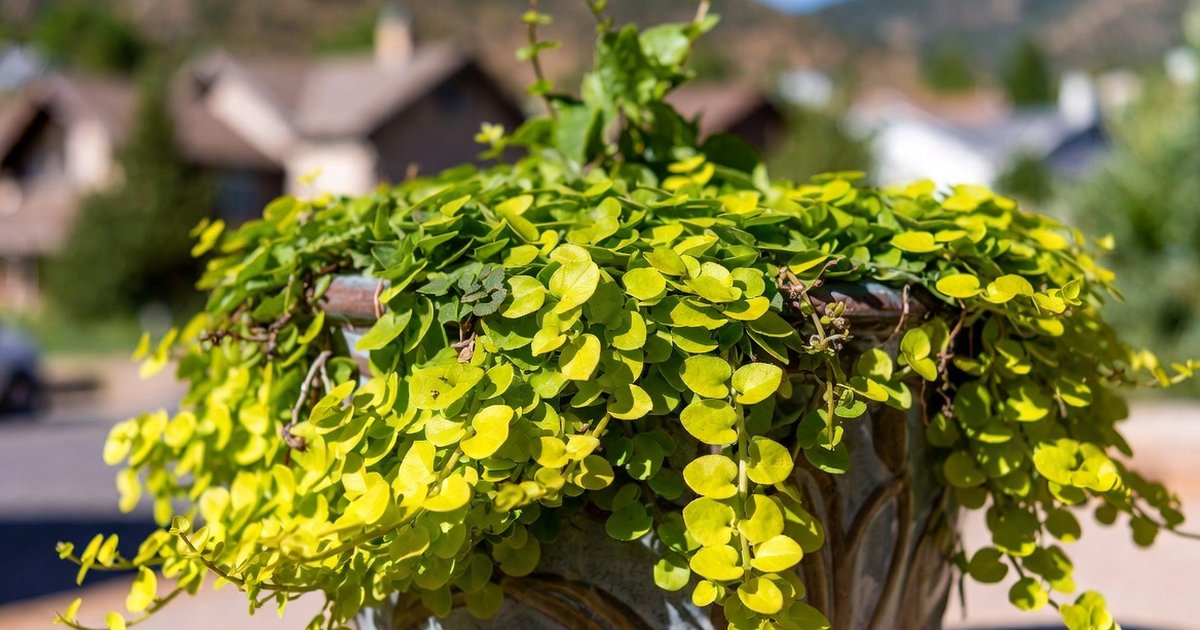
Lysimachia nummularia (commonly called Creeping Jenny or Moneywort, especially the popular golden variety ‘Aurea’ or ‘Goldilocks’) is a vigorous, trailing perennial prized for its cascading foliage. It adds a bright chartreuse-to-golden pop as a “spiller” in containers.
It pairs beautifully with the plants you’ve asked about: trailing under Lobelia and Alyssum, contrasting with Sweet Potato Vine, and softening the base of upright Juncus or mounding Lantana.
Growing Conditions in Fort Collins
Creeping Jenny is one of the tougher options for Zone 5b and handles Colorado’s climate well when given consistent moisture.
- Hardiness: Perennial in Zones 3–9 (or 4–9). It is reliably hardy in Fort Collins and will return each spring, dying back in winter and regrowing from the crown.
- Planting time: Spring after last frost (mid-to-late May) or early fall.
- Sun: Full sun to partial shade. In hot Colorado summers, afternoon shade helps prevent leaf scorch. Golden varieties show their brightest chartreuse/yellow color in full sun; they turn more lime-green in deeper shade.
- Soil: Moist, well-draining, average to rich soil. It tolerates clay and a range of pH levels.
- Water: High moisture needs — keep soil consistently moist (but not constantly soggy). It loves “wet feet” and is excellent near water features or in rain gardens. In dry Fort Collins air and containers, it will need frequent watering.
Care Tips
- Growth habit: Low-growing (2–6 inches tall) but spreads/trails 1–3+ feet. Very fast-growing and excellent for hanging baskets, window boxes, and large pots.
- Maintenance: Easy. Trim back if it gets too long or invasive in containers. Divide every few years if growing in the ground.
- Fertilizer: Light feeder. A balanced slow-release fertilizer in spring is usually enough.
- Flowers: Small, cup-shaped yellow flowers in summer (not the main feature — it’s grown for foliage).
- Considerations: Can be vigorous/spreading. In containers this is rarely a problem, but avoid planting it in open garden beds near natural areas where it could escape (it’s considered invasive in some regions).
Pro tip for Fort Collins containers: Golden Creeping Jenny is a fantastic foliage plant that provides season-long color and softens pot edges. It works especially well in “spiller-thriller-filler” combos with your other plants.
Would you like info on a different Lysimachia species or specific variety recommendations?
Facts Only
* Lysimachia nummularia* is a vigorous, trailing perennial.
* It is prized for its cascading foliage, exhibiting chartreuse-to-golden color.
* It is reliably hardy in Zones 3–9 (or 4–9).
* Planting time is Spring after the last frost (mid-to-late May) or early fall.
* Optimal sun exposure is full sun to partial shade.
* Afternoon shade is recommended in hot Colorado summers to prevent leaf scorch.
* The plant requires moist, well-draining soil and high moisture.
* It is suitable for containers, hanging baskets, and window boxes.
* Growth habit is low-growing (2–6 inches tall) but spreads/trails 1–3+ feet.
* It functions as a light feeder, requiring a balanced, slow-release fertilizer in spring.
* The plant has small, cup-shaped yellow flowers in summer.
Executive Summary
Full Take
Sentinel — Likely Synthetic
This text exhibits strong characteristics of AI generation, displaying perfectly optimized structure and factual coherence typical of LLM synthesis, even though the botanical facts presented are accurate.