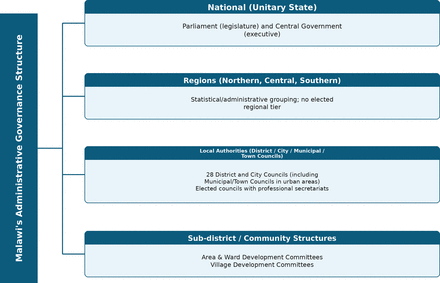
The pertinent question, then, is what is required to enhance decentralisation efforts in health systems? In other words, what functional capacitation is necessary to effectively strengthen district health systems? Blantyre District in Malawi’s southern region offers answers to these questions and how to operationalise those functions.
Blantyre context
Prior to BPS, Blantyre was the epicentre of Malawi’s HIV epidemic.36 37 Blantyre has a population of about 1.5 million people, nearly 48% of whom are under 15 years of age.37 In 2016, Blantyre City’s adult HIV prevalence was 17.7%, the highest among Malawi’s 28 districts and almost two times the national average of 10%.36 37 Several factors contributed to this, including Blantyre’s status as the country’s oldest urban centre and commercial capital, which attracts many young people and migrant workers seeking economic opportunities.38
While Blantyre has been a priority district for implementing HIV programmes in Malawi, many activities were implemented in a fragmented manner by numerous local faith-based, non-governmental and community-based organisations (NGO/CBO), as well as international partner affiliates.38 The district also lacked the systems and resources needed to coordinate these diverse actors and interventions, resulting in activities that were often poorly aligned with community needs.38
Blantyre prevention strategy
In response to these challenges, BPS was launched in May 2020, under the leadership of the Government of Malawi, with support from the Center for Innovation in Global Health at Georgetown University and other partners, and funding from the Bill and Melinda Gates Foundation. It was designed as a counterweight to vertical or parallel programmes that may have some public health benefit but further fragment subnational health systems. The project aimed to develop a robust local system for sustained HIV prevention and institutionalise a cohesive, effective and sustainable country-led HIV prevention response with coordinated external support. To test the hypotheses within the BPS theory of change, its holistic approach channelled investments towards strengthening and embedding essential functions and capabilities within existing district-level structures for effective targeting and surveillance, demand generation, service delivery and sustained use of HIV prevention interventions. (See figure 3: BPS Theory of Change).
BPS theory of change. BPS, Blantyre Prevention Strategy.
Over the course of 3 years, national and local government staff, BPS-supported partners and others adapted previously tested approaches to Blantyre, co-developed plans, trained local staff and implemented activities. BPS applied adaptive learning techniques to course correct and try new approaches based on data and experience. In year 4 (May 2023 to April 2024), leadership of activity planning and implementation shifted from being largely BPS-funded partner-driven to ownership by the District and City Health Teams.39
The effects of BPS have been far-reaching,37 enhancing ‘district leadership capacity’ to coordinate previously fragmented multisectoral partners working in Blantyre and strengthening district health system capacity from communities up to elected officials.40 BPS has also supported quality improvement initiatives that increased pre-exposure prophylaxis (PrEP) uptake in Blantyre; use of data and insights from ‘community labs’ (structured community engagement sessions using simplified human-centred design methods) to inform service delivery priorities; and implementation of HIV surveillance, detection and response activities.40 41
Coinciding with BPS implementation, and within the context of Malawi’s broader national and district HIV response, Blantyre’s HIV prevalence declined from over 17% in 2016 to 10% by 2025 and the district is no longer the one with the highest HIV prevalence in Malawi.37 While these trends cannot be attributed solely to BPS, an external evaluation of BPS found that ‘BPS significantly increased HIV testing, sustaining an additional 533 tests per month. Similarly, …PrEP uptake, screening and initiation improved, with PrEP initiation rates rising from 19.8% in early 2021 to 65.1% in early 2024’.40
With BPS project implementation in Blantyre scheduled to conclude on 31 July 2026, the focus in its final year is on documenting and institutionalising the systems components needed for HIV prevention within the Blantyre District and City public health system. Among these components are the functions, capabilities and relationships to ensure the district and city health teams continue to lead the coordination of HIV services across facilities, partners and communities; deliver services that are high-quality, data-driven, people-centred and non-stigmatising; detect and respond rapidly to HIV risks; and co-design health promotion and prevention interventions with communities.
The section below maps the various domains of the Harare Declaration Action Points against BPS activities to describe how BPS is strengthening Blantyre’s District Health System.
Mapping Blantyre Prevention Strategy-supported strengthening of Blantyre’s District Health System to the Harare Action Points
The Declaration of the Harare Conference identified several action points for strengthening district health systems (see figure 4).5 This section draws on evidence from BPS programme documentation, peer-reviewed publications, routine activity reports, implementation experience and external evaluation findings.40 Using these sources, BPS activities were mapped against the Harare Declaration Action Points to examine how the project has strengthened the district health system in Blantyre and built institutional capacity to enhance the effectiveness of decentralisation efforts in Malawi’s health sector. Together, these domains show how BPS supported Malawi’s decentralisation objectives by strengthening district capacity to plan and prioritise using local data, deliver quality services, mobilise resources, engage communities, coordinate stakeholders and promote intersectoral action.
Declaration of the Harare Conference on Strengthening District Health Systems (Action Points).
Supporting district planning
The objective of health systems planning is to enhance the delivery of health services and improve population health outcomes.42 Achieving this goal requires district health systems to be able to (1) develop plans for health services, (2) determine district priorities (which may differ from national priorities), (3) involve stakeholders in the planning process and promote alignment of stakeholder activities and funding with district priorities and (4) implement district plans.43 44 Integral to this process is a robust health information system that facilitates effective planning and decision-making.
BPS supports district planning by improving routine access to and use of data for informed HIV and health-related decision-making. BPS invested in creating a data pipeline, linked to national systems, that synthesises multisectoral data sources into the Prevention Adaptive Learning and Management System (PALMS), a user-friendly digital dashboard. PALMS was developed from Blantyre district-based health data users’ insights about their needs and preferences for data presentation and use. PALMS presents data from the pipeline that allows DHMT coordinators to monitor relevant disease and programme performance-related indicators across HIV and other health programmes while also enabling data access for decision-making by site/community-level individuals. Having necessary data in a single, easy-to-access digital health platform has improved access to data at district, facility and community levels, along with data use and data-informed planning and decision-making.
In addition, BPS built capacity for passive and active HIV surveillance within the DHO’s existing Integrated Disease Surveillance and Response (IDSR) unit, district coordinators and facilities through pilot use of IDSR approaches for HIV prevention. District, facility and community health workers can now identify upticks in new infections and/or proxy risk for infection by geographical area and subpopulation, target services to those communities or populations and coordinate and monitor the performance of government staff as well as NGO/CBO partners operating in the district.
To support institutionalisation and sustainability, the Ministry of Health Digital Health Division (DHD) assumed management of PALMS and the data pipeline in 2025. Blantyre’s new data-driven, decision-making culture is on its way to meeting HSSP III objectives, which include further decentralisation of the health information system to each decision-making entity at every level of the health system, aiming to foster ‘fully decentralized yet optimally integrated, fit for purpose, [Health Management Information Systems] at the community, health facility, district, [and] central hospital [.]’.22
Strengthening district leadership
District leadership is crucial for ensuring effective programme implementation and quality service delivery.43 44 BPS has worked to enhance the district health team’s governance and technical leadership skills in all aspects of the HIV prevention system, creating connections between the district and city health teams and between other systems actors, which has improved coordination and created a more seamless, whole-of-district HIV response.40 One focus area is strengthening the leadership and operational capacity of the DHO’s quality improvement (QI) unit. Extensive training and mentorship were provided to the district Quality Manager, QI ‘mentors’ (District Coordinators) and focal persons at district and facility levels to apply QI methodologies and develop, test and implement change ideas for QI projects. Quality Improvement Support Teams at both levels have become the centre of the district’s data review and response activities. The DHO has used these systems investments and tools to address other health challenges, including a cholera outbreak and respond to other emerging public health needs caused by Cyclone Freddy in 2023.
Bolstering community involvement
Community involvement is strengthened by ‘creating appropriate mechanisms for providing support and increasing self-reliance by strengthening the knowledge and skills of communities in solving health and development problems’.5 Active community involvement in planning health services can promote service responsiveness and ensure that health interventions reflect local needs.45 46 Under DHSS leadership, BPS instituted a systematic approach that enables district staff and partners to elicit community insights from clients and community members about HIV service delivery challenges and opportunities for improvement. It adapted a ‘community lab’ model to the Malawian context in which trained staff use simplified human-centred design methodologies to generate insights that the district and partners can use to address identified issues. The laboratories have fostered feedback loops between communities, health facilities and the district and city health offices that enable people-centred programming. For example, insights gathered from community labs identified barriers to PrEP delivery due to the stigma around its delivery at HIV treatment clinics within facilities. This information was incorporated into a district-led QI collaborative, and a change idea was tested, which increased access to PrEP delivery at additional clinics within the facility. In addition, the information informed changes to the national PrEP guidelines.
Based on early project implementation, in the project’s third year (May 2022 to April 2023) the district established linked networks between communities, facilities, the district, the city and others to align the work of CBOs with health facilities and other partners. Network committees centred around public health facilities have become the platform for multisectoral partners to jointly review data and coordinate activities to address local needs within the catchment area. Facilitated by district coordinators, these committees seek to strengthen the coordination of fragmented multisectoral delivery and community channels, promote shared resource allocation and improve service delivery and health outcomes. Importantly, the networks enable community leaders to play an active role in decision-making processes for community activities, fostering community empowerment objectives espoused in the Harare Declaration and HSSP III.
Promoting intersectoral action
Intersectoral action is shaped by the broad conceptualisation of health beyond a biomedical approach, encompassing social, economic, political and environmental factors that influence population health.47 48 Promoting intersectoral action requires ‘creating mechanisms to give health concerns higher priority on the agenda of district development and helping each sector define their role in health activities’.5
Under BPS, efforts were made to engage local government leaders in Blantyre who had become disengaged from the HIV response over time as ‘others’—largely externally financed international NGOs—had taken on more of the response. A structural risk reduction working group, consisting of local political leaders (Ward Councillors) from the City Council, was established to re-engage them in addressing the multifaceted social and structural drivers of HIV in Blantyre, including poverty, unemployment, alcohol and substance abuse and transactional sex. It was later expanded to include District Councillors.49
BPS co-developed a training programme that increased councillor capabilities in data access and interpretation, advocacy, community engagement and resource mobilisation. Following the trainings, the Councillors launched HIV prevention efforts in their respective wards, for example, integrating HIV prevention messages into their routine activities, visiting health facilities and engaging with implementing partners to ensure accountability.50 It is anticipated that Councillors will use their BPS-supported capacitation to act at council level, including enforcing existing or enacting new by-laws to address structural risks, further promoting intersectoral action.
Mobilising resources
Resource mobilisation is vital for effective health system strengthening. Domestic resources are scarcely sufficient to finance health services in low- and middle-income countries, but external assistance can often be vertical, targeting specific services.51 While donors recognise the benefits of channelling funds through local institutions and understand how the prevalence of vertical disease programmes can lead to health system fragmentation, lack of accountability and limited capacity lead them to bypass state institutions.52–54 Overcoming such fragmentation and promoting country ownership of health plans and priorities requires creating attractive opportunities for donor investment, for example, local institutions with demonstrated capacity to use such funding effectively.52
By investing in strengthening district-level capacity to execute vital health system functions, BPS creates opportunities for further domestic and external investment. As evidence, Blantyre district collaborated with health facilities and implementing partners to incorporate activities that enable operationalisation of the BPS-supported health system functions into the 2024 District Implementation Plan, which set out its funding priorities. This strategic inclusion supports the sustainability of these functions, promotes a less fragmented funding environment and creates a platform to mobilise resources for broader health system strengthening.
Additionally, Blantyre is one of the pilot districts selected for direct facility financing (DFF), with 12 facilities participating in the pilot. The selection criteria included the location of the facility (rural vs urban), the number of clients served and, most importantly, the functionality of the HCMC. Training of HCMCs supported by BPS helped activate some of these committees, thereby qualifying their facilities for DFF. Facility staff and HCMCs have been trained in planning, budgeting and financial management. As part of sustainability efforts, facilities will incorporate risk identification and response mechanisms within DFF processes and will receive support for mobility through budgeted items such as fuel, data bundles and other allowable expenses under DFF guidelines, while programme coordinators will budget for capacity-building initiatives for the participating facilities.
Ensuring sustainability
Sustainability is crucial to protecting investments in public health systems and maximising their public health impacts.55 Vertical programmes, which are often rigid, centrally planned, narrowly targeted and managed separately from routine health services, limit sustainability within the local system.14 18 56 57 The absence of integration and inability of district health managers to administer these programmes deters sustainability and broader health system strengthening.18 Moreover, unsustainable activities or projects result in the waste of financial, technical and human investments, low levels of community support and reduced trust in health systems.55 They also create vulnerabilities in the health system when funding disruptions occur, as experienced in 2025.58
Ensuring sustainability requires ‘integrating all programs into the district health system and improving the basic management skills of health personnel’.5 BPS’s objective is not to sustain specific activities but rather to institutionalise the capabilities and relationships needed for effective HIV prevention within the health system, ensuring they become routinised across all of Blantyre’s HIV prevention activities and other disease categories as part of a broader integrated health response.
Affordability importantly contributes to sustainability. BPS has endeavoured to create a model that is affordable for sustainability and adaptable to other contexts with minimal additional cost. For example, BPS built the data pipeline on existing interoperable digital health platforms and transferred PALMS ownership to the DHD. BPS collaborated with national mobile network operators in Malawi to enable reversible billing for users with airtime limitations and developed a mobile application that allows offline access to archived data when the internet is unavailable. These efforts contribute to the sustainable integration of BPS-supported tools and functions into the health system for affordable, broader use.
Facts Only
* Blantyre was the epicenter of Malawi’s HIV epidemic prior to BPS.
* Blantyre City had an adult HIV prevalence of 17.7% in 2016, which was nearly twice the national average of 10%.
* Many HIV activities were implemented in a fragmented manner by local faith-based, NGO/CBOs, and international partners prior to BPS.
* The Blantyre Prevention Strategy (BPS) was launched in May 2020.
* BPS aimed to develop a robust local system for sustained HIV prevention.
* BPS tested hypotheses by channeling investments toward strengthening functions within district-level structures for targeting, surveillance, service delivery, and sustained use of interventions.
* Leadership of activity planning shifted in year 4 (May 2023 to April 2024) to the District and City Health Teams.
* BPS enhanced 'district leadership capacity' to coordinate multisectoral partners and strengthened district health system capacity from communities up to elected officials.
* BPS increased HIV testing by sustaining an additional 533 tests per month.
* PrEP initiation rates rose from 19.8% in early 2021 to 65.1% in early 2024.
* The final phase focuses on institutionalizing systems components for HIV prevention within the Blantyre District and City public health system.
* PALMS was developed to synthesize multisectoral data into a digital dashboard for district-level monitoring.
* District staff used pilot IDSR approaches for HIV prevention surveillance.
* Community labs used human-centered design methods to generate insights for service delivery priorities.
* Network committees centered around public health facilities were established to coordinate multisectoral partners.
Executive Summary
The Blantyre Prevention Strategy (BPS) was launched in May 2020 with support from international partners to address the HIV epidemic, which had previously been concentrated in Blantyre and involved fragmented implementation by various local organizations. The BPS aimed to create a robust, country-led response by strengthening essential functions within district-level structures for effective targeting, surveillance, service delivery, and sustained intervention use. Over three years, the project utilized adaptive learning to adjust approaches based on data and experience, shifting leadership of planning and implementation to the District and City Health Teams.
The program demonstrated measurable effects, including enhanced 'district leadership capacity' and improved HIV testing and PrEP uptake, with PrEP initiation rates rising significantly from 19.8% in early 2021 to 65.1% in early 2024. The final phase of the project focuses on institutionalizing these systems components within the Blantyre public health system, ensuring district and city health teams can lead coordination, deliver quality services, detect risks, and co-design interventions with communities.
The strategy reinforced decentralization objectives by improving data use through a digital platform called PALMS, which synthesizes multisectoral data for planning. It also strengthened leadership capacity, quality improvement functions within the District Health Office (DHO), community involvement via 'community labs,' and fostered intersectoral action by engaging local leaders in addressing structural drivers of HIV risk. Furthermore, efforts focused on resource mobilization by integrating BPS functions into district implementation plans and piloting facility financing to ensure sustainability through integrated management and affordable tools.
Full Take
The narrative demonstrates a clear pivot from fragmented, externally driven interventions to an attempt at systemic integration and localization, driven by the principle of decentralized capacity building. The effectiveness of the BPS lies in its success at shifting focus from merely delivering specific services (like testing) to institutionalizing the *functions* required for sustained public health governance—planning, data-driven decision-making, and coordination across sectors.
A key pattern emerging is the successful linkage between operational change and structural outcomes: increasing community involvement through 'community labs' directly informed changes in service delivery access (e.g., PrEP delivery), demonstrating that localized knowledge can drive system improvements rather than simply being an add-on. However, the focus on sustainability highlights a critical tension: achieving short-term measurable gains versus embedding deep, long-term institutional change. The push to delegate data management to the Digital Health Division suggests an awareness of necessary centralization for system coherence (like meeting HSSP III objectives), yet the need for decentralized decision-making remains paramount.
The emphasis on mobilizing resources and engaging political leaders—specifically ward councillors through training on data and advocacy—points toward a recognition that health outcomes are inextricably linked to socio-political structures, not just biomedical inputs. The implicit assumption is that if local actors are given the tools (data, leadership training, community platforms), they will prioritize system strengthening over siloed service delivery. The remaining tension lies in whether this institutionalization successfully translates into sustained accountability when external funding priorities shift, and whether the 'affordable' digital solutions truly mitigate existing power imbalances between central and local entities.
Bridge Questions: How do changes in data ownership (PALMS transfer to DHD) impact the political influence of district-level actors who previously used localized data for advocacy? What specific metrics will determine if institutionalization results in genuine sustained integration rather than temporary compliance during funding cycles? If community feedback leads to successful service change, what mechanism is needed to ensure that this locally-informed approach is not co-opted or overridden by formal bureaucratic structures?
Sentinel — Human
This text functions as a detailed, evidence-based report that synthesizes project implementation data against stated health system strengthening objectives, exhibiting the structure and citation practices of expert journalistic or policy analysis.