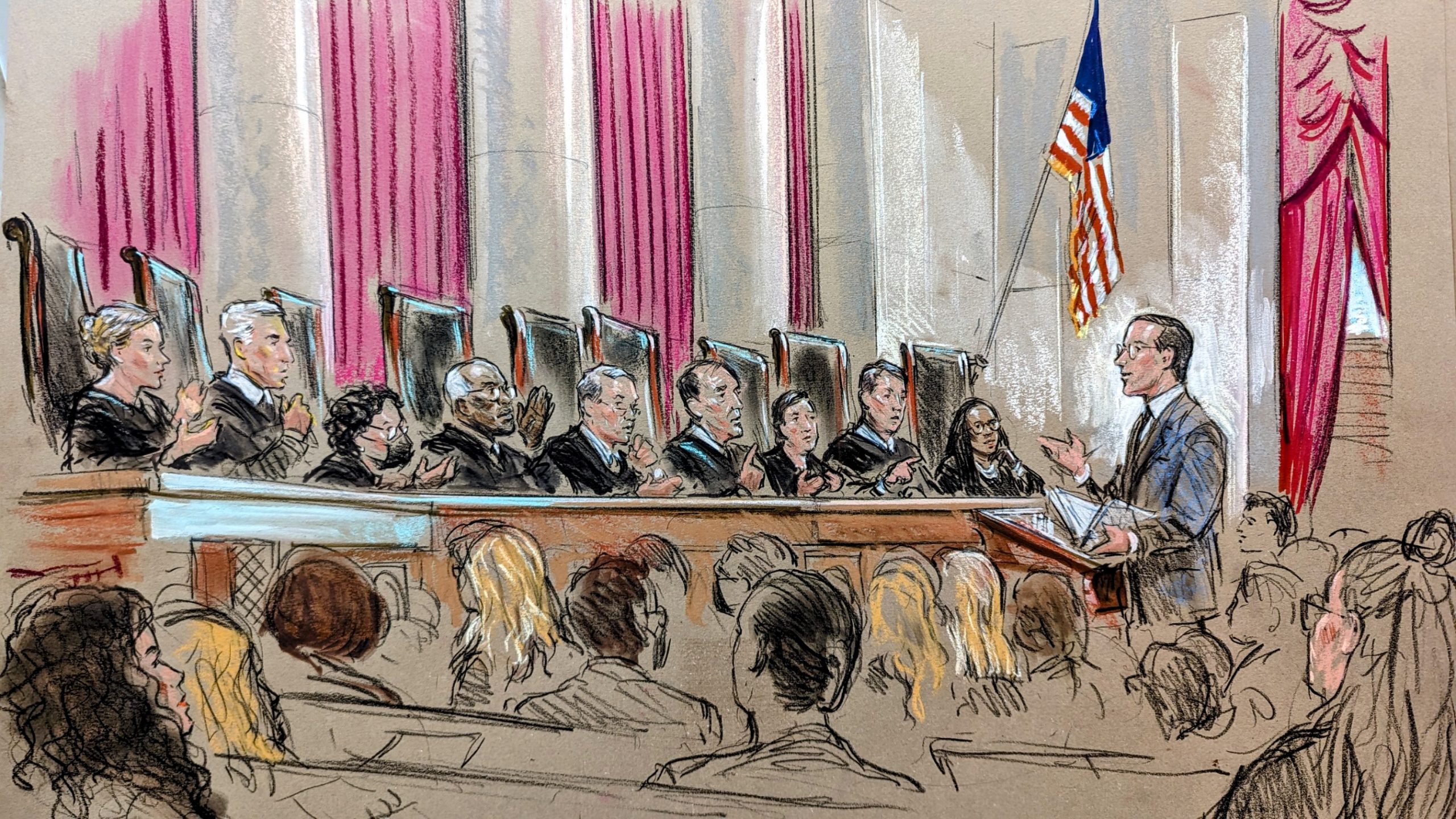
Empirical SCOTUS is a recurring series by Adam Feldman that looks at Supreme Court data, primarily in the form of opinions and oral arguments, to provide insights into the justices’ decision making and what we can expect from the court in the future.
In last year’s TikTok v. Garland, the Supreme Court confronted a statute threatening to ban one of America’s most popular social media platforms. The court’s per curiam opinion rejecting TikTok’s emergency application opened with a familiar constitutional refrain: “At the heart of the First Amendment lies the principle that each person should decide for himself or herself the ideas and beliefs deserving of expression, consideration, and adherence.” The citation? The 1994 case of Turner Broadcasting System, Inc. v. FCC.
That same precedent appeared throughout the briefing – but in radically different forms. TikTok’s brief invoked Turner to argue that the government cannot evade heightened review of a statute under the First Amendment through claims that speech should be treated differently based on its source. Turner, the brief argued, “does not suggest that, where Congress engages in content-and-speaker-based regulation, the Government can evade strict scrutiny by claiming the speaker is ‘special.’” The government’s brief cited the same case for the opposite proposition.
For the present sake, the details of this argument don’t much matter. What does is that it was the same case and the same citation, yet there were completely different arguments about what it meant.
Of course, this isn’t unusual – it’s how Supreme Court advocacy works. Citations aren’t neutral markers of legal authority. They’re strategic choices about which precedents lend credibility, which frameworks control the analysis, and which justices’ reasoning will resonate with the court.
This leaves open the question: Which authorities do advocates choose most, and what do those patterns reveal about the Supreme Court?
This article examines all 191 parties’ merits briefs citing 3,482 cases across a total of 5,238 pages of briefs filed during the Supreme Court’s 2024 term. By coding every citation in each brief’s table of authorities, we can see not just which justices advocates invoke most often, but also which law firms cite which authorities, how public interest organizations and the Office of the Solicitor General approach citations differently, and what the aggregate picture tells us about how Supreme Court advocacy works today.
Chief Justice John Roberts dominates the citation landscape. Across all 191 briefs, Roberts accounts for 437 pages of citations – more than any other justice. Justice Antonin Scalia comes in second at 387 pages, followed by Justice Clarence Thomas at 307. The gap between Roberts and everyone else is substantial: he receives roughly 13% more citations than Scalia, despite Scalia’s reputation as a methodological touchstone (see more on that below).
This makes sense. Roberts has been on the court since 2005, authoring major opinions across nearly every area of law. He’s written landmark decisions on the Affordable Care Act, presidential immunity, voting rights, campaign finance, administrative law, and arbitration. His opinions represent doctrinal stability – the kind of precedent that both sides in a dispute can invoke because it established governing frameworks rather than taking maximalist positions. Roberts is key to the court’s infrastructure.
As noted, Scalia is in second. Even nearly a decade after his death, Scalia’s writing continues to shape how advocates argue. Textualism, once a controversial method, is now the default language of statutory interpretation before the court. And Scalia remains its leading light.
Thomas occupies the third tier, with 307 citations. His opinions appear most often in cases involving constitutional structure – federalism, the commerce clause, the nondelegation doctrine, etc. Advocates cite Thomas when they want to argue for limits on federal power or restrictions on the administrative state. In other words, his writing supplies the doctrinal architecture for arguments about what the federal government cannot do.
The middle tier – Justices Samuel Alito (251 citations), Anthony Kennedy (243), Elena Kagan (225), Chief Justice William Rehnquist (224), and Justice Ruth Bader Ginsburg (207) – reflects a mix of seniority, subject matter expertise, and methodological influence. Kennedy’s citations concentrate in constitutional rights cases where his pivotal opinions in Obergefell, Citizens United, and First Amendment disputes still govern. Kagan appears frequently in statutory interpretation and administrative law. Alito’s citations cluster in religious liberty, criminal procedure, and separation of powers disputes.
The distribution suggests something important: citation patterns track both institutional authority and ideology. Roberts and Scalia together account for nearly a quarter of all justice citations. Their dominance reflects not just individual influence but the court’s center of gravity over the past two decades: towards a textualist, conservative orientation.
The solicitor general’s Scalia strategy
One of this study’s most striking findings involves the Office of the Solicitor General. Across all OSG briefs filed, Scalia was the most-cited justice – 80 pages of citations, compared to 70 for Kagan, 61 for Thomas, and only around 60 for Roberts.
This pattern is revealing. By invoking Scalia most frequently the OSG also borrows his textualist credibility. When the government argues that an agency acted within statutory bounds, for example, citing Scalia’s opinions about how to read statutes lends the argument legitimacy with the court’s current majority. But the OSG’s heavier reliance on Scalia suggests something more strategic: when you’re defending federal power before a court skeptical of federal power, you need to speak the court’s language. That language, today, is Scalia’s.
The OSG’s citation pattern for other justices reinforces this. Kagan and Thomas appear frequently, but neither eclipses Scalia. The OSG cites Kennedy, Ginsburg, and Justice Stephen Breyer in moderate amounts – enough to invoke settled precedent in their areas of strength (especially on court deference to administrative agencies), but not so much as to signal ideological alignment. The OSG’s approach is ecumenical but tilted: invoke everyone but lean hardest on the justice whose methodology the court’s majority most respects.
Big Law’s citation portfolio
The repeat-player law firms from this term (those that filed more than one brief on behalf of a merits party) that appear most often before the court exhibit distinct citation patterns. Firms like Gibson Dunn, Williams & Connolly, and Sidley Austin cite justices in ways that reveal both strategic calculation and subject-matter specialization. (Note that these firms were selected based on their participation levels alone.)
Gibson Dunn, for example, cites Scalia most heavily (23 pages), but also draws extensively on Roberts (17 pages), Thomas (15 pages), and Breyer (13 pages). The firm’s practice spans business litigation, constitutional challenges, and regulatory disputes – areas where Roberts’ and Kennedy’s opinions establish controlling law. Williams & Connolly shows a propensity towards former-Justice William Brennan (26 pages) and Chief Justice Rehnquist (22 pages), but with significant citations to Alito as well (20 pages).
Other firms show more pronounced patterns. Jones Day, which has strong conservative ties, cites Scalia heavily (29 pages) but also draws substantially on Thomas (24 pages) and Roberts (21 pages). Latham & Watkins spreads citations more evenly across justices. But the pattern suggests that repeat players don’t pick ideological sides so much as cite whoever wrote the governing opinions in their practice areas.
One notable pattern: nearly every major firm cites Scalia extensively. No matter the case type, no matter the client, Scalia just keeps appearing. This confirms his role as the baseline authority – the justice whose methodology you must engage even if you’re arguing for an outcome that he would have rejected.
Public interest organizations and citation strategy
Public interest law firms show more divergent patterns. Organizations representing different constituencies cite different justices depending on their docket and litigation goals.
The Becket Fund, which litigates religious liberty cases, cites Roberts most (14 pages) but also relies heavily on Kennedy (5 pages) and Alito (5 pages) – the justices who authored some key religious freedom decisions. The Alliance Defending Freedom, another conservative organization, cited Rehnquist most frequently (12 pages). The more liberal ACLU cites Kennedy and Powell evenly at 3 pages apiece. The NAACP Legal Defense Fund similarly spreads citations across justices, reflecting its work in voting rights, criminal justice, and education – areas where precedent comes from multiple justices across ideological lines.
The Institute for Justice, a libertarian public interest firm, shows its most heavy reliance on Thomas (5 pages) with several other justices trailing behind. Public Citizen, which is more liberal-leaning, cited Brennan most often.
Again, these patterns suggest the possibility that ideological alignment matters, but less so than subject matter. Even organizations with strong political identities cite across the court’s spectrum. What matters most is which justice wrote the relevant opinion in the relevant area of law.
Precedent’s gravitational pull
Beyond individual justices, certain cases emerge as citation magnets. The most-cited case was Loper Bright Enterprises v. Raimondo (39 citations), which overruled Chevron deference, or the idea that courts should defer to agencies’ interpretation of ambiguous statutes. This makes sense – almost every regulatory or administrative law case now needs to address the post-Chevron landscape. Advocates cite Loper Bright both to argue that agencies lack authority and to distinguish why an agency’s interpretation of a statute or regulation remains valid even without Chevron deference.
Other heavily cited cases reflect the term’s docket. Becerra v. Empire Health Foundation (26 citations), which dealt with Medicare payment amounts to hospitals, appears frequently in healthcare and statutory interpretation disputes. Bostock v. Clayton County (24 citations), the discrimination case protecting gay and transgender employees, shows up across civil rights and textualism arguments. And Espinoza v. Montana Department of Revenue (23 citations), in which the court ruled that religious schools cannot be excluded from state funding for private schools, anchors religious liberty disputes.
The pattern of case-within-case citations reveals something about how advocacy works. Certain precedents become unavoidable – every brief in a category of cases must cite them. This creates citation cascades: once a case becomes central to a legal question, it appears in every brief addressing that question, which then reinforces its centrality.
The temporal distribution of citations
Perhaps most striking is the distribution of citations over time. The overwhelming majority of citations come from cases decided after 1980. Briefs cite 974 opinions from the 2000s, 693 from the 1990s, 553 from the 1980s, and then the numbers drop precipitously. Only 180 citations reach back to the 1960s. Relatively fewer citations invoke cases from before 1940.
This temporal skew reflects several dynamics. First, modern cases address modern problems – administrative agencies, technology, contemporary statutory regimes. Second, the court’s current composition has been shaped by appointments from the 1980s onward, and those justices cite their own work and each other’s. Third, doctrinal frameworks change. Older cases get overruled, distinguished, or simply forgotten as newer precedent takes over.
But the distribution also reflects advocacy strategy. Citing a 19th-century case can signal either deep historical grounding … or desperation – you’re reaching back because more recent precedent doesn’t help. And modern advocates prefer recent citations because the court prefers recent citations. The justices are often more familiar with opinions from their own era, more confident in their continued validity, and more likely to see them as controlling.
The temporal pattern also reveals that constitutional law isn’t static. Despite the shift to originalism in some areas, advocates today aren’t arguing from first principles rooted in 1789 or 1868 as often as modern precedent. More often they’re arguing from frameworks established in the late 20th and early 21st centuries, with older precedent invoked only when it remains directly relevant or serves rhetorical (or historical) purposes.
What citation patterns reveal
Taken together, these patterns tell us how Supreme Court advocacy works. As noted earlier, citations aren’t neutral – they’re strategic choices about which authorities lend credibility, which doctrinal frameworks control, and which justices’ methodologies the court will accept.
Roberts dominates not simply because he’s ideologically centrist but because he’s institutionally central. His opinions represent the court’s governing precedents across many areas of law. Scalia remains influential not through particular outcomes, necessarily, but through his methodological legacy – textualism as the default language of statutory interpretation. Thomas supplies the doctrinal architecture for arguments about structural constitutional limits. Other justices contribute specialized authority in their areas of expertise.
The OSG’s heavy reliance on Scalia’s decisions reveals sophisticated advocacy: when defending federal power before a skeptical court, borrow the court’s preferred interpretive method. Big law firms cite whoever wrote the controlling opinions in their practice areas, which can be without regard to ideology. Public interest organizations do the same.
The temporal distribution shows that advocacy operates in the present, not the distant past. Modern cases dominate because modern law is what the court applies. And certain precedents – especially new, transformative ones like Loper Bright – become inescapable, shaping every brief in their domain.
These patterns matter because they reveal the hidden structure of appellate advocacy. Which justices get cited most isn’t just about influence – it’s about which authorities the court will find persuasive.
This convergence also reflects professionalization. Supreme Court advocacy is now dominated by repeat players who know which citations work. The result is a relatively narrow citation universe – a few hundred cases and a handful of justices supply most of the authority for arguments before the court.
Ultimately, the 2024 term briefs reveal a court and a bar operating within established frameworks. The citations track institutional authority, methodological influence, and subject-matter precedent. They show advocates making strategic choices about which authorities will resonate with this court, at this moment, on these issues. Maybe most importantly they show that in Supreme Court advocacy, some justices matter more than others – not because their views are always right, but because their opinions set the terms of the debate.
Posted in Empirical SCOTUS, Featured, Recurring Columns
Cases: TikTok, Inc. v. Garland
Facts Only
The analysis covers 191 merits briefs filed during the Supreme Court’s 2024 term, totaling 5,238 pages and 3,482 cited cases.
Chief Justice John Roberts was the most-cited justice, with 437 pages of citations across all briefs.
Justice Antonin Scalia was the second most-cited, with 387 pages, followed by Justice Clarence Thomas at 307 pages.
The Office of the Solicitor General (OSG) cited Scalia most frequently in its briefs, with 80 pages, compared to 70 for Justice Elena Kagan and 61 for Thomas.
The most-cited case was *Loper Bright Enterprises v. Raimondo*, with 39 citations, which overruled *Chevron* deference.
Other frequently cited cases included *Becerra v. Empire Health Foundation* (26 citations), *Bostock v. Clayton County* (24 citations), and *Espinoza v. Montana Department of Revenue* (23 citations).
Citations overwhelmingly favored recent cases, with 974 from the 2000s, 693 from the 1990s, and 553 from the 1980s.
Older cases were cited far less frequently, with only 180 citations from the 1960s and fewer from earlier decades.
Law firms like Gibson Dunn, Williams & Connolly, and Jones Day exhibited distinct citation patterns, often aligning with their practice areas.
Public interest organizations, such as the Becket Fund and the ACLU, cited justices based on their litigation goals and subject matter expertise.
The study found that citation patterns reflect both institutional authority and ideological alignment, with certain justices serving as key authorities in specific legal domains.
Executive Summary
The analysis examines citation patterns in 191 merits briefs filed during the Supreme Court’s 2024 term, revealing how advocates strategically select precedents to influence the Court. Chief Justice John Roberts was the most-cited justice, with 437 pages of citations, followed by Antonin Scalia (387) and Clarence Thomas (307). Roberts’ dominance reflects his role in establishing broad doctrinal frameworks across multiple legal areas, while Scalia’s enduring influence stems from his textualist methodology, now the default approach for statutory interpretation. The Office of the Solicitor General (OSG) cited Scalia most frequently, likely to align with the Court’s conservative majority, while public interest organizations and law firms tailored citations to their practice areas and ideological leanings. The most-cited case was *Loper Bright Enterprises v. Raimondo*, which overruled *Chevron* deference, underscoring its immediate impact on administrative law. The study also found that citations overwhelmingly favor recent cases, with 974 from the 2000s and far fewer from earlier decades, reflecting the Court’s focus on modern legal frameworks. These patterns highlight how advocacy adapts to the Court’s composition and methodological preferences, with certain justices and precedents serving as linchpins for legal arguments.
The data suggests that Supreme Court advocacy is highly professionalized, with repeat players—such as elite law firms and the OSG—employing citation strategies that prioritize institutional authority and ideological resonance. While Roberts’ opinions provide neutral doctrinal stability, Scalia’s textualism and Thomas’ structural constitutional arguments offer frameworks for conservative and libertarian challenges. Public interest groups, however, cite across ideological lines, depending on the relevant precedent in their cases. The temporal skew toward recent cases indicates that advocates and justices alike prioritize contemporary legal frameworks, even as older precedents retain niche relevance. Ultimately, the study reveals how citation patterns reflect both the Court’s evolving jurisprudence and the strategic calculations of those arguing before it.
Full Take
The strongest version of this narrative is that Supreme Court advocacy is a highly strategic endeavor, where citation patterns reveal deeper dynamics of institutional power, methodological influence, and ideological alignment. The data shows that Chief Justice Roberts’ opinions dominate because they provide neutral, governing frameworks that both sides can invoke, while Scalia’s textualism remains a cornerstone of statutory interpretation, even posthumously. The OSG’s heavy reliance on Scalia suggests a deliberate effort to borrow his methodological credibility when defending federal power before a skeptical Court. Meanwhile, law firms and public interest groups tailor their citations to the justices most relevant to their cases, demonstrating that subject-matter expertise often outweighs pure ideology. The temporal skew toward recent cases underscores how modern legal frameworks shape advocacy, with older precedents fading unless they remain directly applicable.
Patterns detected: none
This analysis echoes the broader professionalization of appellate advocacy, where repeat players—elite firms, the OSG, and specialized public interest groups—operate within a narrow citation universe. The implications for human agency are significant: the Court’s jurisprudence is increasingly shaped by a small cohort of advocates who understand which authorities resonate with the current justices. This system benefits those with the resources to master these strategies, potentially marginalizing less experienced litigants. The second-order consequence is a feedback loop where certain precedents and justices become entrenched, reinforcing the Court’s methodological preferences and doctrinal priorities.
Bridge questions: How might this professionalization of advocacy affect the diversity of legal arguments before the Court? If citation patterns reflect strategic alignment with the Court’s current composition, what happens when the Court’s ideology shifts? Could this system inadvertently limit the evolution of legal doctrine by favoring recent, familiar precedents over older or more radical interpretations?
Counterstrike scan: If this were part of a coordinated influence campaign, the playbook would involve amplifying the dominance of certain justices and precedents to shape the Court’s perceived legitimacy and methodological direction. The actual content does not match this pattern; it presents an empirical analysis of citation trends without overt advocacy or manipulation. The study’s focus on data-driven insights aligns with academic rigor rather than strategic messaging.
Sentinel — Human
The article shows strong signs of human authorship, with high stylistic variance, domain-specific expertise, and a clear personal voice.