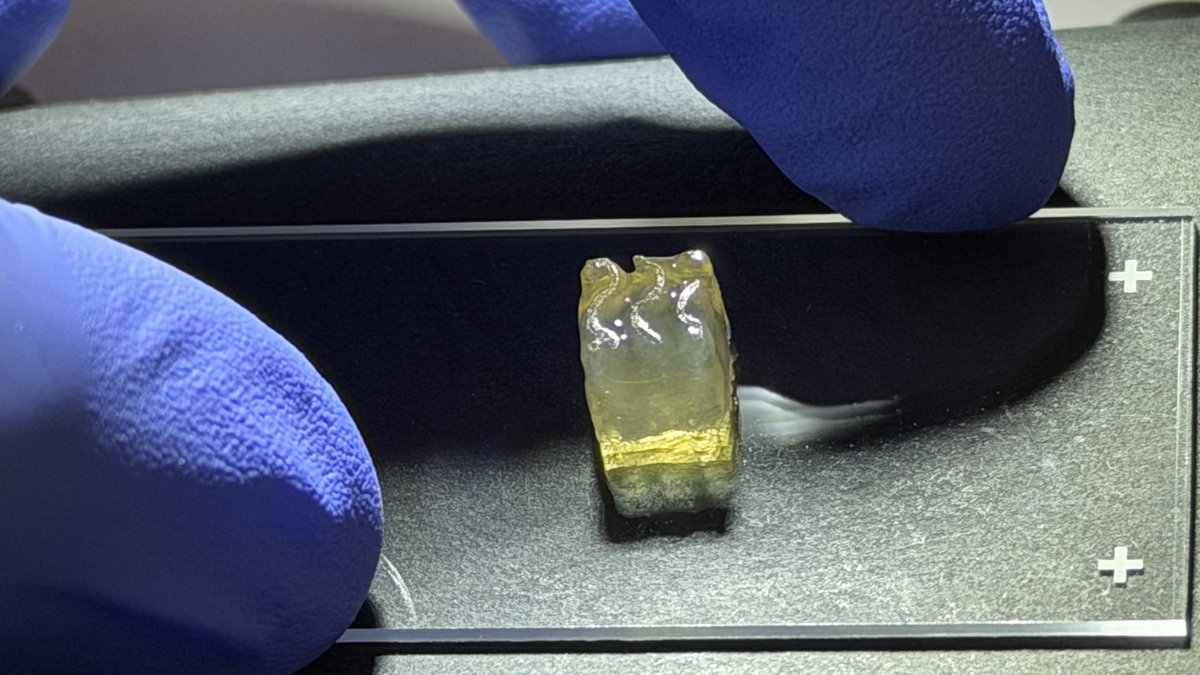
Auxilium Biotechnologies, a clinical-stage biotechnology company, has bioprinted kidney and liver tissue aboard the International Space Station (ISS), marking the first time either tissue type has been manufactured in orbit. The tissues, along with cartilage and 28 nerve repair implants, were produced using the company’s AMP-1 bioprinting platform during Mission AXLM-3, which launched on SpaceX-34 and splashed down off the California coast on June 17, 2026.
According to Auxilium, the mission marks the first time three distinct tissue types have been manufactured during a single spaceflight, and the first time a single manufacturing platform has produced both living tissue and implantable medical devices on the same flight. The kidney and liver tissues were made using cells and tissue designs from the Wake Forest Institute for Regenerative Medicine (WFIRM), with Auxilium supplying the orbital manufacturing hardware.
Isac Lazarovits, Vice President of Engineering at Auxilium, said producing multiple tissue types alongside dozens of implants in a single mission marks a step toward “routine manufacturing operations in orbit.”
Why Kidney and Liver Tissue Is Harder to Print in Orbit
Kidney and liver present a different challenge than the vascular tubes, nerve implants, and knee meniscus tissue that orbital bioprinting missions have produced before. WFIRM has been testing that challenge directly: in August 2025, the institute sent 3D printed liver tissue to the ISS to study how microgravity affects the growth, stability, and function of bioprinted organ constructs, building on its earlier work in NASA’s Vascular Tissue Challenge, where the team’s vascularized tissue functioned for up to 30 days in lab conditions.
In space, zero gravity changes how cells distribute, behave, and adhere within vascularized tissue constructs, removing the external forces that cause soft tissue to collapse under its own weight on Earth. That is part of why space conditions allow bioprinted constructs to take on more complex geometries, including voids, cavities, and tunnels similar to the internal channel structures kidney and liver tissue require.
Dr. Anthony Atala, MD, Professor and Director of WFIRM, said the uniform cell distribution achieved aboard the station “points to real possibilities for manufacturing medical devices and tissues in space.”
Organoid Research and Future Plans
The company points to organoid production as a potential future application. Organoids are 3D tissue models used by researchers to study disease and screen drugs; they are currently manufactured on Earth and shipped to orbit for use in experiments. The U.S. Food & Drug Administration (FDA) has listed organoids among its New Approach Methodologies initiative aimed at reducing reliance on animal testing, while the National Institutes of Health (NIH) has expanded funding for similar non-animal research platforms.
Building Toward Scalable Orbital Biomanufacturing
The kidney and liver tissue mission fits into Auxilium’s broader push to move beyond single product demonstrations toward a manufacturing platform capable of producing multiple tissue and device types in one flight.
Auxilium is working with Vast Space and Starlab Space on future orbital manufacturing platforms as commercial space stations prepare to replace the aging ISS, and says it is also developing capabilities intended to support future lunar and deep-space missions. Its collaboration with Starlab Space specifically will bring in orbit bioprinting and biofabrication to Starlab’s future commercial station, with the AMP-1 platform having previously produced perfusable vascular systems in microgravity.
The AMP-1 platform has been building toward this scale for some time. In an earlier ISS deployment, the system 3D printed eight medical devices in just two hours, a run CEO Jacob Koffler called a landmark for space biomanufacturing at the time.
This mission expanded that output to 28 implants alongside kidney, liver, and cartilage tissue. The mission involved support from BioServe Space Technologies, Space Tango, and NASA‘s InSPA program, along with the astronauts aboard the ISS.
3D Printing Industry is inviting speakers for its 2026 Additive Manufacturing Applications (AMA) series, covering Energy, Healthcare, Automotive and Mobility, Aerospace, Space and Defense, and Software. Each online event focuses on real production deployments, qualification, and supply chain integration. Practitioners interested in contributing can complete the call for speakers form here.
To stay up to date with the latest 3D printing news, don’t forget to subscribe to the 3D Printing Industry newsletter or follow us on LinkedIn.
Explore the full Future of 3D Printing and Executive Survey series from 3D Printing Industry, featuring perspectives from CEOs, engineers, and industry leaders on the industrialization of additive manufacturing, 3D printing industry trends 2026, qualification, supply chains, and additive manufacturing industry analysis.
Featured image shows Nerve repair implant: Auxilium Biotechnologies successfully completed the first ever mission to bioprint both medical implants and biological tissues during a single spaceflight aboard the International Space Station (ISS). Photo via Auxilium Biotechnologies.
Sentinel — Human
The text reads as a structured journalistic piece that synthesizes specific technical achievements with future research trajectories, exhibiting human editorial structuring rather than pure synthetic generation.