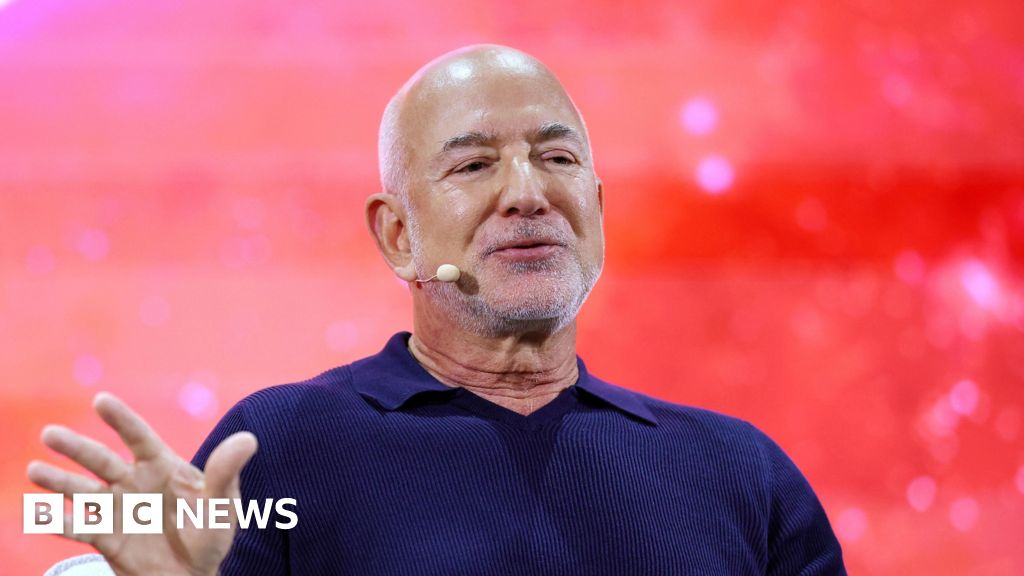
AI will lead to more need for workers rather than make people redundant, Amazon founder Jeff Bezos predicted during an appearance at a tech conference in Paris.
Bezos pushed back against growing concerns that AI will replace large numbers of workers.
Instead he argued that the tech will unlock new opportunities and increase demand for human labour.
This is in contradiction to some other tech and political figures - including former UK prime minister Rishi Sunak, now an adviser to Microsoft and AI firm Anthropic, who recently said AI was having an impact on young people's job prospects.
"I know there's a lot of concern that many people have, including many smart people, that AI is going to make humans redundant and so on," Bezos said.
"I totally disagree with this point of view. And I think, in fact, AI is going to create a labour shortage."
He painted an optimistic picture of AI's future role in society, suggesting that people are limited not by a lack of ambition, but by barriers that technology can help remove.
Billionaire entrepreneur Bezos was speaking about his new AI venture Prometheus, which is focused on accelerating physical manufacturing - a sector which is becoming increasingly automated.
The UK's Trades Union Congress has warned that AI technology could repeat "the disaster of deindustrialisation" as shareholders get richer while jobs are "degraded or displaced".
But it adds that AI could have transformative potential if developed properly, and workers could benefit from its productivity gains.
Permanent base on the Moon
Bezos also used his appearance at Europe's largest tech expo VivaTech Paris to outline his long-term vision for space exploration.
He described space as "supply constrained, not demand constrained", arguing that access to space remains the biggest obstacle to future development.
The Moon, he said, offers a natural starting point for humanity's expansion beyond Earth because of its proximity and resources.
"We're going to the Moon to stay, not just to visit," Bezos told the audience, adding that technologies such as electrolysis could eventually allow lunar resources to be used to refuel rockets and support a permanent presence beyond Earth.
The discussion also turned to another Bezos venture, space travel company Blue Origin.
It had a recent setback after an uncrewed New Glenn rocket exploded during a ground test at Cape Canaveral in Florida in May.
"It was a gut punch for the whole team. But what we've learned since then is we got really lucky," Bezos said.
No injuries were reported in the explosion, and Bezos noted several critical pieces of launch infrastructure survived the incident, including propellant and fuel systems that would have taken significantly longer to replace.
On the same stage as Bezos, Blue Origin chief executive Dave Limp said reconstruction work at the launch site is already underway and the company expects launches to resume before the end of the year.
Blue Origin is in the race to establish itself as a major player in commercial spaceflight and lunar exploration, competing with Elon Musk's SpaceX in the growing market for extraterrestrial infrastructure.
Away from the main stage, Unitree's humanoid robot was the definite crowd-pleaser. Constant queues of visitors wanted to see the latest advances in the robotics field.
This time the robot was teaming up with French neuro-AI company HABS, which showcased technology designed to allow humans to interact with machines using cognitive signals rather than speech.
The robot responded to commands generated through brain activity, via a headband with an electroencephalogram (commonly known as an EEG) attached to it.
The test uses small, metal probes called electrodes that touch the scalp.
The demo offered a glimpse of how future humans and machines could work together in the future.
It also reflected a broader trend running through this year's event: AI moving beyond chatbots and into the physical world.
Humanoid robots are increasingly becoming a reality with companies racing to develop machines capable of working alongside humans in healthcare, manufacturing and hospitality.
Sign up for our Tech Decoded newsletter to follow the world's top tech stories and trends. Outside the UK? Sign up here.
Facts Only
* Amazon founder Jeff Bezos made statements regarding AI creating a labor shortage rather than replacing jobs.
* Bezos discussed his new AI venture, Prometheus, focused on accelerating physical manufacturing.
* Bezos outlined a long-term vision for space exploration, stating that access to space is supply constrained.
* The Moon is presented as a natural starting point for humanity's expansion beyond Earth.
* An uncrewed New Glenn rocket exploded during a ground test at Cape Canaveral in May.
* Bezos noted that critical launch infrastructure survived the explosion, including propellant and fuel systems.
* Blue Origin chief executive Dave Limp reported reconstruction work was underway and expected launches to resume before the end of the year.
* Unitree's humanoid robot collaborated with French neuro-AI company HABS.
* The robot responded to commands generated through brain activity via an electroencephalogram (EEG).
Executive Summary
Full Take
The narrative surrounding AI and labor operates on a dichotomy between techno-optimism and systemic fear. Bezos frames AI as an engine for creating demand, shifting the focus from job displacement to new opportunity or labor shortage. This framing functions to preempt moral panic by reframing economic change as inevitable growth rather than immediate loss. The reference to the UK Trades Union Congress warning about deindustrialization suggests that this techno-optimistic view ignores existing structural inequalities and the real-world costs of technological shifts for displaced workers.
The focus on space exploration, presented as "supply constrained," reflects a pattern where immense, distant goals are used to justify resource allocation and technological ambition. This can serve as an escape mechanism from immediate terrestrial economic concerns. Furthermore, the simultaneous promotion of advanced physical robotics, which integrate human cognitive signals (EEG), suggests a deliberate narrative shift: technology is not just optimizing existing workflows but fundamentally redefining the nature of human-machine interaction. This pattern—where complex, often abstract technological goals are deployed to soothe or distract from concrete socio-economic costs—suggests a systemic attempt to manage public anxiety by focusing on limitless future potential rather than present challenges of distribution and equity.
Patterns detected: ARC-0043 Motte-and-Bailey, ARC-0024 Ambiguity
Sentinel — Human
The text exhibits the characteristics of human-authored journalism, synthesizing specific, complex facts about corporate ventures and public events rather than producing generic AI output.