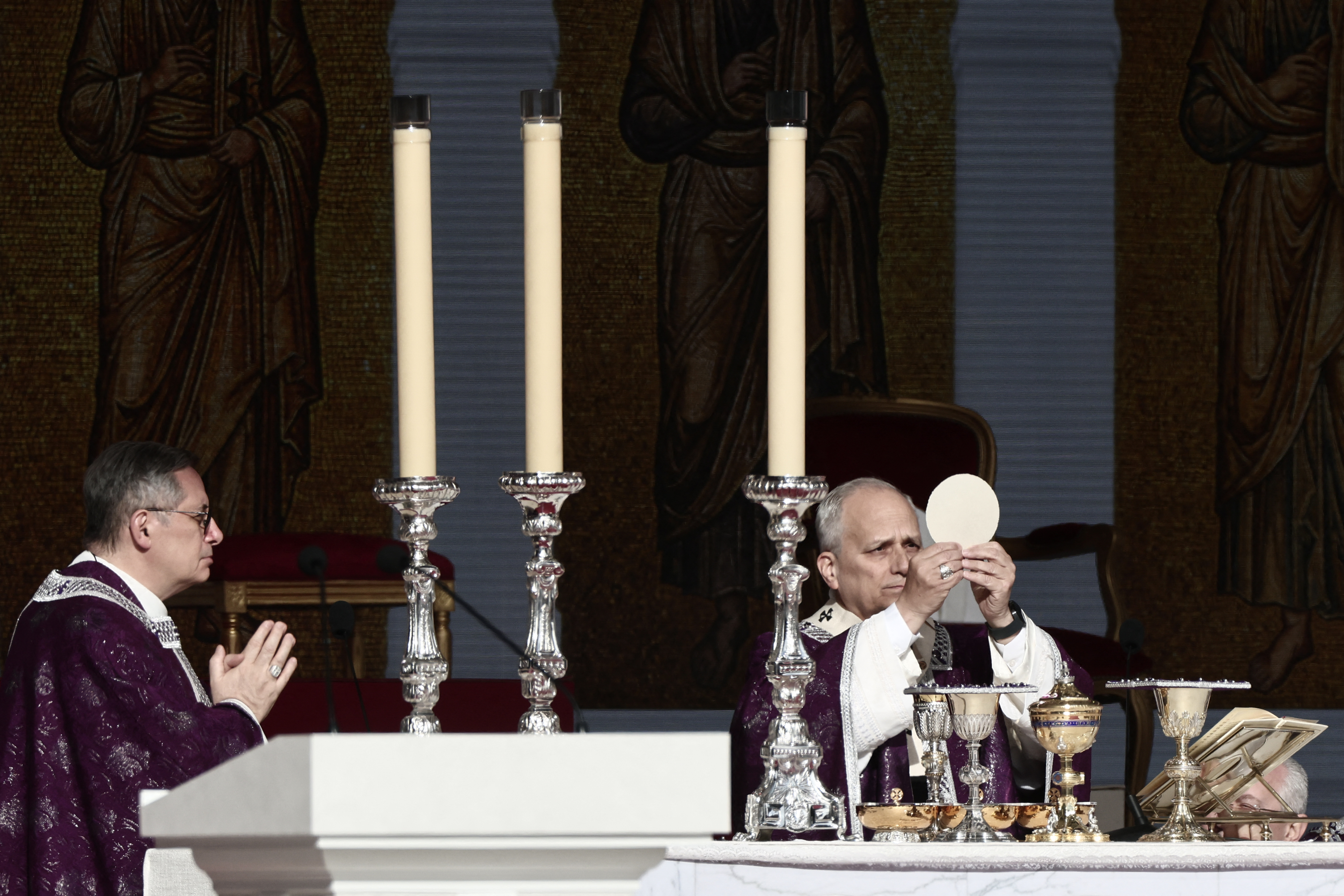
Pope Leo XIV on March 28 condemned all military conflicts, which he argued are the result of the “idolatry of power and money” and which “bloody” Godʼs gift of grace to men.
Godʼs grace “illuminates our present, because the wars that bloody it are the result of the idolatry of power and money,” said Leo in the homily he delivered during the Mass at the Louis II Stadium in Monaco.
Four months after his first apostolic trip to Turkey and Lebanon, the pontiff ended his lightning visit to the Principality of Monaco with the Mass in the stadium dedicated to Prince Louis II, who reigned between 1922 and 1949.
The stadium has a capacity for more than 18,000 spectators, which makes it a prominent place for sporting and entertainment events, in addition to being an ideal place for the papal Mass.
Upon his arrival, Leo toured the venue in a golf cart, from which he greeted and blessed the cheering faithful who were waiting for him while waving flags of the Vatican City and of Monaco.
The logic of power versus innocence
In his homily, the pope highlighted the biblical account in which the members of the Sanhedrin decide to kill Jesus.
From this passage, he explained that the face of God is revealed alongside those who, moved by power interests, are willing to eliminate the innocent.
As he pointed out, Caiphas' verdict is born from a political calculation based on fear: “Forgetting Godʼs promise to his people, they want to kill the innocent, because behind their fear is the attachment to power.”
“Isnʼt that what happens today?” the pope asked. “Even today, how many calculations are made in the world to kill innocent people; how many false reasons are used to get them out of the way!”
Not getting used to war
The pontiff called for the purification of the “idolatry” that feeds wars and turns men into slaves of other men, while urging the faithful to not get used to violence.
“Every truncated life is a wound to the body of Christ. Letʼs not get used to the rumble of weapons or the images of war!” he exclaimed.
In this sense, he stressed that peace cannot be reduced to a balance of power: “It is not a mere balance of forces, but the work of purified hearts, of those who see in the other a brother to take care of, not an enemy to bring down.”
Mercy, response to evil
Faced with the persistence of evil, the pope recalled that Godʼs justice acts as a source of hope and renewal: “The Lord frees from pain by infusing hope, he converts the hardness of the heart by transforming power into service, precisely while manifesting the true name of his omnipotence: mercy.”
In this way, he assured that it is “mercy that saves the world” because it takes charge of all human existence, “in each of its weaknesses, from the moment it is conceived in the womb until it ages,” he added.
A message on the eve of Easter
The popeʼs visit to Monaco, just eight hours long, was made at the invitation of Albert II of Monaco.
It took place on the eve of Holy Week, a context to which the pope referred during his homily. “The Lord changes the history of the world by calling us from idolatry to true faith, from death to life,” he said.
In this context, he also evoked the prophet Jeremiah: “In the face of the numerous injustices that destroy the peoples and the war that plagues the nations, the voice of the prophet Jeremiah is constantly raised: I will change their mourning into joy, I will make them happy and I will console them with their affliction” (Jer 31,13).
The joy that is born of charity
Finally, the pontiff called the faithful to be witnesses of hope, making “many happy with their faith” and sharing a joy that is not acquired as a prize, but is born of charity.
“The source of this joy is the love of God: love for the nascent and fragile life, which must always be welcomed and cared for; love for young and old life, which must be encouraged in the trials of each stage; love for healthy and sick life, sometimes alone, always in need of being accompanied with care,” he concluded.
At the end of the celebration, the Archbishop of Monaco, Monsignor Dominique-Marie David, thanked Pope Leo XIV for his visit, emphasizing that God is “the source of all good” and that the pontiff, as the successor of Peter, has come to remind the local Church of this.
In this sense, he stressed that the pope has encouraged the faithful to face “fearlessly” the current challenges, aware that they have “a treasure capable of sustaining hope, ours and that of the world.”
On the eve of Holy Week, David said that the popeʼs visit has served to “confirm the faith of his brothers,” reinforcing the commitment of the Christian community.
Pope Leo XIV gave the Archdiocese of Monaco a contemporary sculpture by St. Francis of Assisi. The work represents the Italian saint, one of the most beloved figures of the Christian tradition and universally recognized as a messenger of peace, fraternity and reconciliation.
Francis in the sculpture appears dressed in the simple Franciscan habit, a symbol of evangelical poverty and inner freedom, girded by the characteristic cord with three knots.
In the sculpture the saint holds a white dove in his left hand, while the right hand opens in a gesture of welcome and donation.
This story was first published by ACI Prensa, the Spanish-language sister service of EWTN News. It has been translated and adapted by EWTN News English.
The Holy Father urged Catholics in Monaco to “announce the Gospel of life, hope and love” and defend the dignity of human beings from birth to death.
Facts Only
Pope Leo XIV condemned military conflicts during a Mass at Louis II Stadium in Monaco on March 28.
The stadium, named after Prince Louis II (reigned 1922–1949), has a capacity of over 18,000.
The pope arrived via golf cart, greeting and blessing attendees waving Vatican and Monacan flags.
The homily referenced the biblical Sanhedrin's decision to kill Jesus, linking it to modern power dynamics.
Pope Leo XIV criticized "idolatry of power and money" as the root of wars.
He urged against normalizing war, stating, "Every truncated life is a wound to the body of Christ."
The pope defined peace as "the work of purified hearts," not a balance of power.
He emphasized mercy as God's response to evil, quoting Jeremiah 31:13.
The visit lasted eight hours and occurred at the invitation of Prince Albert II of Monaco.
Archbishop Dominique-Marie David thanked the pope, calling him a source of hope for the local Church.
Pope Leo XIV gifted the Archdiocese of Monaco a contemporary sculpture of St. Francis of Assisi holding a dove.
The sculpture depicts St. Francis in a Franciscan habit with a cord of three knots.
Executive Summary
Pope Leo XIV delivered a homily during Mass at Monaco's Louis II Stadium on March 28, condemning military conflicts as products of the "idolatry of power and money." The event marked the conclusion of his brief visit to the Principality of Monaco, invited by Prince Albert II. Addressing over 18,000 attendees, the pope criticized the logic of power that sacrifices innocence, drawing parallels to the biblical account of Jesus' condemnation by the Sanhedrin. He urged against normalization of war, framing peace as a moral imperative rooted in mercy rather than a balance of power. The visit, timed before Holy Week, emphasized themes of hope and renewal, with the pope gifting a sculpture of St. Francis of Assisi to the Archdiocese of Monaco. Local clergy, including Archbishop Dominique-Marie David, highlighted the pope's message as a reinforcement of faith and resilience amid global challenges.
The homily intertwined theological reflection with contemporary geopolitical concerns, positioning mercy as the antidote to systemic violence. The pope's critique of "idolatry" extended to societal structures that devalue human life, while his call to "announce the Gospel of life" underscored the Catholic Church's stance on human dignity from conception to death. The event's symbolic setting—a stadium named after a historical monarch—contrasted with the pope's emphasis on evangelical poverty and fraternity, embodied in the St. Francis sculpture. While the visit was brief, its timing and messaging aligned with the liturgical season's focus on redemption and hope.
Full Take
The strongest version of this narrative frames Pope Leo XIV's visit as a moral clarion call against the dehumanizing forces of power and greed, using theological language to critique systemic violence. The homily's biblical parallels—particularly the Sanhedrin's condemnation of Jesus—serve as a potent steelman, positioning modern conflicts as moral failures rather than mere political disputes. The pope's emphasis on mercy as a transformative force, coupled with the gift of a St. Francis sculpture, reinforces a vision of Christianity as a counter-cultural movement against idolatry. This framing is compelling because it ties ancient scriptural themes to contemporary geopolitical realities, offering a coherent moral framework for resistance.
Pattern scan: The narrative employs emotional resonance (e.g., "bloody God’s gift of grace") and moral urgency ("Every truncated life is a wound to the body of Christ") to amplify its message. While these appeals are consistent with religious rhetoric, they risk slipping into ARC-0043 (Motte-and-Bailey) if the broad condemnation of "idolatry of power" is later narrowed to specific political targets without evidence. The use of biblical parallels could also edge into ARC-0024 (Ambiguity) if listeners interpret the critique as applying selectively to adversaries while excusing allied actions. However, the pope's explicit call to "not get used to war" and his focus on universal mercy mitigate this risk.
Root cause: The narrative assumes that wars stem from a spiritual crisis—idolatry of power—rather than structural or material factors. This theological paradigm echoes historical Christian pacifist traditions but sidesteps complex geopolitical analyses. The unstated assumption is that moral renewal alone can dismantle systems of violence, which may underestimate the role of institutions, economics, or historical grievances.
Implications: For human agency, the message empowers individuals to resist complicity in violence through personal conversion. However, it places the burden of change on "purified hearts" rather than systemic reform, potentially absolving institutions of accountability. The beneficiaries are those who align with the pope's moral framework, while costs may fall on communities expecting concrete political solutions. Second-order consequences could include heightened polarization if the critique is weaponized by partisan actors.
Bridge questions: How might this spiritual critique of power interact with secular frameworks for conflict resolution? What historical examples challenge or support the idea that mercy alone can "save the world"? Would the pope's message resonate differently in a conflict zone versus a wealthy principality like Monaco?
Counterstrike scan: A coordinated influence campaign would amplify the pope's moral authority to delegitimize specific adversaries (e.g., framing one side in a conflict as uniquely "idolatrous"). The actual content, however, avoids naming specific actors or conflicts, focusing instead on universal principles. This alignment with the campaign playbook is minimal; the message remains broadly humanitarian rather than strategically partisan.