Eighteen months of casting and welding, compressed into three weeks on a single machine. That is what additive manufacturing in aerospace now means in practice at one of the sector’s largest groups.
Safran, the French aerospace and defence manufacturer with revenues of €27.3 billion and a workforce of 100,000 across 27 countries, has additive manufacturing (AM) sitting at the centre of its joint development effort with GE Aerospace on the CFM RISE programme. Safran has already 14 part references in serial production since 2017 and targets to add more than 10 new references with the Rise program
Hugo Sistach, AM principal expert at Safran, presented the group’s production experience and open challenges at 3DPI’s AMA: Aerospace, Space & Defence 2025 online conference.
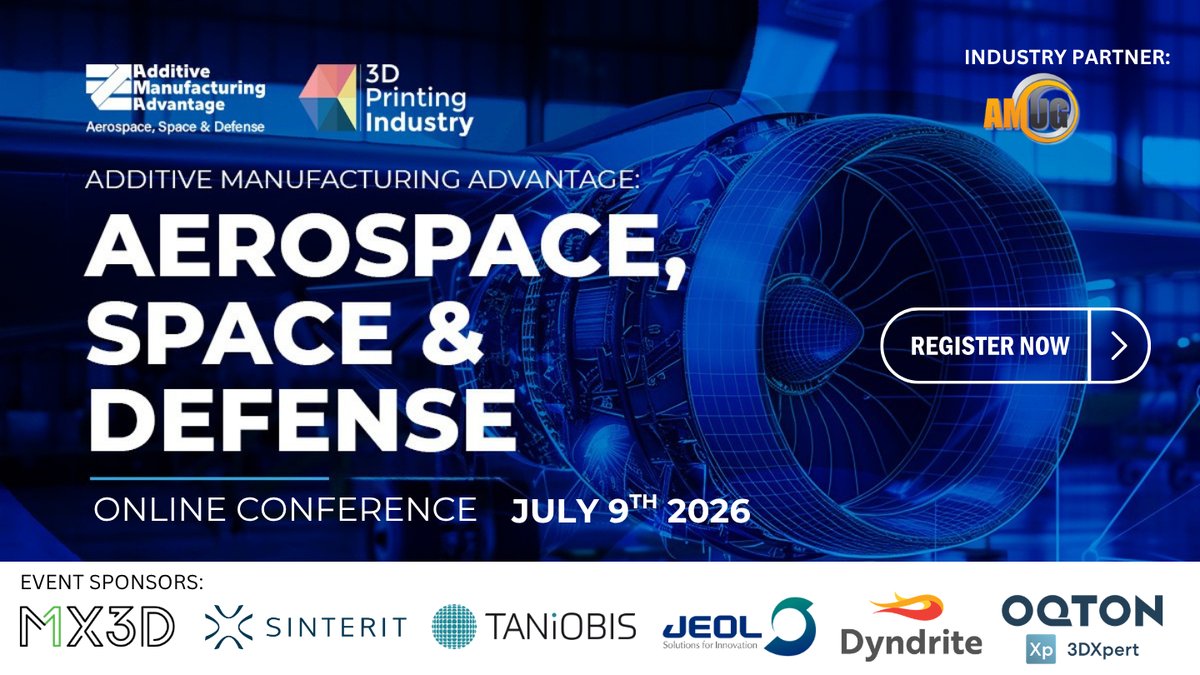
Register for AMAA 2026, taking place online on July 9th.
AM is already a production technology at Safran
Safran’s AM operation is centralised at the Safran Additive Manufacturing Campus, a 12,500 square metre facility in Le Haillan, near Bordeaux, inaugurated in October 2022 at a cost of €68 million. The campus consolidates the group’s full AM production chain under one roof, from R&D and design engineering through to part production and workforce training, and employs more than 100 scientists, engineers, and technicians producing parts across all Safran divisions.
Running more than 12 L-PBF machines and more than 4 DED machines for production, with a further seven industrial 3D printers reserved for R&T, the facility has delivered more than 111,000 AM parts since opening and currently runs at more than 4,000 per year. Fourteen part references have been certified and placed into serial production since 2017, including class B criticality components (according ASTM F3572-22), across titanium, nickel, aluminium, iron, and copper alloys, a materials range Sistach said reflects more than 17 years of AM involvement across the group.
The CFM RISE programme puts AM at the centre of engine design
The clearest statement of strategic intent came through the CFM RISE programme, Revolutionary Innovation for Sustainable Engines, a joint development effort between Safran and GE Aerospace targeting more than 20% lower fuel consumption through an open fan architecture and a range of disruptive technologies. Sistach placed AM first among those technologies, and said the group is aiming for it to account for 25% of the RISE programme’s production.
AM allows functions previously spread across multiple parts to be combined, reducing interface count and assembly complexity, and on certain complex subsystems, Sistach said reductions in part count by a factor of two to five are achievable, citing swirlers, injectors, and guide vane blades already in production. A concrete illustration was the turbine rear frame: previously manufactured as six cast components welded together, it can now be produced as a single piece with a one-metre diameter. Production cycle time has dropped from 18 months for the casting and welding route to approximately three weeks today, with a target of one week for serial production. The part was displayed at the Paris Air Show.
Mass reduction and supply chain sovereignty drive parallel workstreams
Beyond architectural innovation, Sistach pointed to mass reduction as a second major rationale for AM adoption. He cited weight savings ranging from 10% to 60% depending on the baseline process being replaced. The e-APU 60 turbine stator, previously made in eight parts, is now produced in four, with a 35% mass reduction versus casting in Hastelloy X via L-PBF; it is already in production. A hydraulic manifold unit delivers a 40% reduction against casting, and the A380 box beam achieves the same 40% reduction, equivalent to eight kilograms per part, against forging.
Sistach presented a life cycle assessment (LCA) of the box beam that illustrated why mass savings carry more environmental weight than manufacturing emissions. Production-phase CO₂ equivalent emissions for the AM part were roughly half those of the forged equivalent. However, he stressed that manufacturing accounts for less than 2.5% of total lifecycle emissions, with the dominant factor being the part’s weight while in service. “The major environmental impact of the parts is not the manufacturing, it is the use of the part in the engine,” he said.
Safran’s defence contracts require domestic or European production, and AM has become a practical route to meeting that requirement. The M88 bearing support five, a key component of the Rafale fighter’s M88 engine, is produced in nickel L-PBF alloy at more than 60 units per year directly at the Safran AM campus, a capability that Sistach said cannot be replicated through casting with equivalent sovereignty. The Leap lubrication unit, an aluminium L-PBF class B part, was developed as an alternative to casting to support production ramp-up on the Leap engine programme.
The production shift is already underway across aerospace
Safran’s experience is part of a wider recalibration. Major engine manufacturers have spent the past decade moving AM from development programmes onto the production floor, and the pressure to do so now comes from fuel efficiency targets as much as from supply chain economics.
GE Aerospace committed over $650 million to scaling its manufacturing plants and supply chain in 2024, specifically to increase output of its 3D printing-enabled LEAP engines, developed through CFM International, its joint venture with Safran, alongside full-scale production of the GE9X, which incorporates over 300 3D printed parts. The UK-based Aerospace Technology Institute (ATI) projected the aerospace AM market would reach £10 billion by 2033, noting that Boeing alone had produced over 70,000 metal and polymer 3D printed parts across civil and defence applications.
Across all these programmes, the bottleneck is the same: qualifying AM parts for flight-critical applications demands certification frameworks, supply chain depth, and design expertise that the industry is still building.
Unresolved challenges will require industry-wide collaboration
Sistach identified six active challenge areas: qualification and certification of complex and critical parts; finishing and post-processing supply chain maturity; process robustness and cost control; training design offices to work with AM design freedom rather than casting or forging conventions; the development of large-format machines up to one metre for L-PBF and DED within European or Western supply chains; and R&D into new materials and processes such as binder jetting, multi-material deposition, and AM-specific alloys.
The certification gap drew particular emphasis. Sistach noted that existing structural qualification frameworks were not designed with AM’s geometric complexity in mind, and that closing this gap requires active coordination with ASTM, ISO, SAE AMS, EASA, and the FAA. “The full potential of AM is in complex and critical parts. For the moment we cannot use that full potential without solving this challenge,” he said. On machine sovereignty, he noted that large-format machines currently come primarily from Chinese manufacturers, and that European alternatives need to be accelerated through partnerships with machine suppliers and research institutes such as CETIM and Fraunhofer, rather than left to standard commercial timelines.
Asked for a single takeaway, Sistach was unambiguous: AM is a present technology for Safran, and what remains is the collaborative work of making it fully certifiable, controllable, and scalable across the industry. “We need to work together on these challenges, all the aerospace industry,” he said.
Register for AMAA 2026, taking place online on July 9th.
To stay up to date with the latest 3D printing news, don’t forget to subscribe to the 3D Printing Industry newsletter or follow us on Twitter, or like our page on Facebook.
While you’re here, why not subscribe to our Youtube channel? Featuring discussion, debriefs, video shorts, and webinar replays.
Featured image shows Additive Manufacturing Advantage: Aerospace, Space and Defense. Image via 3D Printing Industry.