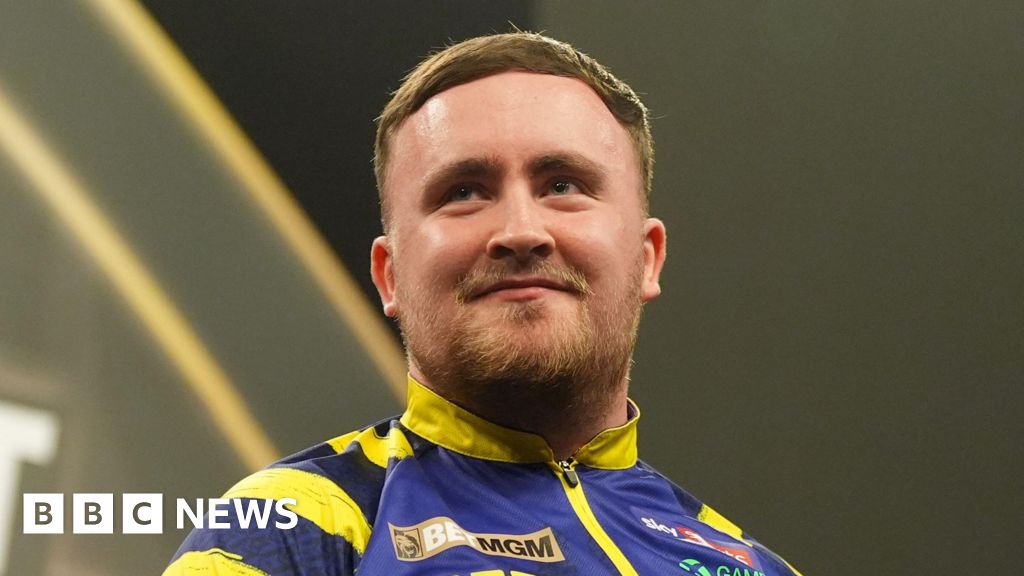
Luke Littler, the youngest darts world champion in history, has applied to the Intellectual Property Office to trademark his face.
The move is intended to prevent his face being reproduced, including by generative AI, without permission.
Littler has won two World Championship titles in a row and has had his image used legally on darts merchandise, as well as by multiple brands such as KP Nuts.
The 19-year-old joins celebrities such as actor Matthew McConaughey who have filed to protect their likeness from AI misuse in recent months. In October 2025, Chelsea footballer Cole Palmer not only trademarked his autograph and facial image but also the term "Cold Palmer".
Littler has already trademarked his nickname "the Nuke" in the United States.
Registering a trademark lets people or businesses legally protect their ideas or brand from being used without permission.
It also allows them to put a registered trademark symbol on their products to show ownership and warn others not to copy or use it.
Celebrities in Hollywood and the music industry, such as Scarlett Johansson and Taylor Swift, have been affected by a surge of fake videos, audio, and images online made using AI tools.
Louise Popple, a copyright expert at law firm Taylor Wessing, told the BBC part of the reason why celebrities went down the route of trademarking their appearance in the UK was the "lack of any image rights law".
She added while it was "unlikely" Littler would be able to stop anything other than a very similar image of his own face even with the trademark, the move signaled he was taking his rights "seriously", which could put off "opportunistic merchandising".
"Owning a registration can also help with licensing deals as it gives the celebrity 'something' to licence," she said.
'Smart branding decision'
Joe Doyle-Ward, Senior Associate and Trade Mark Attorney at Abion, one of the UK and Europe's leading intellectual property firms, told the BBC the move was a "smart branding decision" and one which firms were seeing happen more and more often with celebrities.
"The legal framework around AI and copyright is still evolving, but trademarks remain one of the most effective tools to control commercial use in the meantime," he said.
"It's not about stopping everyday use, but about ensuring that any commercial exploitation is authorised," he added.
The application is currently under examination at the Intellectual Property Office.
Littler rose to prominence in 2024, aged 16, winning the BBC Young Sports Personality of the Year.
In January 2025 Littler became the youngest ever darts world champion after beating three-time world champion Michael van Gerwen aged just 17.
He has since gone on to repeat the feat again in 2026, by beating Dutch darts player Gian van Veen 7-1 in the final.
Sign up for our Tech Decoded newsletter to follow the world's top tech stories and trends. Outside the UK? Sign up here.
Facts Only
Luke Littler, a 19-year-old darts player, has applied to trademark his face with the UK Intellectual Property Office.
The application aims to prevent unauthorized reproduction of his likeness, including by generative AI.
Littler has won two consecutive World Championship titles in darts.
His image has been legally used on merchandise and in brand partnerships, such as with KP Nuts.
He previously trademarked his nickname "the Nuke" in the United States.
Other celebrities, including actor Matthew McConaughey and footballer Cole Palmer, have taken similar steps to protect their likeness.
Cole Palmer trademarked his autograph, facial image, and the term "Cold Palmer" in October 2025.
The UK has no specific image rights law, making trademarks a key legal tool for celebrities.
Experts suggest trademarks may not stop all unauthorized use but can deter opportunistic merchandising.
The application is currently under examination by the Intellectual Property Office.
Littler won the BBC Young Sports Personality of the Year in 2024 at age 16.
He became the youngest darts world champion in January 2025 at age 17, defeating Michael van Gerwen.
He defended his title in 2026 by beating Gian van Veen 7-1 in the final.
Executive Summary
Luke Littler, the 19-year-old darts world champion, has applied to trademark his face with the UK Intellectual Property Office to prevent unauthorized use, particularly by generative AI. This move follows similar actions by other celebrities, such as Matthew McConaughey and Chelsea footballer Cole Palmer, who have sought legal protection for their likeness. Littler has already trademarked his nickname "the Nuke" in the US and has seen his image used commercially on merchandise and in brand partnerships. The application is currently under review, and experts note that while trademarks may not stop all unauthorized use, they serve as a deterrent and provide legal leverage for licensing deals. The broader context includes growing concerns among celebrities about AI-generated deepfakes and unauthorized commercial exploitation of their images.
The legal landscape around AI and intellectual property remains uncertain, but trademarks are seen as a practical tool for controlling commercial use. Experts highlight that the UK lacks specific image rights laws, making trademarks a key strategy for protecting personal branding. Littler's rise to fame—winning back-to-back world championships at a young age—has amplified his commercial value, making this legal move a strategic step in managing his public identity. While the effectiveness of such trademarks in curbing AI misuse is debated, the trend reflects a broader shift toward proactive legal measures in the digital age.
Full Take
The strongest version of this narrative is that Littler’s trademark application is a proactive and pragmatic response to the growing threat of AI-generated deepfakes and unauthorized commercial exploitation. It reflects a broader trend among celebrities seeking to assert control over their digital identities in an era where legal protections lag behind technological advancements. The move is framed as a necessary step to safeguard personal branding and commercial interests, particularly in the absence of comprehensive image rights laws in the UK.
However, the pattern scan reveals potential elements of **ARC-0024 Ambiguity** and **ARC-0043 Motte-and-Bailey**. The ambiguity lies in the uncertain legal efficacy of trademarks against AI misuse—experts acknowledge they may only deter "very similar" images, not broader AI-generated content. The motte-and-bailey appears in the framing of trademarks as a robust solution while simultaneously admitting their limitations. The narrative also leans on **ARC-0012 Appeal to Authority**, citing legal experts to lend credibility to the strategy, though the actual legal outcomes remain untested.
The root cause is the collision between rapid AI development and outdated intellectual property frameworks. The assumption that trademarks can meaningfully curb AI misuse is largely unproven, yet the narrative presents it as a viable stopgap. Historically, this echoes past attempts to retroactively regulate disruptive technologies (e.g., early internet piracy laws), where legal tools were repurposed with mixed success.
Implications for human agency are significant: if trademarks become the default defense, only those with resources to navigate legal systems will benefit, potentially exacerbating inequality in digital representation. Second-order consequences could include a surge in frivolous trademark applications, clogging legal systems, or AI developers finding workarounds that render such protections moot.
Bridge questions: How might this trend reshape the balance between public domain use and private ownership of personal likeness? What alternative legal or technological solutions could better address AI-generated deepfakes without over-reliance on trademarks? Would a dedicated image rights law in the UK be more effective, or would it face similar enforcement challenges?
Counterstrike scan: If this were part of a coordinated campaign, the playbook would involve amplifying fear of AI misuse to normalize aggressive legal measures, framing trademarks as the only viable solution while downplaying their limitations. The actual content aligns partially—it acknowledges uncertainties but still presents the move as a necessary step. No overt manipulation is detected, but the narrative could be leveraged to push broader IP expansion agendas.
Sentinel — Likely Human
This article reports on Luke Littler's trademark application to combat AI-generated fakes, citing expert opinions on the evolving legal landscape surrounding AI and image rights. The piece demonstrates a typical journalistic approach to presenting information and context, without strong indicators of synthetic generation.